
Identity area
Reference code
Title
Date(s)
Level of description
Extent and medium
1 digital image
Context area
Name of creator
Name of creator
Archival history
Immediate source of acquisition or transfer
Content and structure area
Scope and content
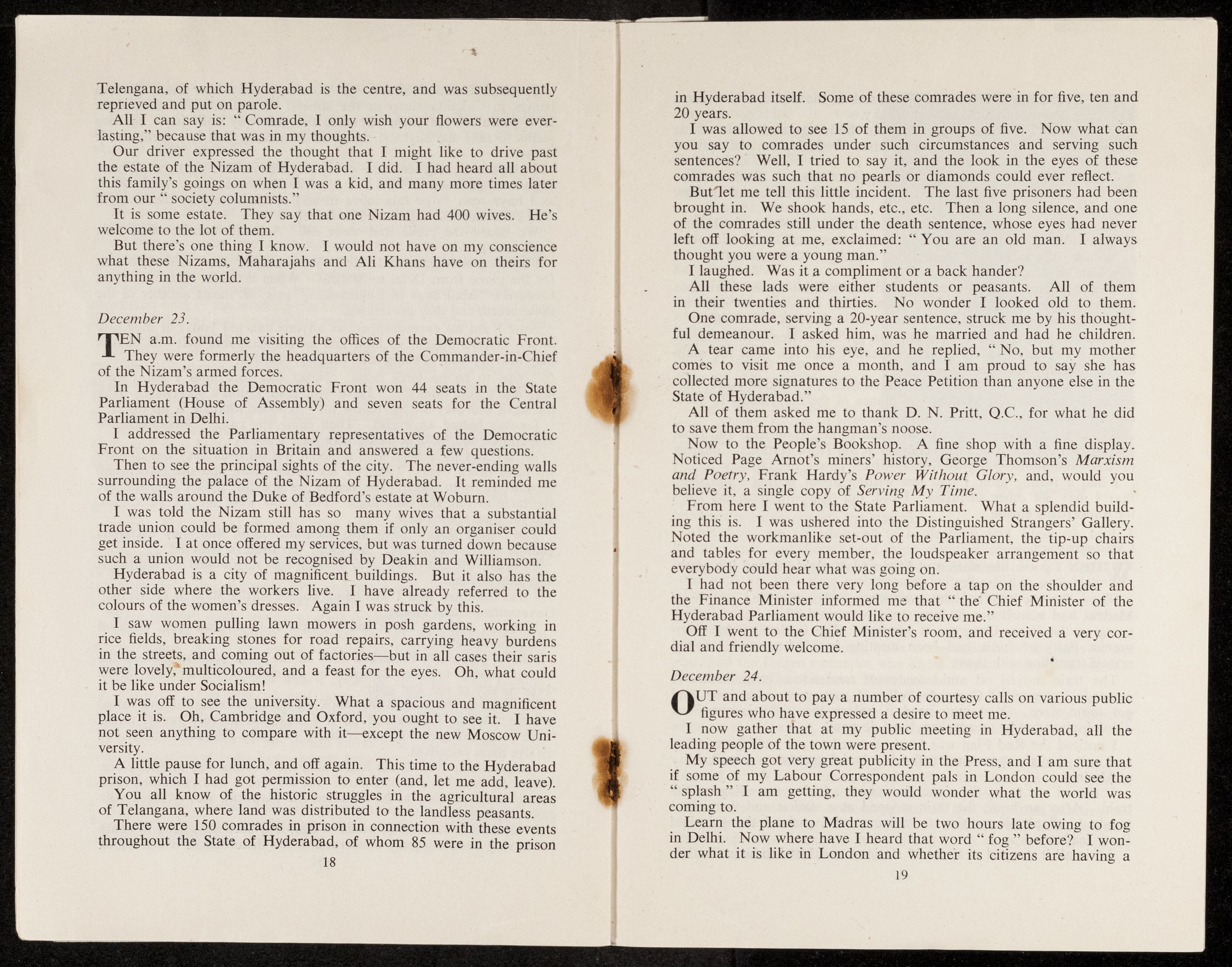
Telengana, of which Hyderabad is the centre, and was subsequently reprieved and put on parole. All I can say is: "Comrade, I only wish your flowers were ever- lasting," because that was in my thoughts. Our driver expressed the thought that I might like to drive past the estate of the Nizam of Hyderabad. I did. I had heard all about this family's goings on when I was a kid, and many more times later from our "society columnists." It is some estate. They say that one Nizam had 400 wives. He's welcome to the lot of them. But there's one thing I know. I would not have on my conscience what these Nizams, Maharajahs and Ali Khans have on theirs for anything in the world. December 23. TEN a.m. found me visiting the offices of the Democratic Front. They were formerly the headquarters of the Commander-in-Chief of the Nizam's armed forces. In Hyderabad the Democratic Front won 44 seats in the State Parliament (House of Assembly) and seven seats for the Central Parliament in Delhi. I addressed the Parliamentary representatives of the Democratic Front on the situation in Britain and answered a few questions. Then to see the principal sights of the city. The never-ending walls surrounding the palace of the Nizam of Hyderabad. It reminded me of the walls around the Duke of Bedford's estate at Woburn. I was told the Nizam still has so many wives that a substantial trade union could be formed among them if only an organiser could get inside. I at once offered my services, but was turned down because such a union would not be recognised by Deakin and Williamson. Hyderabad is a city of magnificent buildings. But it also has the other side where the workers live. I have already referred to the colours of the women's dresses. Again I was struck by this. I saw women pulling lawn mowers in posh gardens, working in rice fields, breaking stones for road repairs, carrying heavy burdens in the streets, and coming out of factories—but in all cases their saris were lovely, multicoloured, and a feast for the eyes. Oh, what could it be like under Socialism! I was off to see the university. What a spacious and magnificent place it is. Oh, Cambridge and Oxford, you ought to see it. I have not seen anything to compare with it—except the new Moscow Uni- versity. A little pause for lunch, and off again. This time to the Hyderabad prison, which I had got permission to enter (and, let me add, leave). You all know of the historic struggles in the agricultural areas of Telangana, where land was distributed to the landless peasants. There were 150 comrades in prison in connection with these events throughout the State of Hyderabad, of whom 85 were in the prison 18 in Hyderabad itself. Some of these comrades were in for five, ten and 20 years. I was allowed to see 15 of them in groups of five. Now what can you say to comrades under such circumstances and serving such sentences? Well, I tried to say it, and the look in the eyes of these comrades was such that no pearls or diamonds could ever reflect. But let me tell this little incident. The last five prisoners had been brought in. We shook hands, etc., etc. Then a long silence, and one of the comrades still under the death sentence, whose eyes had never left off looking at me, exclaimed: "You are an old man. I always thought you were a young man." I laughed. Was it a compliment or a back hander? All these lads were either students or peasants. All of them in their twenties and thirties. No wonder I looked old to them. One comrade, serving a 20-year sentence, struck me by his thought- ful demeanour. I asked him, was he married and had he children. A tear came into his eye, and he replied, "No, but my mother comes to visit me once a month, and I am proud to say she has collected more signatures to the Peace Petition than anyone else in the State of Hyderabad." All of them asked me to thank D. N. Pritt, Q.C., for what he did to save them from the hangman's noose. Now to the People's Bookshop. A fine shop with a fine display. Noticed Page Arnot's miners' history, George Thomson's Marxism and Poetry, Frank Hardy's Power Without Glory, and, would you believe it, a single copy of Serving My Time. From here I went to the State Parliament. What a splendid build- ing this is. I was ushered into the Distinguished Strangers' Gallery. Noted the workmanlike set-out of the Parliament, the tip-up chairs and tables for every member, the loudspeaker arrangement so that everybody could hear what was going on. I had not been there very long before a tap on the shoulder and the Finance Minister informed me that "the Chief Minister of the Hyderabad Parliament would like to receive me." Off I went to the Chief Minister's room, and received a very cor- dial and friendly welcome. December 24. OUT and about to pay a number of courtesy calls on various public figures who have expressed a desire to meet me. I now gather that at my public meeting in Hyderabad, all the leading people of the town were present. My speech got very great publicity in the Press, and I am sure that if some of my Labour Correspondent pals in London could see the "splash" I am getting, they would wonder what the world was coming to. Learn the plane to Madras will be two hours late owing to fog in Delhi. Now where have I heard that word "fog" before? I won- der what it is like in London and whether its citizens are having a 19
Appraisal, destruction and scheduling
Accruals
System of arrangement
Conditions of access and use area
Conditions governing access
Conditions governing reproduction
Language of material
Script of material
Language and script notes
Physical characteristics and technical requirements
Finding aids
Uploaded finding aid
Allied materials area
Existence and location of originals
full_reference_code