
Identity area
Reference code
Title
Date(s)
Level of description
Extent and medium
1 digital image
Context area
Name of creator
Name of creator
Archival history
Immediate source of acquisition or transfer
Content and structure area
Scope and content
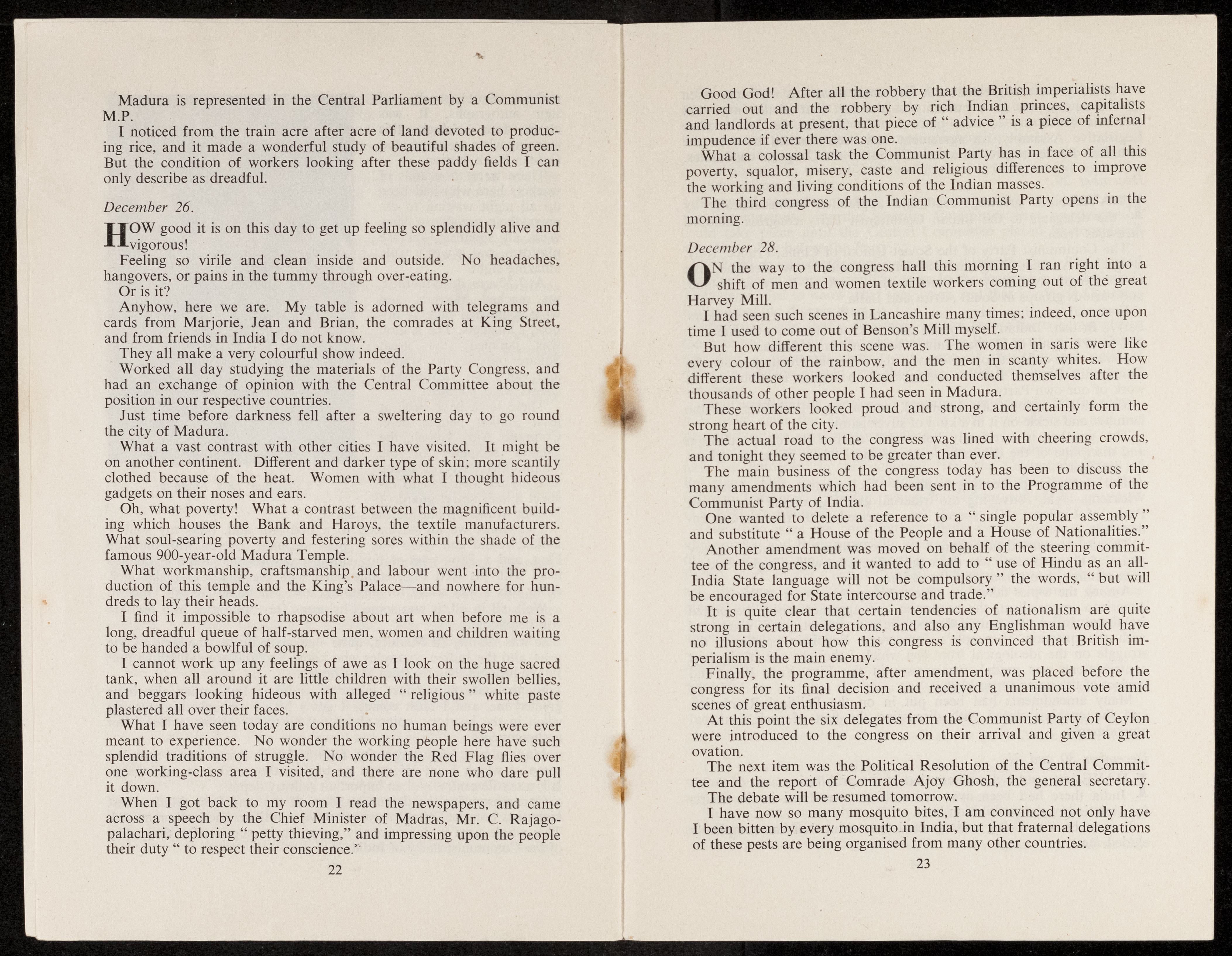
Madura is represented in the Central Parliament by a Communist M.P. I noticed from the train acre after acre of land devoted to produc- ing rice, and it made a wonderful study of beautiful shades of green. But the condition of workers looking after these paddy fields I can only describe as dreadful. December 26. H OW good it is on this day to get up feeling so splendidly alive and vigorous! Feeling so virile and clean inside and outside. No headaches, hangovers, or pains in the tummy through over-eating. Or is it? Anyhow, here we are. My table is adorned with telegrams and cards from Marjorie, Jean and Brian, the comrades at King Street, and from friends in India I do not know. They all make a very colourful show indeed. Worked all day studying the materials of the Party Congress, and had an exchange of opinion with the Central Committee about the position in our respective countries. Just time before darkness fell after a sweltering day to go round the city of Madura. What a vast contrast with other cities I have visited. It might be on another continent. Different and darker type of skin; more scantily clothed because of the heat. Women with what I thought hideous gadgets on their noses and ears. Oh, what poverty! What a contrast between the magnificent build- ing which houses the Bank and Haroys, the textile manufacturers. What soul-searing poverty and festering sores within the shade of the famous 900-year-old Madura Temple. What workmanship, craftsmanship and labour went into the pro- duction of this temple and the King's Palace-and nowhere for hun- dreds to lay their heads. I find it impossible to rhapsodise about art when before me is a long, dreadful queue of half-starved men, women and children waiting to be handed a bowlful of soup. I cannot work up any feelings of awe as I look on the huge sacred tank, when all around it are little children with their swollen bellies, and beggars looking hideous with alleged "religious" white paste plastered all over their faces. What I have seen today are conditions no human beings were ever meant to experience. No wonder the working people here have such splendid traditions of struggle. No wonder the Red Flag flies over one working-class area I visited, and there are none who dare pull it down. When I got back to my room I read the newspapers, and came across a speech by the Chief Minister of Madras, Mr. C. Rajago- palachari, deploring "petty thieving," and impressing upon the people their duty " to respect their conscience." 22 Good God! After all the robbery that the British imperialists have carried out and the robbery by rich Indian princes, capitalists and landlords at present, that piece of "advice" is a piece of infernal impudence if ever there was one. What a colossal task the Communist Party has in face of all this poverty, squalor, misery, caste and religious differences to improve the working and living conditions of the Indian masses. The third congress of the Indian Communist Party opens in the morning. December 28. O N the way to the congress hall this morning I ran right into a shift of men and women textile workers coming out of the great Harvey Mill. I had seen such scenes in Lancashire many times; indeed, once upon time I used to come out of Benson's Mill myself. But how different this scene was. The women in saris were like every colour of the rainbow, and the men in scanty whites. How different these workers looked and conducted themselves after the thousands of other people I had seen in Madura. These workers looked proud and strong, and certainly form the strong heart of the city. The actual road to the congress was lined with cheering crowds, and tonight they seemed to be greater than ever. The main business of the congress today has been to discuss the many amendments which had been sent in to the Programme of the Communist Party of India. One wanted to delete a reference to a "single popular assembly" and substitute "a House of the People and a House of Nationalities." Another amendment was moved on behalf of the steering commit- tee of the congress, and it wanted to add to "use of Hindu as an all- India State language will not be compulsory" the words, "but will be encouraged for State intercourse and trade." It is quite clear that certain tendencies of nationalism are quite strong in certain delegations, and also any Englishman would have no illusions about how this congress is convinced that British im- perialism is the main enemy. Finally, the programme, after amendment, was placed before the congress for its final decision and received a unanimous vote amid scenes of great enthusiasm. At this point the six delegates from the Communist Party of Ceylon were introduced to the congress on their arrival and given a great ovation. The next item was the Political Resolution of the Central Commit- tee and the report of Comrade Ajoy Ghosh, the general secretary. The debate will be resumed tomorrow. I have now so many mosquito bites, I am convinced not only have I been bitten by every mosquito in India, but that fraternal delegations of these pests are being organised from many other countries. 23
Appraisal, destruction and scheduling
Accruals
System of arrangement
Conditions of access and use area
Conditions governing access
Conditions governing reproduction
Language of material
Script of material
Language and script notes
Physical characteristics and technical requirements
Finding aids
Uploaded finding aid
Allied materials area
Existence and location of originals
full_reference_code