
Identity area
Reference code
Title
Date(s)
Level of description
Extent and medium
1 digital image
Context area
Name of creator
Name of creator
Archival history
Immediate source of acquisition or transfer
Content and structure area
Scope and content
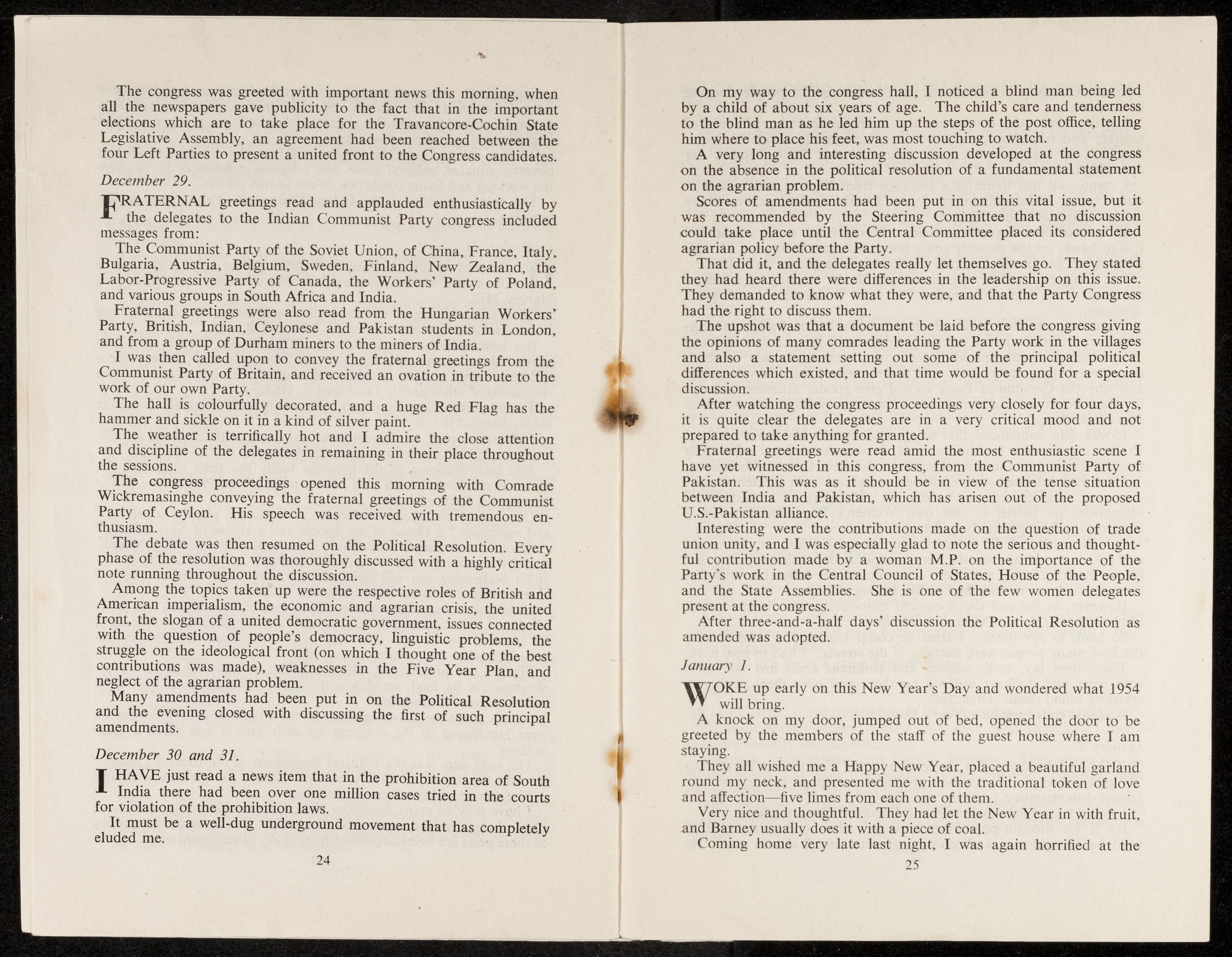
The congress was greeted with important news this morning, when all the newspapers gave publicity to the fact that in the important elections which are to take place for the Travancore-Cochin State Legislative Assembly, an agreement had been reached between the four Left Parties to present a united front to the Congress candidates. December 29. FRATERNAL greetings read and applauded enthusiastically by the delegates to the Indian Communist Party congress included messages from: The Communist Party of the Soviet Union, of China, France, Italy, Bulgaria, Austria, Belgium, Sweden, Finland, New Zealand, the Labor-Progressive Party of Canada, the Workers' Party of Poland, and various groups in South Africa and India. Fraternal greetings were also read from the Hungarian Workers' Party, British, Indian, Ceylonese and Pakistan students in London, and from a group of Durham miners to the miners of India. I was then called upon to convey the fraternal greetings from the Communist Party of Britain, and received an ovation in tribute to the work of our own Party. The hall is colourfully decorated, and a huge Red Flag has the hammer and sickle on it in a kind of silver paint. The weather is terrifically hot and I admire the close attention and discipline of the delegates in remaining in their place throughout the sessions. The congress proceedings opened this morning with Comrade Wickremasinghe conveying the fraternal greetings of the Communist Party of Ceylon. His speech was received with tremendous en- thusiasm. The debate was then resumed on the Political Resolution. Every phase of the resolution was thoroughly discussed with a highly critical note running throughout the discussion. Among the topics taken up were the respective roles of British and American imperialism, the economic and agrarian crisis, the united front, the slogan of a united democratic government, issues connected with the question of people's democracy, linguistic problems, the struggle on the ideological front (on which I thought one of the best contributions was made), weaknesses in the Five Year Plan, and neglect of the agrarian problem. Many amendments had been put in on the Political Resolution and the evening closed with discussing the first of such principal amendments. December 30 and 31. I HAVE just read a news item that in the prohibition area of South India there had been over one million cases tried in the courts for violation of the prohibition laws. It must be a well-dug underground movement that has completely eluded me. 24 On my way to the congress hall, I noticed a blind man being led by a child of about six years of age. The child's care and tenderness to the blind man as he led him up the steps of the post office, telling him where to place his feet, was most touching to watch. A very long and interesting discussion developed at the congress on the absence in the political resolution of a fundamental statement on the agrarian problem. Scores of amendments had been put in on this vital issue, but it was recommended by the Steering Committee that no discussion could take place until the Central Committee placed its considered agrarian policy before the Party. That did it, and the delegates really let themselves go. They stated they had heard there were differences in the leadership on this issue. They demanded to know what they were, and that the Party Congress had the right to discuss them. The upshot was that a document be laid before the congress giving the opinions of many comrades leading the Party work in the villages and also a statement setting out some of the principal political differences which existed, and that time would be found for a special discussion. After watching the congress proceedings very closely for four days, it is quite clear the delegates are in a very critical mood and not prepared to take anything for granted. Fraternal greetings were read amid the most enthusiastic scene I have yet witnessed in this congress, from the Communist Party of Pakistan. This was as it should be in view of the tense situation between India and Pakistan, which has arisen out of the proposed U.S.-Pakistan alliance. Interesting were the contributions made on the question of trade union unity, and I was especially glad to note the serious and thought- ful contribution made by a woman M.P. on the importance of the Party's work in the Central Council of States, House of the People, and the State Assemblies. She is one of the few women delegates present at the congress. After three-and-a-half days' discussion the Political Resolution as amended was adopted. January 1. WOKE up early on this New Year's Day and wondered what 1954 will bring. A knock on my door, jumped out of bed, opened the door to be greeted by the members of the staff of the guest house where I am staying. They all wished me a Happy New Year, placed a beautiful garland round my neck, and presented me with the traditional token of love and affection—five limes from each one of them. Very nice and thoughtful. They had let the New Year in with fruit, and Barney usually does it with a piece of coal. Coming home very late last night, I was again horrified at the 25
Appraisal, destruction and scheduling
Accruals
System of arrangement
Conditions of access and use area
Conditions governing access
Conditions governing reproduction
Language of material
Script of material
Language and script notes
Physical characteristics and technical requirements
Finding aids
Uploaded finding aid
Allied materials area
Existence and location of originals
full_reference_code