
Identity area
Reference code
Title
Date(s)
Level of description
Extent and medium
1 digital image
Context area
Name of creator
Name of creator
Archival history
Immediate source of acquisition or transfer
Content and structure area
Scope and content
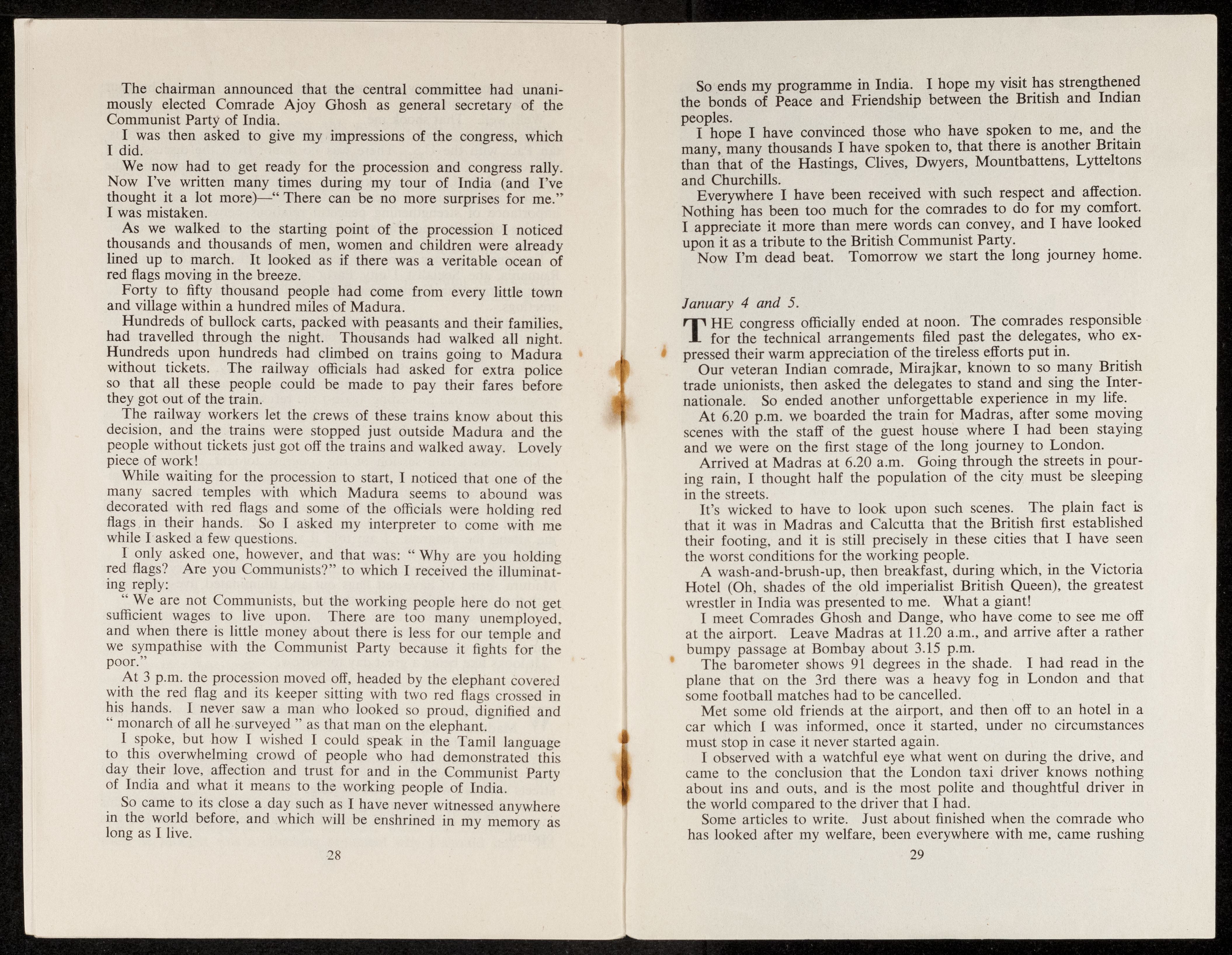
The chairman announced that the central committee had unani- mously elected Comrade Ajoy Ghosh as general secretary of the Communist Party of India. I was then asked to give my impressions of the congress, which I did. We now had to get ready for the procession and congress rally. Now I've written many times during my tour of India (and I've thought it a lot more)" There can be no more surprises for me." I was mistaken. As we walked to the starting point of the procession I noticed thousands and thousands of men, women and children were already lined up to march. It looked as if there was a veritable ocean of red flags moving in the breeze. Forty to fifty thousand people had come from every little town and village within a hundred miles of Madura. Hundreds of bullock carts, packed with peasants and their families, had travelled through the night. Thousands had walked all night. Hundreds upon hundreds had climbed on trains going to Madura without tickets. The railway officials had asked for extra police so that all these people could be made to pay their fares before they got out of the train. The railway workers let the crews of these trains know about this decision, and the trains were stopped just outside Madura and the people without tickets just got off the trains and walked away. Lovely piece of work! While waiting for the procession to start, I noticed that one of the many sacred temples with which Madura seems to abound was decorated with red flags and some of the officials were holding red flags in their hands. So I asked my interpreter to come with me while I asked a few questions. I only asked one, however, and that was: "Why are you holding red flags? Are you Communists?" to which I received the illuminat- ing reply: "We are not Communists, but the working people here do not get sufficient wages to live upon. There are too many unemployed, and when there is little money about there is less for our temple and we sympathise with the Communist Party because it fights for the poor." At 3 p.m. the procession moved off, headed by the elephant covered with the red flag and its keeper sitting with two red flags crossed in his hands. I never saw a man who looked so proud, dignified and "monarch of all he surveyed " as that man on the elephant. I spoke, but how I wished I could speak in the Tamil language to this overwhelming crowd of people who had demonstrated this day their love, affection and trust for and in the Communist Party of India and what it means to the working people of India. So came to its close a day such as I have never witnessed anywhere in the world before, and which will be enshrined in my memory as long as I live. 28 So ends my programme in India. I hope my visit has strengthened the bonds of Peace and Friendship between the British and Indian peoples. I hope I have convinced those who have spoken to me, and the many, many thousands I have spoken to, that there is another Britain than that of the Hastings, Clives, Dwyers, Mountbattens, Lytteltons and Churchills. Everywhere I have been received with such respect and affection. Nothing has been too much for the comrades to do for my comfort. I appreciate it more than mere words can convey, and I have looked upon it as a tribute to the British Communist Party. Now I'm dead beat. Tomorrow we start the long journey home. January 4 and 5. THE congress officially ended at noon. The comrades responsible for the technical arrangements filed past the delegates, who ex- pressed their warm appreciation of the tireless efforts put in. Our veteran Indian comrade, Mirajkar, known to so many British trade unionists, then asked the delegates to stand and sing the Inter- nationale. So ended another unforgettable experience in my life. At 6.20 p.m. we boarded the train for Madras, after some moving scenes with the staff of the guest house where I had been staying and we were on the first stage of the long journey to London. Arrived at Madras at 6.20 a.m. Going through the streets in pour- ing rain, I thought half the population of the city must be sleeping in the streets. It's wicked to have to look upon such scenes. The plain fact is that it was in Madras and Calcutta that the British first established their footing, and it is still precisely in these cities that I have seen the worst conditions for the working people. A wash-and-brush-up, then breakfast, during which, in the Victoria Hotel (Oh, shades of the old imperialist British Queen), the greatest wrestler in India was presented to me. What a giant! I meet Comrades Ghosh and Dange, who have come to see me off at the airport. Leave Madras at 11.20 a.m., and arrive after a rather bumpy passage at Bombay about 3.15 p.m. The barometer shows 91 degrees in the shade. I had read in the plane that on the 3rd there was a heavy fog in London and that some football matches had to be cancelled. Met some old friends at the airport, and then off to an hotel in a car which I was informed, once it started, under no circumstances must stop in case it never started again. I observed with a watchful eye what went on during the drive, and came to the conclusion that the London taxi driver knows nothing about ins and outs, and is the most polite and thoughtful driver in the world compared to the driver that I had. Some articles to write. Just about finished when the comrade who has looked after my welfare, been everywhere with me, came rushing 29
Appraisal, destruction and scheduling
Accruals
System of arrangement
Conditions of access and use area
Conditions governing access
Conditions governing reproduction
Language of material
Script of material
Language and script notes
Physical characteristics and technical requirements
Finding aids
Uploaded finding aid
Allied materials area
Existence and location of originals
full_reference_code