
Identity area
Reference code
Title
Date(s)
Level of description
Extent and medium
1 digital image
Context area
Archival history
Immediate source of acquisition or transfer
Content and structure area
Scope and content
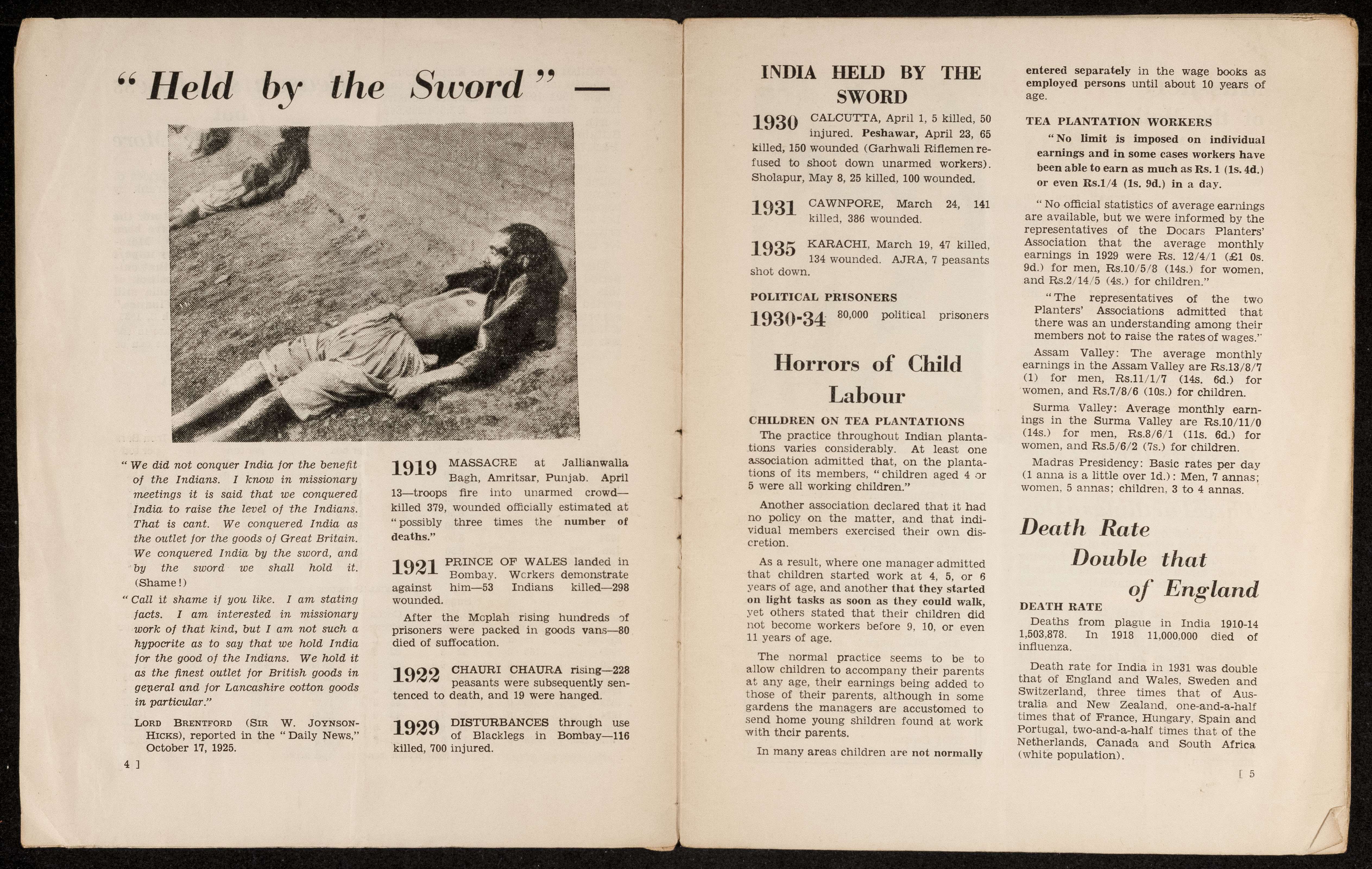
"Held by the Sword" — "We did not conquer India for the benefit of the Indians. I know in missionary meetings it is said that we conquered India to raise the level of the Indians. That is cant. We conquered India as the outlet for the goods of Great Britain. We conquered India by the sword, and by the sword we shall hold it. (Shame!) "Call it shame if you like. I am stating facts. I am interested in missionary work of that kind, but I am not such a hypocrite as to say that we hold India for the good of the Indians. We hold it as the finest outlet for British goods in general and for Lancashire cotton goods in particular." LORD BRENTFORD (SIR W. JOYNSON- HICKS), reported in the "Daily News," October 17, 1925. 4 ] 1919 MASSACRE at Jallianwalla Bagh, Amritsar, Punjab. April 13—troops fire into unarmed crowd— killed 379, wounded officially estimated at "possibly three times the number of deaths." 1921 PRINCE OF WALES landed in Bombay. Workers demonstrate against him—53 Indians killed—298 wounded. After the Moplah rising hundreds of prisoners were packed in goods vans—80 died of suffocation. 1922 CHAURI CHAURA rising—228 peasants were subsequently sen- tenced to death, and 19 were hanged. 1929 DISTURBANCES through use of Blacklegs in Bombay—116 killed, 700 injured. INDIA HELD BY THE SWORD 1930 CALCUTTA, April 1, 5 killed, 50 injured. Peshawar, April 23, 65 killed, 150 wounded (Garhwali Riflemen re- fused to shoot down unarmed workers). Sholapur, May 8, 25 killed, 100 wounded. 1931 CAWNPORE, March 24, 141 killed, 386 wounded. 1935 KARACHI, March 19, 47 killed, 134 wounded. AJRA, 7 peasants shot down. POLITICAL PRISONERS 1930-34 80,000 political prisoners Horrors of Child Labour CHILDREN ON TEA PLANTATIONS The practice throughout Indian planta- tions varies considerably. At least one association admitted that, on the planta- tions of its members, "children aged 4 or 5 were all working children." Another association declared that it had no policy on the matter, and that indi- vidual members exercised their own dis- cretion. As a result, where one manager admitted that children started work at 4, 5, or 6 years of age, and another that they started on light tasks as soon as they could walk, yet others stated that their children did not become workers before 9, 10, or even 11 years of age. The normal practice seems to be to allow children to accompany their parents at any age, their earnings being added to those of their parents, although in some gardens the managers are accustomed to send home young children found at work with their parents. In many areas children are not normally entered separately in the wage books as employed persons until about 10 years of age. TEA PLANTATION WORKERS "No limit is imposed on individual earnings and in some cases workers have been able to earn as much as Rs. 1 (1s. 4d.) or even Rs.1/4 (1s. 9d.) in a day. "No official statistics of average earnings are available, but we were informed by the representatives of the Docars Planters' Association that the average monthly earnings in 1929 were Rs. 12/4/1 (£1 0s. 9d.) for men, Rs.10/5/8 (14s.) for women, and Rs.2/14/5 (4s.) for children." "The representatives of the two Planters' Associations admitted that there was an understanding among their members not to raise the rates of wages." Assam Valley: The average monthly earnings in the Assam Valley are Rs.13/8/7 (1) for men, Rs.11/1/7 (14s. 6d.) for women, and Rs.7/8/6 (10s.) for children. Surma Valley: Average monthly earn- ings in the Surma Valley are Rs.10/11/0 (14s.) for men, Rs.8/6/1 (11s. 6d.) for women, and Rs.5/6/2 (7s.) for children. Madras Presidency: Basic rates per day (1 anna is a little over 1d.): Men, 7 annas; women, 5 annas; children, 3 to 4 annas. Death Rate Double that of England DEATH RATE Deaths from plague in India 1910-14 1,503,878. In 1918 11,000,000 died of influenza. Death rate for India in 1931 was double that of England and Wales, Sweden and Switzerland, three times that of Aus- tralia and New Zealand, one-and-a-half times that of France, Hungary, Spain and Portugal, two-and-a-half times that of the Netherlands, Canada and South Africa (white population). [ 5
Appraisal, destruction and scheduling
Accruals
System of arrangement
Conditions of access and use area
Conditions governing access
Conditions governing reproduction
Language of material
Script of material
Language and script notes
Physical characteristics and technical requirements
Finding aids
Uploaded finding aid
Allied materials area
Existence and location of originals
full_reference_code