
Identity area
Reference code
Title
Date(s)
Level of description
Extent and medium
1 digital image
Context area
Archival history
Immediate source of acquisition or transfer
Content and structure area
Scope and content
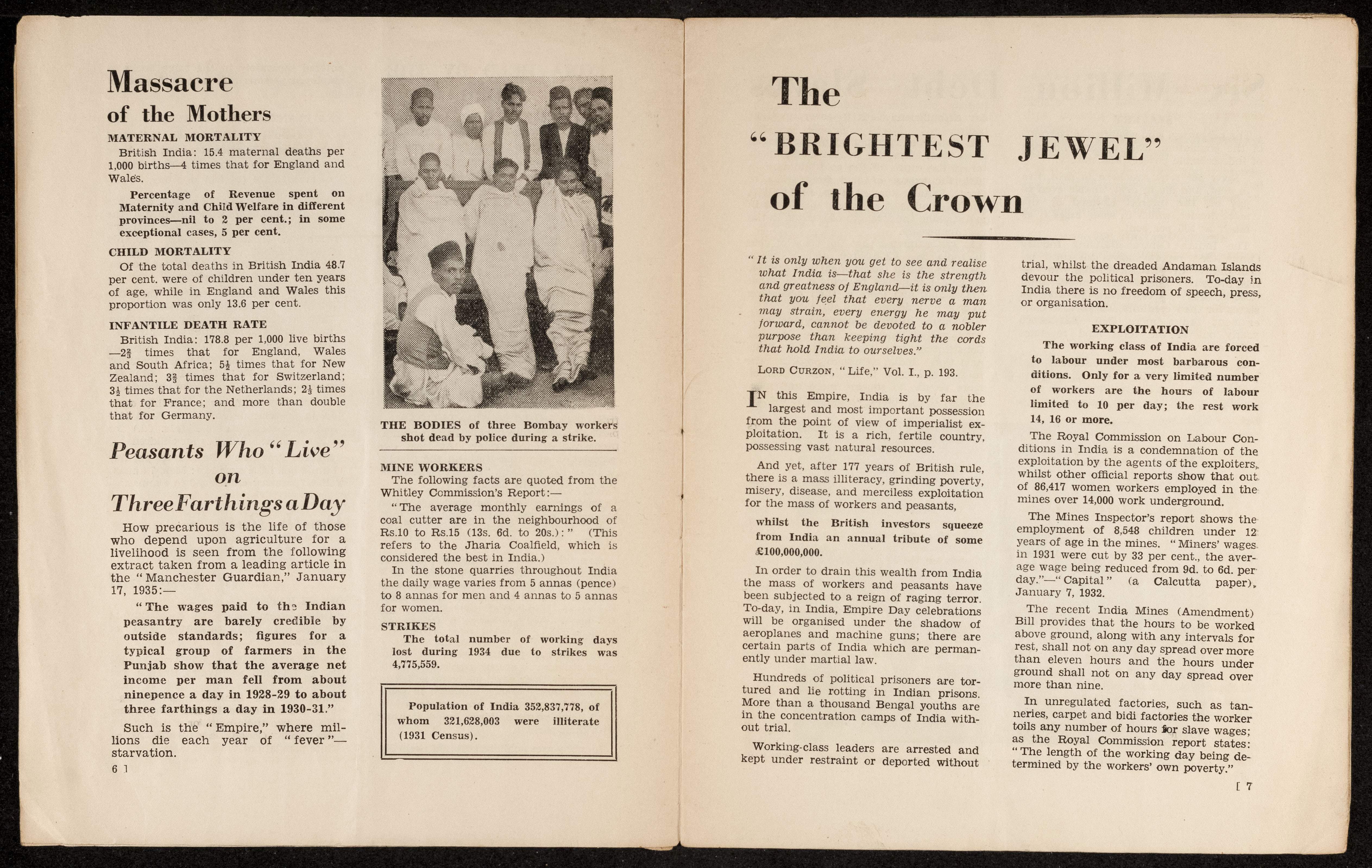
Massacre of the Mothers MATERNAL MORTALITY British India: 15.4 maternal deaths per 1,000 births—4 times that for England and Wales. Percentage of Revenue spent on Maternity and Child Welfare in different provinces—nil to 2 per cent.; in some exceptional cases, 5 per cent. CHILD MORTALITY Of the total deaths in British India 48.7 per cent. were of children under ten years of age, while in England and Wales this proportion was only 13.6 per cent. INFANTILE DEATH RATE British India: 178.8 per 1,000 live births —2¾ times that for England, Wales and South Africa; 5½ times that for New Zealand; 3 times that for Switzerland; 3½ times that for the Netherlands; 2¼ times that for France; and more than double that for Germany. Peasants Who “Live” on Three Farthings a Day How precarious is the life of those who depend upon agriculture for a livelihood is seen from the following extract taken from a leading article in the “Manchester Guardian,” January 17, 1935:— “The wages paid to the Indian peasantry are barely credible by outside standards; figures for a typical group of farmers in the Punjab show that the average net income per man fell from about ninepence a day in 1928-29 to about three farthings a day in 1930-31.” Such is the “Empire,” where mil- lions die each year of “fever”— starvation. 6 1 THE BODIES of three Bombay workers shot dead by police during a strike. MINE WORKERS The following facts are quoted from the Whitley Commission's Report:— “The average monthly earnings of a coal cutter are in the neighbourhood of Rs.10 to Rs.15 (13s. 6d. to 20s.):” (This refers to the Jharia Coalfield, which is considered the best in India.) In the stone quarries throughout India the daily wage varies from 5 annas (pence) to 8 annas for men and 4 annas to 5 annas for women. STRIKES The total number of working days lost during 1934 due to strikes was 4,775,559. Population of India 352,837,778, of whom 321,628,003 were illiterate (1931 Census). The “BRIGHTEST JEWEL” of the Crown “It is only when you get to see and realise what India is—that she is the strength and greatness of England—it is only then that you feel that every nerve a man may strain, every energy he may put forward, cannot be devoted to a nobler purpose than keeping tight the cords that hold India to ourselves.” LORD CURZON, “Life,” Vol. I., p. 193. IN this Empire, India is by far the largest and most important possession from the point of view of imperialist ex- ploitation. It is a rich, fertile country, possessing vast natural resources. And yet, after 177 years of British rule, there is a mass illiteracy, grinding poverty, misery, disease, and merciless exploitation for the mass of workers and peasants, whilst the British investors squeeze from India an annual tribute of some £100,000,000. In order to drain this wealth from India the mass of workers and peasants have been subjected to a reign of raging terror. To-day, in India, Empire Day celebrations will be organised under the shadow of aeroplanes and machine guns; there are certain parts of India which are perman- ently under martial law. Hundreds of political prisoners are tor- tured and lie rotting in Indian prisons. More than a thousand Bengal youths are in the concentration camps of India with- out trial. Working-class leaders are arrested and kept under restraint or deported without trial, whilst the dreaded Andaman Islands devour the political prisoners. To-day in India there is no freedom of speech, press, or organisation. EXPLOITATION The working class of India are forced to labour under most barbarous con- ditions. Only for a very limited number of workers are the hours of labour limited to 10 per day; the rest work 14, 16 or more. The Royal Commission on Labour Con- ditions in India is a condemnation of the exploitation by the agents of the exploiters, whilst other official reports show that out of 86,417 women workers employed in the mines over 14,000 work underground. The Mines Inspector's report shows the employment of 8,548 children under 12 years of age in the mines. “Miners' wages in 1931 were cut by 33 per cent., the aver- age wage being reduced from 9d. to 6d. per day.”—“ Capital” (a Calcutta paper), January 7, 1932. The recent India Mines (Amendment) Bill provides that the hours to be worked above ground, along with any intervals for rest, shall not on any day spread over more than eleven hours and the hours under ground shall not on any day spread over more than nine. In unregulated factories, such as tan- neries, carpet and bidi factories the worker toils any number of hours for slave wages; as the Royal Commission report states: “The length of the working day being de- termined by the workers' own poverty.” [7
Appraisal, destruction and scheduling
Accruals
System of arrangement
Conditions of access and use area
Conditions governing access
Conditions governing reproduction
Language of material
Script of material
Language and script notes
Physical characteristics and technical requirements
Finding aids
Uploaded finding aid
Allied materials area
Existence and location of originals
full_reference_code