
Identity area
Reference code
Title
Date(s)
Level of description
Extent and medium
1 digital image
Context area
Archival history
Immediate source of acquisition or transfer
Content and structure area
Scope and content
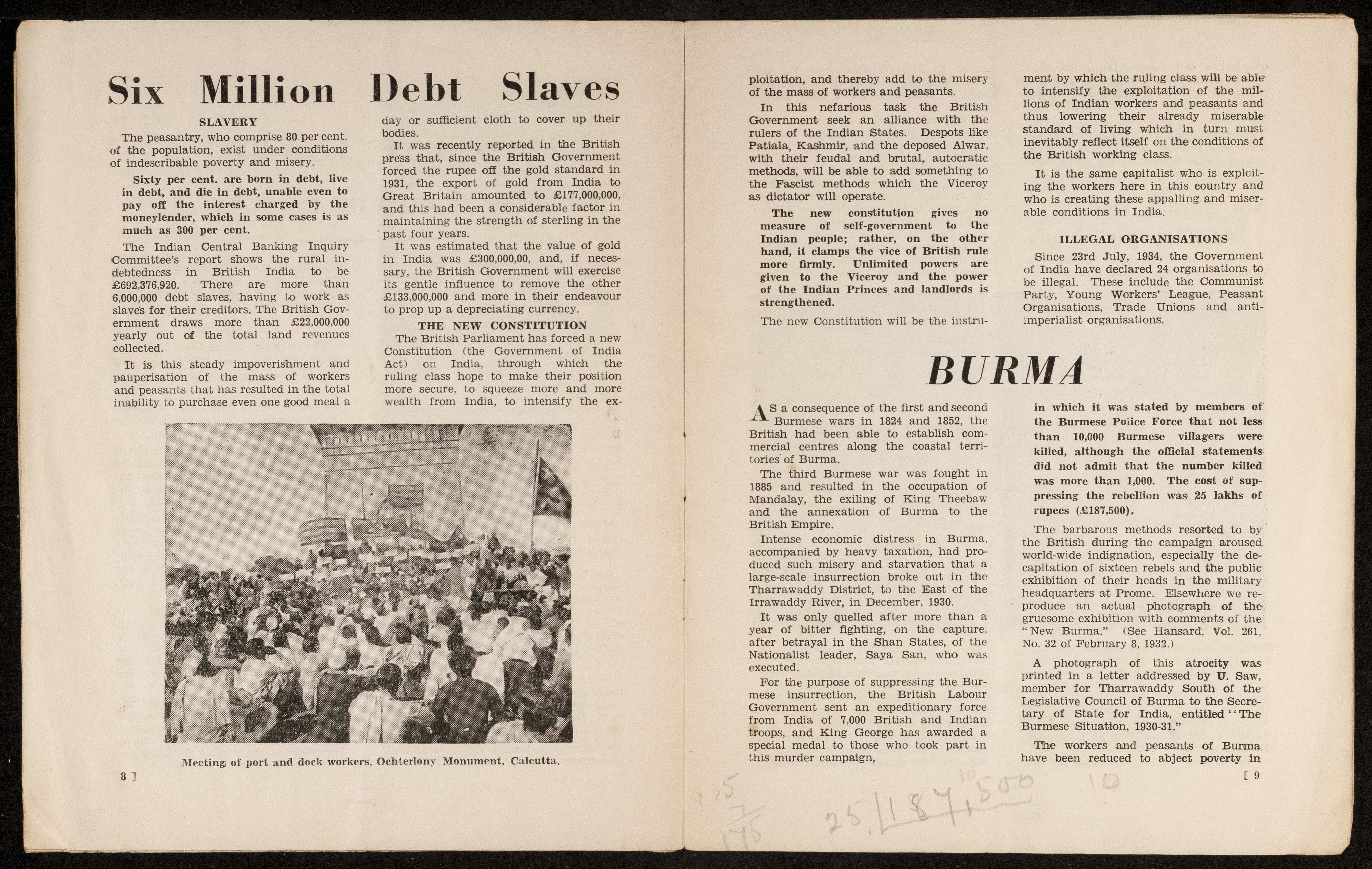
Six Million Debt Slaves SLAVERY The peasantry, who comprise 80 per cent. of the population, exist under conditions of indescribable poverty and misery. Sixty per cent. are born in debt, live in debt, and die in debt, unable even to pay off the interest charged by the moneylender, which in some cases is as much as 300 per cent. The Indian Central Banking Inquiry Committee's report shows the rural in- debtedness in British India to be £692,376,920. There are more than 6,000,000 debt slaves, having to work as slaves for their creditors. The British Gov- ernment draws more than £22,000,000 yearly out of the total land revenues collected. It is this steady impoverishment and pauperisation of the mass of workers and peasants that has resulted in the total inability to purchase even one good meal a day or sufficient cloth to cover up their bodies. It was recently reported in the British press that, since the British Government forced the rupee off the gold standard in 1931, the export of gold from India to Great Britain amounted to £177,000,000, and this had been a considerable factor in maintaining the strength of sterling in the past four years. It was estimated that the value of gold in India was £300,000,00, and, if neces- sary, the British Government will exercise its gentle influence to remove the other £133,000,000 and more in their endeavour to prop up a depreciating currency. THE NEW CONSTITUTION The British Parliament has forced a new Constitution (the Government of India Act) on India, through which the ruling class hope to make their position more secure, to squeeze more and more wealth from India, to intensify the ex- ploitation, and thereby add to the misery of the mass of workers and peasants. In this nefarious task the British Government seek an alliance with the rulers of the Indian States. Despots like Patiala, Kashmir, and the deposed Alwar, with their feudal and brutal, autocratic methods, will be able to add something to the Fascist methods which the Viceroy as dictator will operate. The new constitution gives no measure of self-government to the Indian people; rather, on the other hand, it clamps the vice of British rule more firmly. Unlimited powers are given to the Viceroy and the power of the Indian Princes and landlords is strengthened. The new Constitution will be the instru- ment by which the ruling class will be able to intensify the exploitation of the mil- lions of Indian workers and peasants and thus lowering their already miserable standard of living which in turn must inevitably reflect itself on the conditions of the British working class. It is the same capitalist who is exploit- ing the workers here in this country and who is creating these appalling and miser- able conditions in India. ILLEGAL ORGANISATIONS Since 23rd July, 1934, the Government of India have declared 24 organisations to be illegal. These include the Communist Party, Young Workers' League, Peasant Organisations, Trade Unions and anti- imperialist organisations. BURMA A S a consequence of the first and second Burmese wars in 1824 and 1852, the British had been able to establish com- mercial centres along the coastal terri- tories of Burma. The third Burmese war was fought in 1885 and resulted in the occupation of Mandalay, the exiling of King Theebaw and the annexation of Burma to the British Empire. Intense economic distress in Burma, accompanied by heavy taxation, had pro- duced such misery and starvation that a large-scale insurrection broke out in the Tharrawaddy District, to the East of the Irrawaddy River, in December, 1930. It was only quelled after more than a year of bitter fighting, on the capture, after betrayal in the Shan States, of the Nationalist leader, Saya San, who was executed. For the purpose of suppressing the Bur- mese insurrection, the British Labour Government sent an expeditionary force from India of 7,000 British and Indian troops, and King George has awarded a special medal to those who took part in this murder campaign, in which it was stated by members of the Burmese Police Force that not less than 10,000 Burmese villagers were killed, although the official statements did not admit that the number killed was more than 1,000. The cost of sup- pressing the rebellion was 25 lakhs of rupees (£187,500). The barbarous methods resorted to by the British during the campaign aroused world-wide indignation, especially the de- capitation of sixteen rebels and the public exhibition of their heads in the military headquarters at Prome. Elsewhere we re- produce an actual photograph of the gruesome exhibition with comments of the "New Burma." (See Hansard, Vol. 261, No. 32 of February 8, 1932.) A photograph of this atrocity was printed in a letter addressed by U. Saw, member for Tharrawaddy South of the Legislative Council of Burma to the Secre- tary of State for India, entitled ''The Burmese Situation, 1930-31." The workers and peasants of Burma have been reduced to abject poverty in Meeting of port and dock workers, Ochterlony Monument, Calcutta. 8] 1475 25/184,500 [9
Appraisal, destruction and scheduling
Accruals
System of arrangement
Conditions of access and use area
Conditions governing access
Conditions governing reproduction
Language of material
Script of material
Language and script notes
Physical characteristics and technical requirements
Finding aids
Uploaded finding aid
Allied materials area
Existence and location of originals
full_reference_code