
Identity area
Reference code
Title
Date(s)
Level of description
Extent and medium
1 digital image
Context area
Archival history
Immediate source of acquisition or transfer
Content and structure area
Scope and content
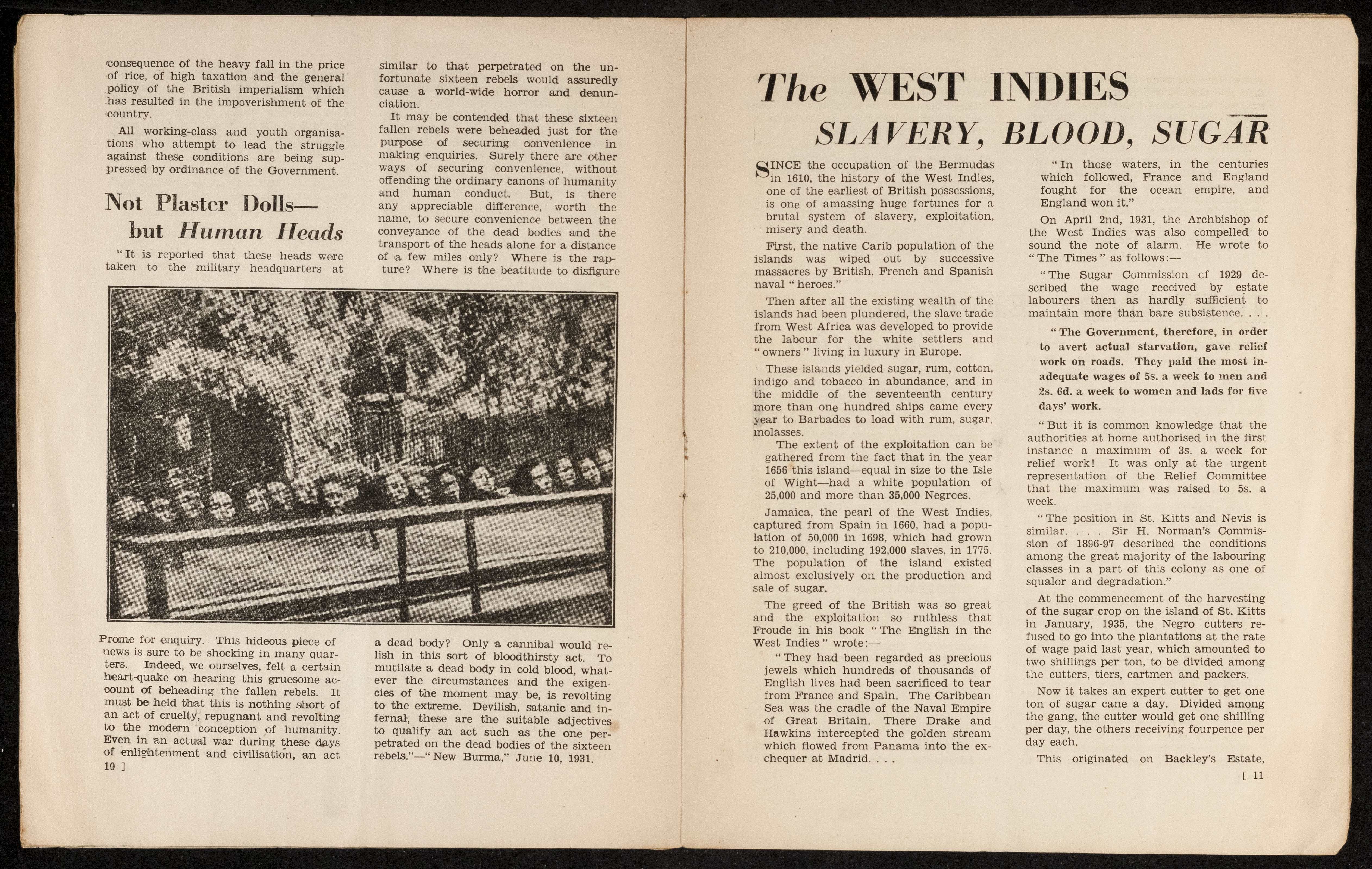
consequence of the heavy fall in the price of rice, of high taxation and the general policy of the British imperialism which has resulted in the impoverishment of the country. All working-class and youth organisa- tions who attempt to lead the struggle against these conditions are being sup- pressed by ordinance of the Government. Not Plaster Dolls— but Human Heads "It is reported that these heads were taken to the military headquarters at Prome for enquiry. This hideous piece of news is sure to be shocking in many quar- ters. Indeed, we ourselves, felt a certain heart-quake on hearing this gruesome ac- count of beheading the fallen rebels. It must be held that this is nothing short of an act of cruelty, repugnant and revolting to the modern conception of humanity. Even in an actual war during these days of enlightenment and civilisation, an act 10 ] similar to that perpetrated on the un- fortunate sixteen rebels would assuredly cause a world-wide horror and denun- ciation. It may be contended that these sixteen fallen rebels were beheaded just for the purpose of securing convenience in making enquiries. Surely there are other ways of securing convenience, without offending the ordinary canons of humanity and human conduct. But, is there any appreciable difference, worth the name, to secure convenience between the conveyance of the dead bodies and the transport of the heads alone for a distance of a few miles only? Where is the rap- ture? Where is the beatitude to disfigure a dead body? Only a cannibal would re- lish in this sort of bloodthirsty act. To mutilate a dead body in cold blood, what- ever the circumstances and the exigen- cies of the moment may be, is revolting to the extreme. Devilish, satanic and in- fernal, these are the suitable adjectives to qualify an act such as the one per- petrated on the dead bodies of the sixteen rebels."" New Burma," June 10, 1931. The WEST INDIES SLAVERY, BLOOD, SUGAR SINCE the occupation of the Bermudas in 1610, the history of the West Indies, one of the earliest of British possessions, is one of amassing huge fortunes for a brutal system of slavery, exploitation, misery and death. First, the native Carib population of the islands was wiped out by successive massacres by British, French and Spanish naval "heroes." Then after all the existing wealth of the islands had been plundered, the slave trade from West Africa was developed to provide the labour for the white settlers and "owners" living in luxury in Europe. These islands yielded sugar, rum, cotton, indigo and tobacco in abundance, and in the middle of the seventeenth century more than one hundred ships came every year to Barbados to load with rum, sugar, molasses. The extent of the exploitation can be gathered from the fact that in the year 1656 this island-equal in size to the Isle of Wight-had a white population of 25,000 and more than 35,000 Negroes. Jamaica, the pearl of the West Indies, captured from Spain in 1660, had a popu- lation of 50,000 in 1698, which had grown to 210,000, including 192,000 slaves, in 1775. The population of the island existed almost exclusively on the production and sale of sugar. The greed of the British was so great and the exploitation so ruthless that Froude in his book "The English in the West Indies" wrote:- "They had been regarded as precious jewels which hundreds of thousands of English lives had been sacrificed to tear from France and Spain. The Caribbean Sea was the cradle of the Naval Empire of Great Britain. There Drake and Hawkins intercepted the golden stream which flowed from Panama into the ex- chequer at Madrid. . . . "In those waters, in the centuries which followed, France and England fought for the ocean empire, and England won it." On April 2nd, 1931, the Archbishop of the West Indies was also compelled to sound the note of alarm. He wrote to "The Times" as follows:-- "The Sugar Commission of 1929 de- scribed the wage received by estate labourers then as hardly sufficient to maintain more than bare subsistence. . . . "The Government, therefore, in order to avert actual starvation, gave relief work on roads. They paid the most in- adequate wages of 5s. a week to men and 2s. 6d. a week to women and lads for five days' work. "But it is common knowledge that the authorities at home authorised in the first instance a maximum of 3s. a week for relief work! It was only at the urgent representation of the Relief Committee that the maximum was raised to 5s. a week. "The position in St. Kitts and Nevis is similar. . . . Sir H. Norman's Commis- sion of 1896-97 described the conditions among the great majority of the labouring classes in a part of this colony as one of squalor and degradation." At the commencement of the harvesting of the sugar crop on the island of St. Kitts in January, 1935, the Negro cutters re- fused to go into the plantations at the rate of wage paid last year, which amounted to two shillings per ton, to be divided among the cutters, tiers, cartmen and packers. Now it takes an expert cutter to get one ton of sugar cane a day. Divided among the gang, the cutter would get one shilling per day, the others receiving fourpence per day each. This originated on Backley's Estate, [ 11
Appraisal, destruction and scheduling
Accruals
System of arrangement
Conditions of access and use area
Conditions governing access
Conditions governing reproduction
Language of material
Script of material
Language and script notes
Physical characteristics and technical requirements
Finding aids
Uploaded finding aid
Allied materials area
Existence and location of originals
full_reference_code