
Identity area
Reference code
Title
Date(s)
Level of description
Extent and medium
1 digital image
Context area
Archival history
Immediate source of acquisition or transfer
Content and structure area
Scope and content
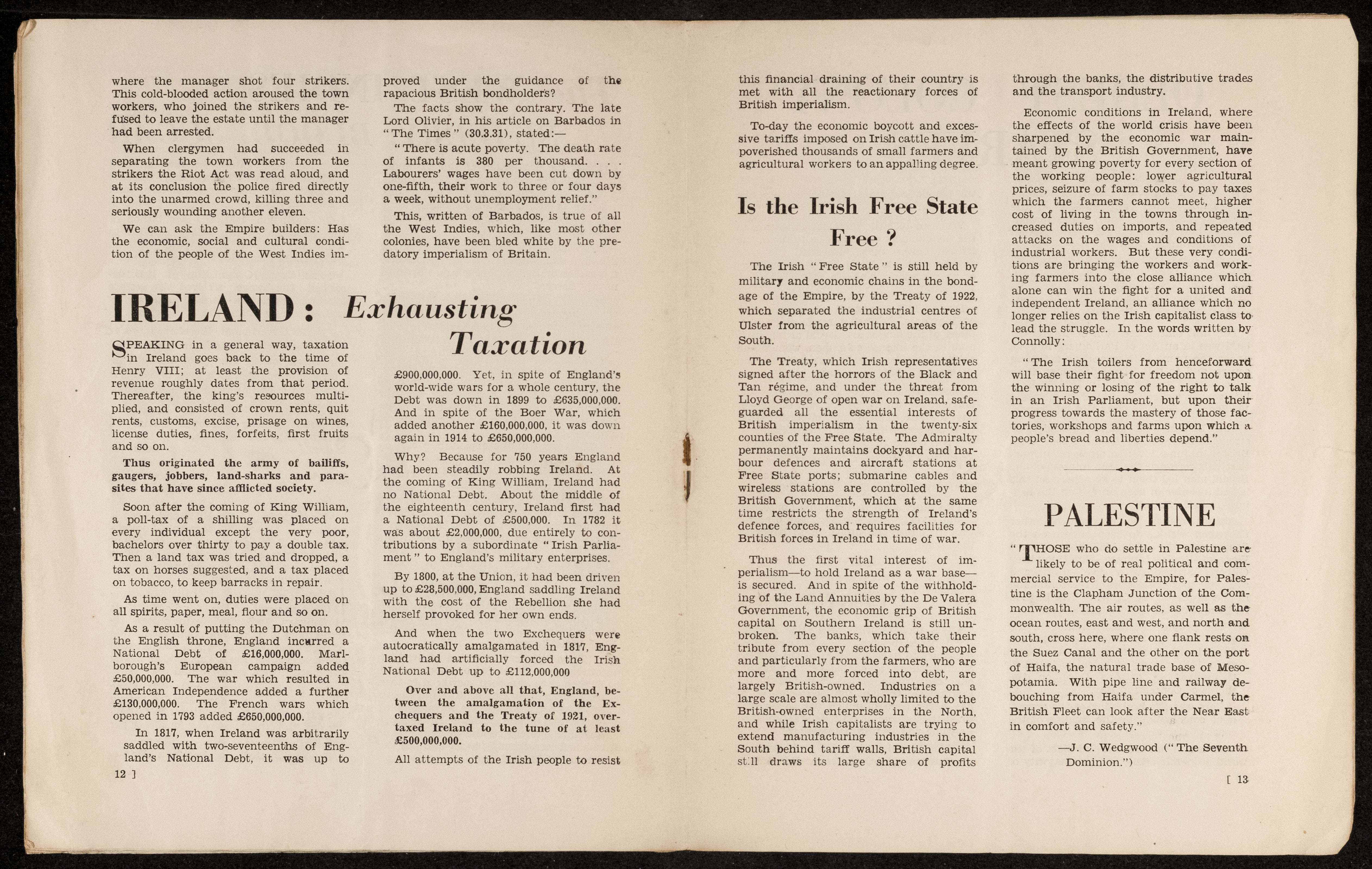
where the manager shot four strikers. This cold-blooded action aroused the town workers, who joined the strikers and re- fused to leave the estate until the manager had been arrested. When clergymen had succeeded in separating the town workers from the strikers the Riot Act was read aloud, and at its conclusion the police fired directly into the unarmed crowd, killing three and seriously wounding another eleven. We can ask the Empire builders: Has the economic, social and cultural condi- tion of the people of the West Indies im- IRELAND: Exhausting SPEAKING in a general way, taxation in Ireland goes back to the time of Henry VIII; at least the provision of revenue roughly dates from that period. Thereafter, the king's resources multi- plied, and consisted of crown rents, quit rents, customs, excise, prisage on wines, license duties, fines, forfeits, first fruits and so on. Thus originated the army of bailiffs, gaugers, jobbers, land-sharks and para- sites that have since afflicted society. Soon after the coming of King William, a poll-tax of a shilling was placed on every individual except the very poor, bachelors over thirty to pay a double tax. Then a land tax was tried and dropped, a tax on horses suggested, and a tax placed on tobacco, to keep barracks in repair. As time went on, duties were placed on all spirits, paper, meal, flour and so on. As a result of putting the Dutchman on the English throne, England incurred a National Debt of £16,000,000. Marl- borough's European campaign added £50,000,000. The war which resulted in American Independence added a further £130,000,000. The French wars which opened in 1793 added £650,000,000. In 1817, when Ireland was arbitrarily saddled with two-seventeenths of Eng- land's National Debt, it was up to 12 ] proved under the guidance of the rapacious British bondholders? The facts show the contrary. The late Lord Olivier, in his article on Barbados in "The Times" (30.3.31), stated:- "There is acute poverty. The death rate of infants is 380 per thousand. . . . Labourers' wages have been cut down by one-fifth, their work to three or four days a week, without unemployment relief." This, written of Barbados, is true of all the West Indies, which, like most other colonies, have been bled white by the pre- datory imperialism of Britain. Taxation £900,000,000. Yet, in spite of England's world-wide wars for a whole century, the Debt was down in 1899 to £635,000,000. And in spite of the Boer War, which added another £160,000,000, it was down again in 1914 to £650,000,000. Why? Because for 750 years England had been steadily robbing Ireland. At the coming of King William, Ireland had no National Debt. About the middle of the eighteenth century, Ireland first had a National Debt of £500,000. In 1782 it was about £2,000,000, due entirely to con- tributions by a subordinate "Irish Parlia- ment" to England's military enterprises. By 1800, at the Union, it had been driven up to £28,500,000, England saddling Ireland with the cost of the Rebellion she had herself provoked for her own ends. And when the two Exchequers were autocratically amalgamated in 1817, Eng- land had artificially forced the Irish National Debt up to £112,000,000 Over and above all that, England, be- tween the amalgamation of the Ex- chequers and the Treaty of 1921, over- taxed Ireland to the tune of at least £500,000,000. All attempts of the Irish people to resist this financial draining of their country is met with all the reactionary forces of British imperialism. To-day the economic boycott and exces- sive tariffs imposed on Irish cattle have im- poverished thousands of small farmers and agricultural workers to an appalling degree. Is the Irish Free State Free ? The Irish "Free State" is still held by military and economic chains in the bond- age of the Empire, by the Treaty of 1922, which separated the industrial centres of Ulster from the agricultural areas of the South. The Treaty, which Irish representatives signed after the horrors of the Black and Tan régime, and under the threat from Lloyd George of open war on Ireland, safe- guarded all the essential interests of British imperialism in the twenty-six counties of the Free State. The Admiralty permanently maintains dockyard and har- bour defences and aircraft stations at Free State ports; submarine cables and wireless stations are controlled by the British Government, which at the same time restricts the strength of Ireland's defence forces, and requires facilities for British forces in Ireland in time of war. Thus the first vital interest of im- perialism to hold Ireland as a war base- is secured. And in spite of the withhold- ing of the Land Annuities by the De Valera Government, the economic grip of British capital on Southern Ireland is still un- broken. The banks, which take their tribute from every section of the people and particularly from the farmers, who are more and more forced into debt, are largely British-owned. Industries on a large scale are almost wholly limited to the British-owned enterprises in the North, and while Irish capitalists are trying to extend manufacturing industries in the South behind tariff walls, British capital still draws its large share of profits through the banks, the distributive trades and the transport industry. Economic conditions in Ireland, where the effects of the world crisis have been sharpened by the economic war main- tained by the British Government, have meant growing poverty for every section of the working people: lower agricultural prices, seizure of farm stocks to pay taxes which the farmers cannot meet, higher cost of living in the towns through in- creased duties on imports, and repeated attacks on the wages and conditions of industrial workers. But these very condi- tions are bringing the workers and work- ing farmers into the close alliance which alone can win the fight for a united and independent Ireland, an alliance which no longer relies on the Irish capitalist class to lead the struggle. In the words written by Connolly: "The Irish toilers from henceforward will base their fight for freedom not upon the winning or losing of the right to talk in an Irish Parliament, but upon their progress towards the mastery of those fac- tories, workshops and farms upon which a people's bread and liberties depend." PALESTINE "THOSE who do settle in Palestine are likely to be of real political and com- mercial service to the Empire, for Pales- tine is the Clapham Junction of the Com- monwealth. The air routes, as well as the ocean routes, east and west, and north and south, cross here, where one flank rests on the Suez Canal and the other on the port of Haifa, the natural trade base of Meso- potamia. With pipe line and railway de- bouching from Haifa under Carmel, the British Fleet can look after the Near East in comfort and safety." -J. C. Wedgwood ("The Seventh Dominion.") [ 13
Appraisal, destruction and scheduling
Accruals
System of arrangement
Conditions of access and use area
Conditions governing access
Conditions governing reproduction
Language of material
Script of material
Language and script notes
Physical characteristics and technical requirements
Finding aids
Uploaded finding aid
Allied materials area
Existence and location of originals
full_reference_code