
Identity area
Reference code
Title
Date(s)
Level of description
Extent and medium
1 digital image
Context area
Archival history
Immediate source of acquisition or transfer
Content and structure area
Scope and content
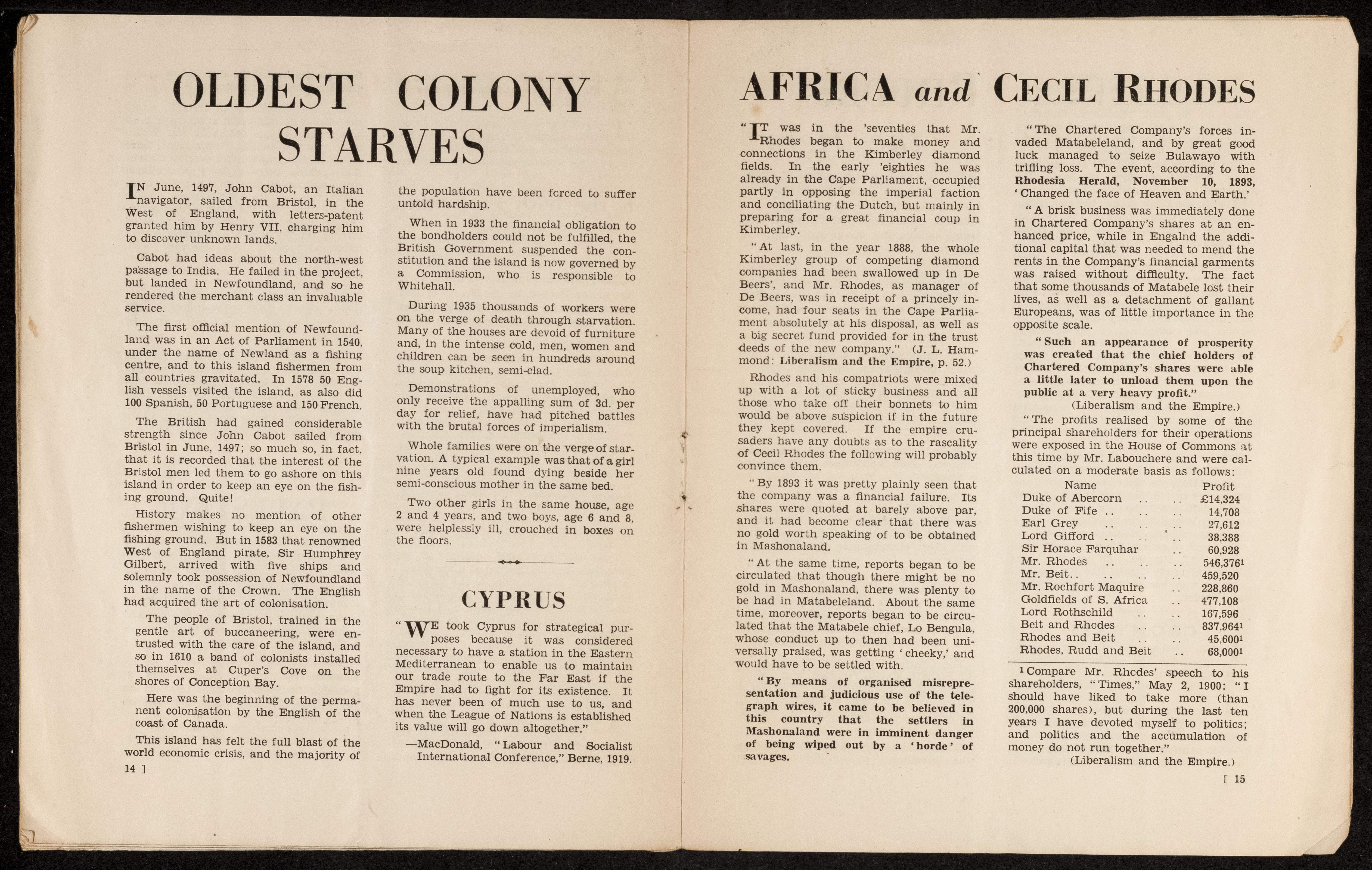
OLDEST COLONY STARVES IN June, 1497, John Cabot, an Italian navigator, sailed from Bristol, in the West of England, with letters-patent granted him by Henry VII, charging him to discover unknown lands. Cabot had ideas about the north-west passage to India. He failed in the project, but landed in Newfoundland, and so he rendered the merchant class an invaluable service. The first official mention of Newfound- land was in an Act of Parliament in 1540, under the name of Newland as a fishing centre, and to this island fishermen from all countries gravitated. In 1578 50 Eng- lish vessels visited the island, as also did 100 Spanish, 50 Portuguese and 150 French. The British had gained considerable strength since John Cabot sailed from Bristol in June, 1497; so much so, in fact, that it is recorded that the interest of the Bristol men led them to go ashore on this island in order to keep an eye on the fish- ing ground. Quite! History makes no mention of other fishermen wishing to keep an eye on the fishing ground. But in 1583 that renowned West of England pirate, Sir Humphrey Gilbert, arrived with five ships and solemnly took possession of Newfoundland in the name of the Crown. The English had acquired the art of colonisation. The people of Bristol, trained in the gentle art of buccaneering, were en- trusted with the care of the island, and so in 1610 a band of colonists installed themselves at Cuper's Cove on the shores of Conception Bay. Here was the beginning of the perma- nent colonisation by the English of the coast of Canada. This island has felt the full blast of the world economic crisis, and the majority of 14 ] the population have been forced to suffer untold hardship. When in 1933 the financial obligation to the bondholders could not be fulfilled, the British Government suspended the con- stitution and the island is now governed by a Commission, who is responsible to Whitehall. During 1935 thousands of workers were on the verge of death through starvation. Many of the houses are devoid of furniture and, in the intense cold, men, women and children can be seen in hundreds around the soup kitchen, semi-clad. Demonstrations of unemployed, who only receive the appalling sum of 3d. per day for relief, have had pitched battles with the brutal forces of imperialism. Whole families were on the verge of star- vation. A typical example was that of a girl nine years old found dying beside her semi-conscious mother in the same bed. Two other girls in the same house, age 2 and 4 years, and two boys, age 6 and 8, were helplessly ill, crouched in boxes on the floors. CYPRUS "WE took Cyprus for strategical pur- poses because it was considered necessary to have a station in the Eastern Mediterranean to enable us to maintain our trade route to the Far East if the Empire had to fight for its existence. It has never been of much use to us, and when the League of Nations is established its value will go down altogether." -MacDonald, "Labour and Socialist International Conference," Berne, 1919. AFRICA and CECIL RHODES "IT was in the 'seventies that Mr. Rhodes began to make money and connections in the Kimberley diamond fields. In the early 'eighties he was already in the Cape Parliament, occupied partly in opposing the imperial faction and conciliating the Dutch, but mainly in preparing for a great financial coup in Kimberley. "At last, in the year 1888, the whole Kimberley group of competing diamond companies had been swallowed up in De Beers', and Mr. Rhodes, as manager of De Beers, was in receipt of a princely in- come, had four seats in the Cape Parlia- ment absolutely at his disposal, as well as a big secret fund provided for in the trust deeds of the new company." (J. L. Ham- mond: Liberalism and the Empire, p. 52.) Rhodes and his compatriots were mixed up with a lot of sticky business and all those who take off their bonnets to him would be above suspicion if in the future they kept covered. If the empire cru- saders have any doubts as to the rascality of Cecil Rhodes the following will probably convince them. "By 1893 it was pretty plainly seen that the company was a financial failure. Its shares were quoted at barely above par, and it had become clear that there was no gold worth speaking of to be obtained in Mashonaland. "At the same time, reports began to be circulated that though there might be no gold in Mashonaland, there was plenty to be had in Matabeleland. About the same time, moreover, reports began to be circu- lated that the Matabele chief, Lo Bengula, whose conduct up to then had been uni- versally praised, was getting 'cheeky,' and would have to be settled with. "By means of organised misrepre- sentation and judicious use of the tele- graph wires, it came to be believed in this country that the settlers in Mashonaland were in imminent danger of being wiped out by a 'horde' of savages. "The Chartered Company's forces in- vaded Matabeleland, and by great good luck managed to seize Bulawayo with trifling loss. The event, according to the Rhodesia Herald, November 10, 1893, 'Changed the face of Heaven and Earth.' "A brisk business was immediately done in Chartered Company's shares at an en- hanced price, while in Engalnd the addi- tional capital that was needed to mend the rents in the Company's financial garments was raised without difficulty. The fact that some thousands of Matabele lost their lives, as well as a detachment of gallant Europeans, was of little importance in the opposite scale. "Such an appearance of prosperity was created that the chief holders of Chartered Company's shares were able a little later to unload them upon the public at a very heavy profit." (Liberalism and the Empire.) "The profits realised by some of the principal shareholders for their operations were exposed in the House of Commons at this time by Mr. Labouchere and were cal- culated on a moderate basis as follows: Name Profit Duke of Abercorn . . . . £14,324 Duke of Fife . . . . 14,708 Earl Grey . . . . 27,612 Lord Gifford . . . . 38,388 Sir Horace Farquhar . . . . 60,928 Mr. Rhodes . . . . 546,3761 Mr. Beit.. . . . . 459,520 Mr. Rochfort Maquire . . . . 228,860 Goldfields of S. Africa . . . . 477,108 Lord Rothschild . . . . 167,596 Beit and Rhodes . . . . 837,9641 Rhodes and Beit . . . . 45,6001 Rhodes, Rudd and Beit . . . . 68,0001 1 Compare Mr. Rhodes' speech to his shareholders, "Times," May 2, 1900: "I should have liked to take more (than 200,000 shares), but during the last ten years I have devoted myself to politics; and politics and the accumulation of money do not run together." (Liberalism and the Empire.) [ 15
Appraisal, destruction and scheduling
Accruals
System of arrangement
Conditions of access and use area
Conditions governing access
Conditions governing reproduction
Language of material
Script of material
Language and script notes
Physical characteristics and technical requirements
Finding aids
Uploaded finding aid
Allied materials area
Existence and location of originals
full_reference_code