
Identity area
Reference code
Title
Date(s)
Level of description
Extent and medium
1 digital image
Context area
Archival history
Immediate source of acquisition or transfer
Content and structure area
Scope and content
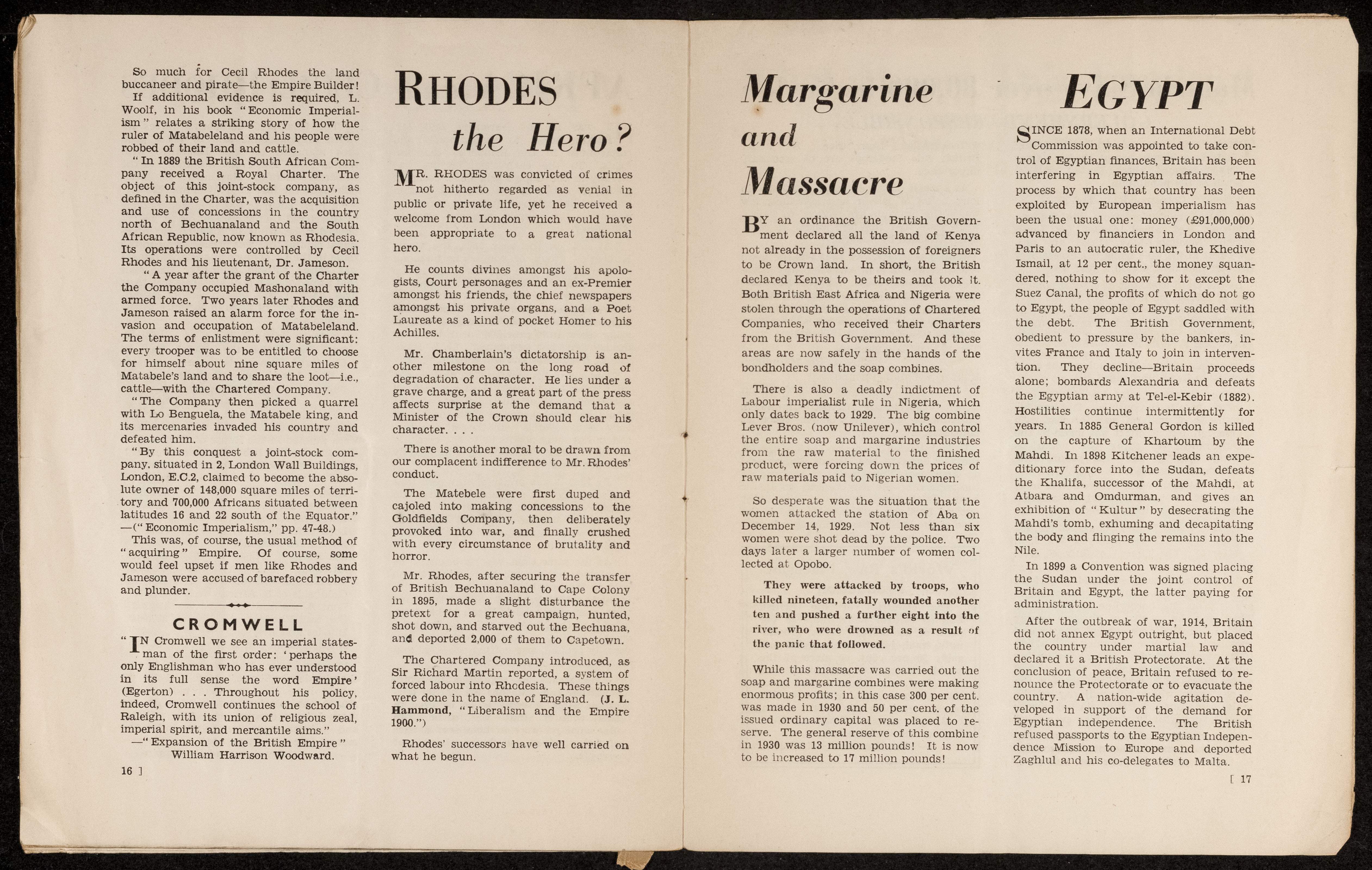
So much for Cecil Rhodes the land buccaneer and pirate—the Empire Builder! If additional evidence is required, L. Woolf, in his book "Economic Imperial- ism" relates a striking story of how the ruler of Matabeleland and his people were robbed of their land and cattle. "In 1889 the British South African Com- pany received a Royal Charter. The object of this joint-stock company, as defined in the Charter, was the acquisition and use of concessions in the country north of Bechuanaland and the South African Republic, now known as Rhodesia. Its operations were controlled by Cecil Rhodes and his lieutenant, Dr. Jameson. "A year after the grant of the Charter the Company occupied Mashonaland with armed force. Two years later Rhodes and Jameson raised an alarm force for the in- vasion and occupation of Matabeleland. The terms of enlistment were significant: every trooper was to be entitled to choose for himself about nine square miles of Matabele's land and to share the loot—i.e., cattle—with the Chartered Company. "The Company then picked a quarrel with Lo Benguela, the Matabele king, and its mercenaries invaded his country and defeated him. "By this conquest a joint-stock com- pany, situated in 2, London Wall Buildings, London, E.C.2, claimed to become the abso- lute owner of 148,000 square miles of terri- tory and 700,000 Africans situated between latitudes 16 and 22 south of the Equator." —("Economic Imperialism," pp. 47-48.) This was, of course, the usual method of "acquiring" Empire. Of course, some would feel upset if men like Rhodes and Jameson were accused of barefaced robbery and plunder. CROMWELL "IN Cromwell we see an imperial states- man of the first order: 'perhaps the only Englishman who has ever understood in its full sense the word Empire' (Egerton) . . . Throughout his policy, indeed, Cromwell continues the school of Raleigh, with its union of religious zeal, imperial spirit, and mercantile aims." —"Expansion of the British Empire" William Harrison Woodward. 16 ] RHODES the Hero? MR. RHODES was convicted of crimes not hitherto regarded as venial in public or private life, yet he received a welcome from London which would have been appropriate to a great national hero. He counts divines amongst his apolo- gists, Court personages and an ex-Premier amongst his friends, the chief newspapers amongst his private organs, and a Poet Laureate as a kind of pocket Homer to his Achilles. Mr. Chamberlain's dictatorship is an- other milestone on the long road of degradation of character. He lies under a grave charge, and a great part of the press affects surprise at the demand that a Minister of the Crown should clear his character. . . . There is another moral to be drawn from our complacent indifference to Mr. Rhodes' conduct. The Matebele were first duped and cajoled into making concessions to the Goldfields Company, then deliberately provoked into war, and finally crushed with every circumstance of brutality and horror. Mr. Rhodes, after securing the transfer of British Bechuanaland to Cape Colony in 1895, made a slight disturbance the pretext for a great campaign, hunted, shot down, and starved out the Bechuana, and deported 2,000 of them to Capetown. The Chartered Company introduced, as Sir Richard Martin reported, a system of forced labour into Rhodesia. These things were done in the name of England. (J. L. Hammond, "Liberalism and the Empire 1900.") Rhodes' successors have well carried on what he begun. Margarine and Massacre BY an ordinance the British Govern- ment declared all the land of Kenya not already in the possession of foreigners to be Crown land. In short, the British declared Kenya to be theirs and took it. Both British East Africa and Nigeria were stolen through the operations of Chartered Companies, who received their Charters from the British Government. And these areas are now safely in the hands of the bondholders and the soap combines. There is also a deadly indictment of Labour imperialist rule in Nigeria, which only dates back to 1929. The big combine Lever Bros. (now Unilever), which control the entire soap and margarine industries from the raw material to the finished product, were forcing down the prices of raw materials paid to Nigerian women. So desperate was the situation that the women attacked the station of Aba on December 14, 1929. Not less than six women were shot dead by the police. Two days later a larger number of women col- lected at Opobo. They were attacked by troops, who killed nineteen, fatally wounded another ten and pushed a further eight into the river, who were drowned as a result of the panic that followed. While this massacre was carried out the soap and margarine combines were making enormous profits; in this case 300 per cent. was made in 1930 and 50 per cent. of the issued ordinary capital was placed to re- serve. The general reserve of this combine in 1930 was 13 million pounds! It is now to be increased to 17 million pounds! EGYPT SINCE 1878, when an International Debt Commission was appointed to take con- trol of Egyptian finances, Britain has been interfering in Egyptian affairs. The process by which that country has been exploited by European imperialism has been the usual one: money (£91,000,000) advanced by financiers in London and Paris to an autocratic ruler, the Khedive Ismail, at 12 per cent., the money squan- dered, nothing to show for it except the Suez Canal, the profits of which do not go to Egypt, the people of Egypt saddled with the debt. The British Government, obedient to pressure by the bankers, in- vites France and Italy to join in interven- tion. They decline—Britain proceeds alone; bombards Alexandria and defeats the Egyptian army at Tel-el-Kebir (1882). Hostilities continue intermittently for years. In 1885 General Gordon is killed on the capture of Khartoum by the Mahdi. In 1898 Kitchener leads an expe- ditionary force into the Sudan, defeats the Khalifa, successor of the Mahdi, at Atbara and Omdurman, and gives an exhibition of "Kultur" by desecrating the Mahdi's tomb, exhuming and decapitating the body and flinging the remains into the Nile. In 1899 a Convention was signed placing the Sudan under the joint control of Britain and Egypt, the latter paying for administration. After the outbreak of war, 1914, Britain did not annex Egypt outright, but placed the country under martial law and declared it a British Protectorate. At the conclusion of peace, Britain refused to re- nounce the Protectorate or to evacuate the country. A nation-wide agitation de- veloped in support of the demand for Egyptian independence. The British refused passports to the Egyptian Indepen- dence Mission to Europe and deported Zaghlul and his co-delegates to Malta. [ 17
Appraisal, destruction and scheduling
Accruals
System of arrangement
Conditions of access and use area
Conditions governing access
Conditions governing reproduction
Language of material
Script of material
Language and script notes
Physical characteristics and technical requirements
Finding aids
Uploaded finding aid
Allied materials area
Existence and location of originals
full_reference_code