
Identity area
Reference code
Title
Date(s)
Level of description
Extent and medium
1 digital image
Context area
Archival history
Immediate source of acquisition or transfer
Content and structure area
Scope and content
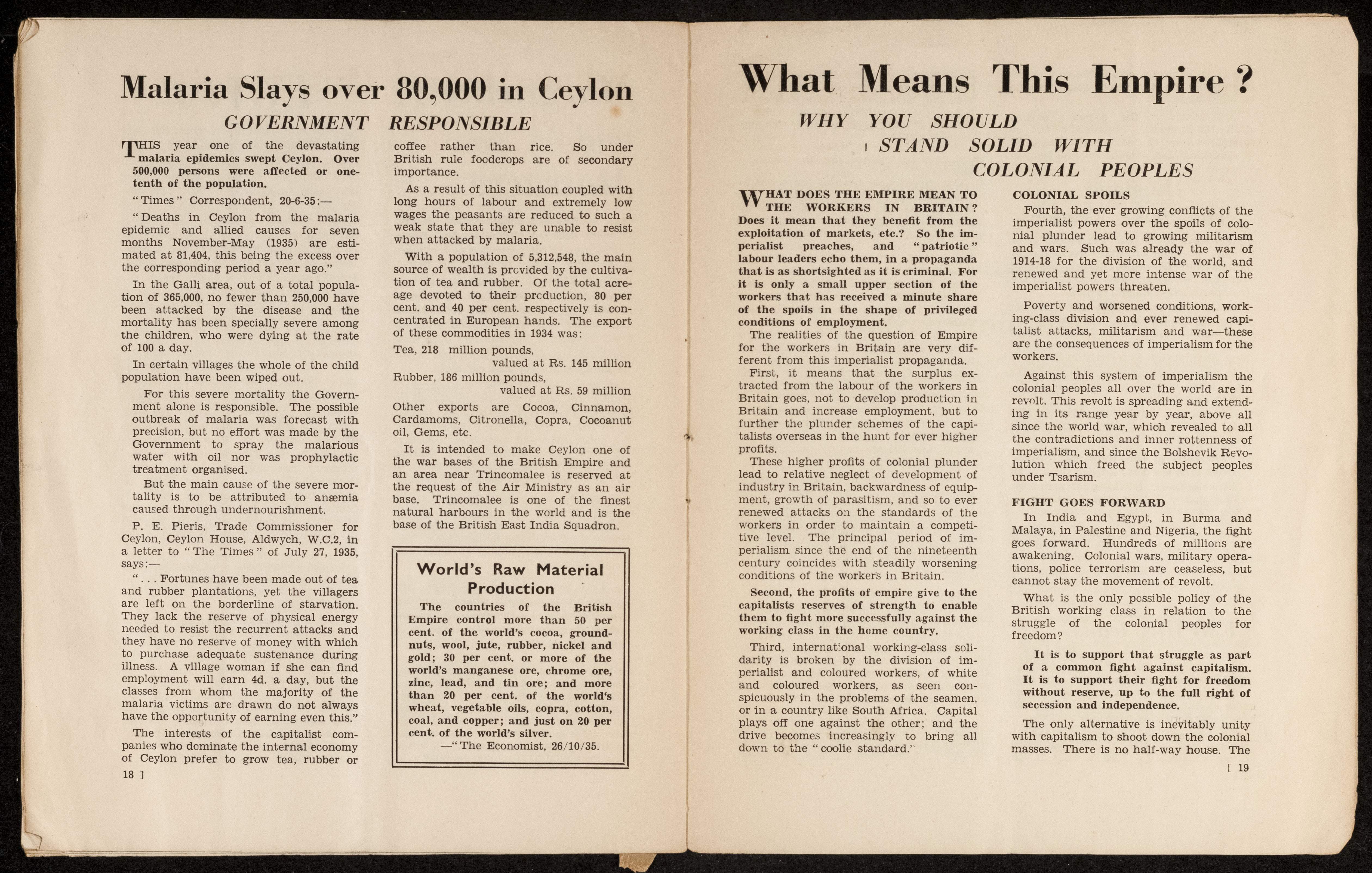
Malaria Slays over 80,000 in Ceylon GOVERNMENT RESPONSIBLE THIS year one of the devastating malaria epidemics swept Ceylon. Over 500,000 persons were affected or one- tenth of the population. "Times" Correspondent, 20-6-35:- "Deaths in Ceylon from the malaria epidemic and allied causes for seven months November-May (1935) are esti- mated at 81,404, this being the excess over the corresponding period a year ago." In the Galli area, out of a total popula- tion of 365,000, no fewer than 250,000 have been attacked by the disease and the mortality has been specially severe among the children, who were dying at the rate of 100 a day. In certain villages the whole of the child population have been wiped out. For this severe mortality the Govern- ment alone is responsible. The possible outbreak of malaria was forecast with precision, but no effort was made by the Government to spray the malarious water with oil nor was prophylactic treatment organised. But the main cause of the severe mor- tality is to be attributed to anæmia caused through undernourishment. P. E. Pieris, Trade Commissioner for Ceylon, Ceylon House, Aldwych, W.C.2, in a letter to "The Times" of July 27, 1935, says:- "... Fortunes have been made out of tea and rubber plantations, yet the villagers are left on the borderline of starvation. They lack the reserve of physical energy needed to resist the recurrent attacks and they have no reserve of money with which to purchase adequate sustenance during illness. A village woman if she can find employment will earn 4d. a day, but the classes from whom the majority of the malaria victims are drawn do not always have the opportunity of earning even this." The interests of the capitalist com- panies who dominate the internal economy of Ceylon prefer to grow tea, rubber or 18 ] coffee rather than rice. So under British rule foodcrops are of secondary importance. As a result of this situation coupled with long hours of labour and extremely low wages the peasants are reduced to such a weak state that they are unable to resist when attacked by malaria. With a population of 5,312,548, the main source of wealth is provided by the cultiva- tion of tea and rubber. Of the total acre- age devoted to their production, 80 per cent. and 40 per cent. respectively is con- centrated in European hands. The export of these commodities in 1934 was: Tea, 218 million pounds, valued at Rs. 145 million Rubber, 186 million pounds, valued at Rs. 59 million Other exports are Cocoa, Cinnamon, Cardamoms, Citronella, Copra, Cocoanut oil, Gems, etc. It is intended to make Ceylon one of the war bases of the British Empire and an area near Trincomalee is reserved at the request of the Air Ministry as an air base. Trincomalee is one of the finest natural harbours in the world and is the base of the British East India Squadron. World's Raw Material Production The countries of the British Empire control more than 50 per cent. of the world's cocoa, ground- nuts, wool, jute, rubber, nickel and gold; 30 per cent. or more of the world's manganese ore, chrome ore, zinc, lead, and tin ore; and more than 20 per cent. of the world's wheat, vegetable oils, copra, cotton, coal, and copper; and just on 20 per cent. of the world's silver. -"The Economist, 26/10/35. What Means This Empire? WHY YOU SHOULD STAND SOLID WITH COLONIAL PEOPLES WHAT DOES THE EMPIRE MEAN TO THE WORKERS IN BRITAIN ? Does it mean that they benefit from the exploitation of markets, etc.? So the im- perialist preaches, and "patriotic" labour leaders echo them, in a propaganda that is as shortsighted as it is criminal. For it is only a small upper section of the workers that has received a minute share of the spoils in the shape of privileged conditions of employment. The realities of the question of Empire for the workers in Britain are very dif- ferent from this imperialist propaganda. First, it means that the surplus ex- tracted from the labour of the workers in Britain goes, not to develop production in Britain and increase employment, but to further the plunder schemes of the capi- talists overseas in the hunt for ever higher profits. These higher profits of colonial plunder lead to relative neglect of development of industry in Britain, backwardness of equip- ment, growth of parasitism, and so to ever renewed attacks on the standards of the workers in order to maintain a competi- tive level. The principal period of im- perialism since the end of the nineteenth century coincides with steadily worsening conditions of the workers in Britain. Second, the profits of empire give to the capitalists reserves of strength to enable them to fight more successfully against the working class in the home country. Third, international working-class soli- darity is broken by the division of im- perialist and coloured workers, of white and coloured workers, as seen con- spicuously in the problems of the seamen, or in a country like South Africa. Capital plays off one against the other; and the drive becomes increasingly to bring all down to the "coolie standard." COLONIAL SPOILS Fourth, the ever growing conflicts of the imperialist powers over the spoils of colo- nial plunder lead to growing militarism and wars. Such was already the war of 1914-18 for the division of the world, and renewed and yet more intense war of the imperialist powers threaten. Poverty and worsened conditions, work- ing-class division and ever renewed capi- talist attacks, militarism and war-these are the consequences of imperialism for the workers. Against this system of imperialism the colonial peoples all over the world are in revolt. This revolt is spreading and extend- ing in its range year by year, above all since the world war, which revealed to all the contradictions and inner rottenness of imperialism, and since the Bolshevik Revo- lution which freed the subject peoples under Tsarism. FIGHT GOES FORWARD In India and Egypt, in Burma and Malaya, in Palestine and Nigeria, the fight goes forward. Hundreds of millions are awakening. Colonial wars, military opera- tions, police terrorism are ceaseless, but cannot stay the movement of revolt. What is the only possible policy of the British working class in relation to the struggle of the colonial peoples for freedom? It is to support that struggle as part of a common fight against capitalism. It is to support their fight for freedom without reserve, up to the full right of secession and independence. The only alternative is inevitably unity with capitalism to shoot down the colonial masses. There is no half-way house. The [ 19
Appraisal, destruction and scheduling
Accruals
System of arrangement
Conditions of access and use area
Conditions governing access
Conditions governing reproduction
Language of material
Script of material
Language and script notes
Physical characteristics and technical requirements
Finding aids
Uploaded finding aid
Allied materials area
Existence and location of originals
full_reference_code