
Identity area
Reference code
Title
Date(s)
Level of description
Extent and medium
1 digital image
Context area
Archival history
Immediate source of acquisition or transfer
Content and structure area
Scope and content
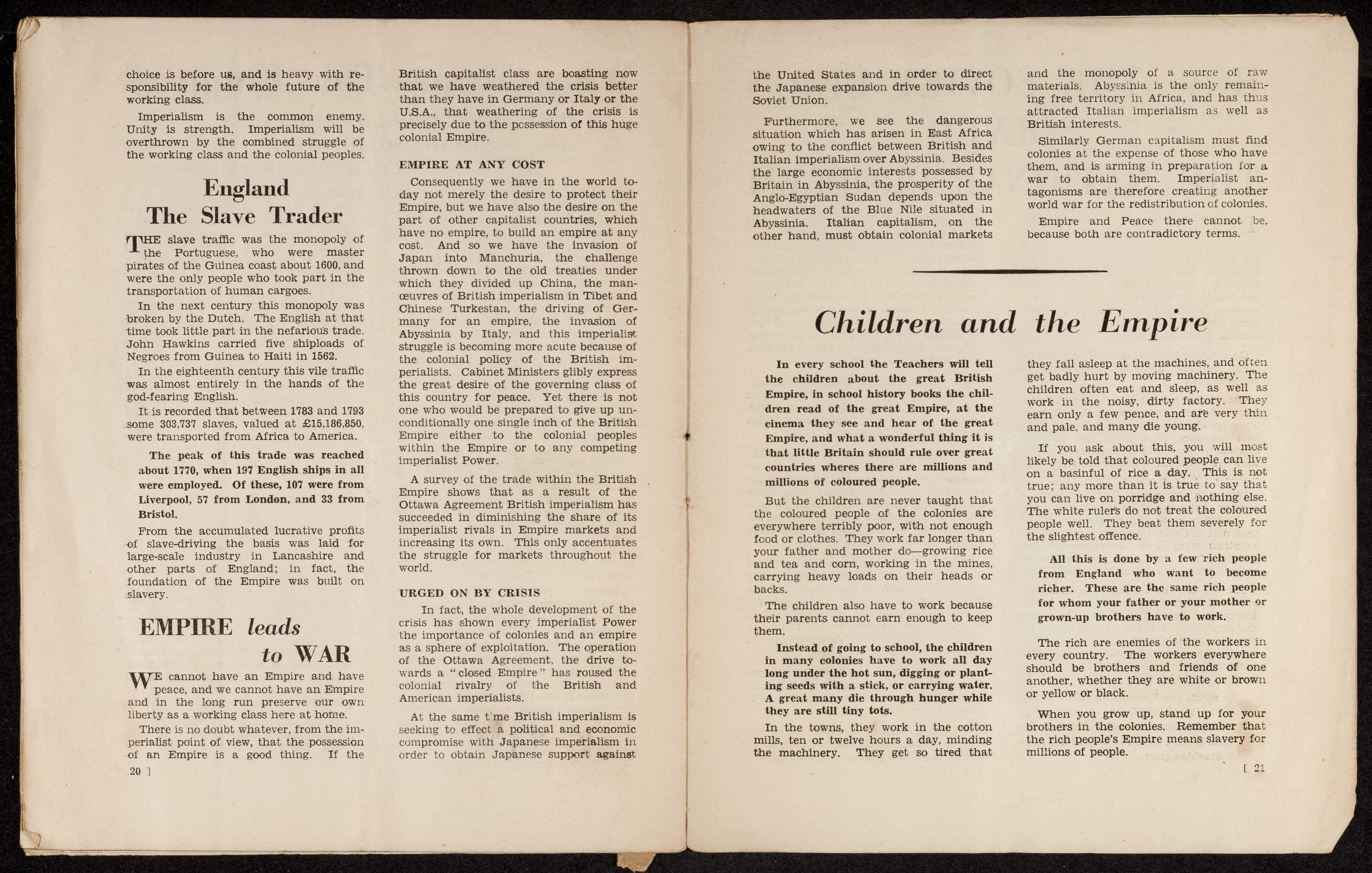
choice is before us, and is heavy with re- sponsibility for the whole future of the working class. Imperialism is the common enemy. Unity is strength. Imperialism will be overthrown by the combined struggle of the working class and the colonial peoples. England The Slave Trader THE slave traffic was the monopoly of the Portuguese, who were master pirates of the Guinea coast about 1600, and were the only people who took part in the transportation of human cargoes. In the next century this monopoly was broken by the Dutch. The English at that time took little part in the nefarious trade. John Hawkins carried five shiploads of Negroes from Guinea to Haiti in 1562. In the eighteenth century this vile traffic was almost entirely in the hands of the god-fearing English. It is recorded that between 1783 and 1793 some 303,737 slaves, valued at £15,186,850, were transported from Africa to America. The peak of this trade was reached about 1770, when 197 English ships in all were employed. Of these, 107 were from Liverpool, 57 from London, and 33 from Bristol. From the accumulated lucrative profits of slave-driving the basis was laid for large-scale industry in Lancashire and other parts of England; in fact, the foundation of the Empire was built on slavery. EMPIRE leads to WAR WE cannot have an Empire and have peace, and we cannot have an Empire and in the long run preserve our own liberty as a working class here at home. There is no doubt whatever, from the im- perialist point of view, that the possession of an Empire is a good thing. If the 20 ] British capitalist class are boasting now that we have weathered the crisis better than they have in Germany or Italy or the U.S.A., that weathering of the crisis is precisely due to the possession of this huge colonial Empire. EMPIRE AT ANY COST Consequently we have in the world to- day not merely the desire to protect their Empire, but we have also the desire on the part of other capitalist countries, which have no empire, to build an empire at any cost. And so we have the invasion of Japan into Manchuria, the challenge thrown down to the old treaties under which they divided up China, the man- œuvres of British imperialism in Tibet and Chinese Turkestan, the driving of Ger- many for an empire, the invasion of Abyssinia by Italy, and this imperialist struggle is becoming more acute because of the colonial policy of the British im- perialists. Cabinet Ministers glibly express the great desire of the governing class of this country for peace. Yet there is not one who would be prepared to give up un- conditionally one single inch of the British Empire either to the colonial peoples within the Empire or to any competing imperialist Power. A survey of the trade within the British Empire shows that as a result of the Ottawa Agreement British imperialism has succeeded in diminishing the share of its imperialist rivals in Empire markets and increasing its own. This only accentuates the struggle for markets throughout the world. URGED ON BY CRISIS In fact, the whole development of the crisis has shown every imperialist Power the importance of colonies and an empire as a sphere of exploitation. The operation of the Ottawa Agreement, the drive to- wards a "closed Empire" has roused the colonial rivalry of the British and American imperialists. At the same time British imperialism is seeking to effect a political and economic compromise with Japanese imperialism in order to obtain Japanese support against the United States and in order to direct the Japanese expansion drive towards the Soviet Union. Furthermore, we see the dangerous situation which has arisen in East Africa owing to the conflict between British and Italian imperialism over Abyssinia. Besides the large economic interests possessed by Britain in Abyssinia, the prosperity of the Anglo-Egyptian Sudan depends upon the headwaters of the Blue Nile situated in Abyssinia. Italian capitalism, on the other hand, must obtain colonial markets and the monopoly of a source of raw materials. Abyssinia is the only remain- ing free territory in Africa, and has thus attracted Italian imperialism as well as British interests. Similarly German capitalism must find colonies at the expense of those who have them, and is arming in preparation for a war to obtain them. Imperialist an- tagonisms are therefore creating another world war for the redistribution of colonies. Empire and Peace there cannot be, because both are contradictory terms. Children and the Empire In every school the Teachers will tell the children about the great British Empire, in school history books the chil- dren read of the great Empire, at the cinema they see and hear of the great Empire, and what a wonderful thing it is that little Britain should rule over great countries wheres there are millions and millions of coloured people. But the children are never taught that the coloured people of the colonies are everywhere terribly poor, with not enough food or clothes. They work far longer than your father and mother do-growing rice and tea and corn, working in the mines, carrying heavy loads on their heads or backs. The children also have to work because their parents cannot earn enough to keep them. Instead of going to school, the children in many colonies have to work all day long under the hot sun, digging or plant- ing seeds with a stick, or carrying water. A great many die through hunger while they are still tiny tots. In the towns, they work in the cotton mills, ten or twelve hours a day, minding the machinery. They get so tired that they fall asleep at the machines, and often get badly hurt by moving machinery. The children often eat and sleep, as well as work in the noisy, dirty factory. They earn only a few pence, and are very thin and pale, and many die young. If you ask about this, you will most likely be told that coloured people can live on a basinful of rice a day. This is not true; any more than it is true to say that you can live on porridge and nothing else. The white rulers do not treat the coloured people well. They beat them severely for the slightest offence. All this is done by a few rich people from England who want to become richer. These are the same rich people for whom your father or your mother or grown-up brothers have to work. The rich are enemies of the workers in every country. The workers everywhere should be brothers and friends of one another, whether they are white or brown or yellow or black. When you grow up, stand up for your brothers in the colonies. Remember that the rich people's Empire means slavery for millions of people. [ 21