
Identity area
Reference code
Title
Date(s)
Level of description
Extent and medium
1 digital image
Context area
Archival history
Immediate source of acquisition or transfer
Content and structure area
Scope and content
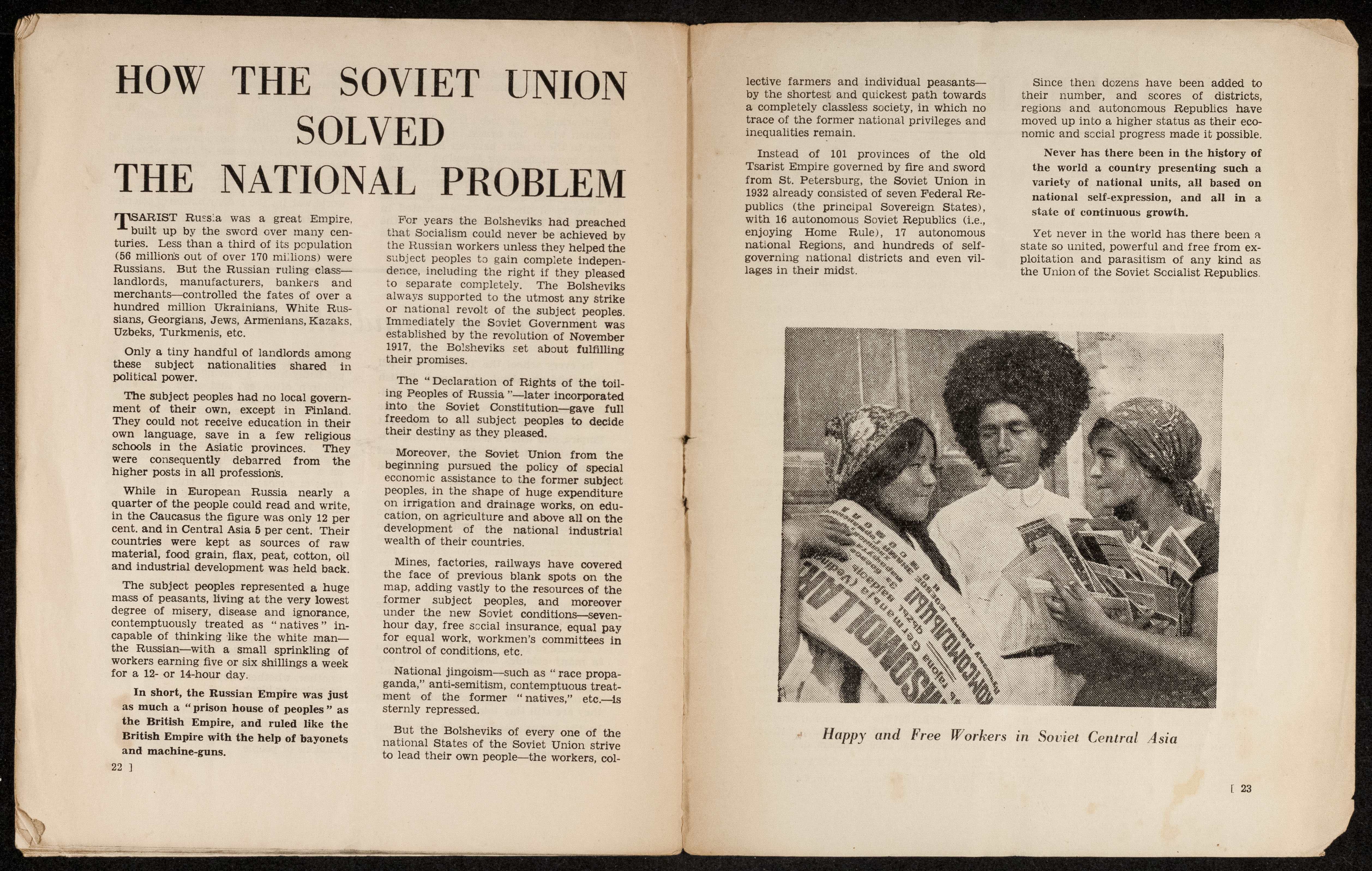
HOW THE SOVIET UNION SOLVED THE NATIONAL PROBLEM TSARIST Russia was a great Empire, built up by the sword over many cen- turies. Less than a third of its population (56 millions out of over 170 millions) were Russians. But the Russian ruling class— landlords, manufacturers, bankers and merchants—controlled the fates of over a hundred million Ukrainians, White Rus- sians, Georgians, Jews, Armenians, Kazaks, Uzbeks, Turkmenis, etc. Only a tiny handful of landlords among these subject nationalities shared in political power. The subject peoples had no local govern- ment of their own, except in Finland. They could not receive education in their own language, save in a few religious schools in the Asiatic provinces. They were consequently debarred from the higher posts in all professions. While in European Russia nearly a quarter of the people could read and write, in the Caucasus the figure was only 12 per cent. and in Central Asia 5 per cent. Their countries were kept as sources of raw material, food grain, flax, peat, cotton, oil and industrial development was held back. The subject peoples represented a huge mass of peasants, living at the very lowest degree of misery, disease and ignorance, contemptuously treated as “natives” in- capable of thinking like the white man— the Russian with a small sprinkling of workers earning five or six shillings a week for a 12- or 14-hour day. In short, the Russian Empire was just as much a “prison house of peoples” as the British Empire, and ruled like the British Empire with the help of bayonets and machine-guns. 22 ] For years the Bolsheviks had preached that Socialism could never be achieved by the Russian workers unless they helped the subject peoples to gain complete indepen- dence, including the right if they pleased to separate completely. The Bolsheviks always supported to the utmost any strike or national revolt of the subject peoples. Immediately the Soviet Government was established by the revolution of November 1917, the Bolsheviks set about fulfilling their promises. The “Declaration of Rights of the toil- ing Peoples of Russia”—later incorporated into the Soviet Constitution—gave full freedom to all subject peoples to decide their destiny as they pleased. Moreover, the Soviet Union from the beginning pursued the policy of special economic assistance to the former subject peoples, in the shape of huge expenditure on irrigation and drainage works, on edu- cation, on agriculture and above all on the development of the national industrial wealth of their countries. Mines, factories, railways have covered the face of previous blank spots on the map, adding vastly to the resources of the former subject peoples, and moreover under the new Soviet conditions—seven- hour day, free social insurance, equal pay for equal work, workmen’s committees in control of conditions, etc. National jingoism—such as “race propa- ganda,” anti-semitism, contemptuous treat- ment of the former “natives,” etc.—is sternly repressed. But the Bolsheviks of every one of the national States of the Soviet Union strive to lead their own people—the workers, col- lective farmers and individual peasants— by the shortest and quickest path towards a completely classless society, in which no trace of the former national privileges and inequalities remain. Instead of 101 provinces of the old Tsarist Empire governed by fire and sword from St. Petersburg, the Soviet Union in 1932 already consisted of seven Federal Re- publics (the principal Sovereign States), with 16 autonomous Soviet Republics (i.e., enjoying Home Rule), 17 autonomous national Regions, and hundreds of self- governing national districts and even vil- lages in their midst. За боевое КОМСОМОЛЬЦЫ! Чыгы вајd 46 rajona SOMOLLAR Since then dozens have been added to their number, and scores of districts, regions and autonomous Republics have moved up into a higher status as their eco- nomic and social progress made it possible. Never has there been in the history of the world a country presenting such a variety of national units, all based on national self-expression, and all in a state of continuous growth. Yet never in the world has there been a state so united, powerful and free from ex- ploitation and parasitism of any kind as the Union of the Soviet Socialist Republics. Happy and Free Workers in Soviet Central Asia [ 23
Appraisal, destruction and scheduling
Accruals
System of arrangement
Conditions of access and use area
Conditions governing access
Conditions governing reproduction
Language of material
Script of material
Language and script notes
Physical characteristics and technical requirements
Finding aids
Uploaded finding aid
Allied materials area
Existence and location of originals
full_reference_code