
Identificatie
referentie code
Titel
Datum(s)
Beschrijvingsniveau
Omvang en medium
1 digital image
Context
Geschiedenis van het archief
Directe bron van verwerving of overbrenging
Inhoud en structuur
Bereik en inhoud
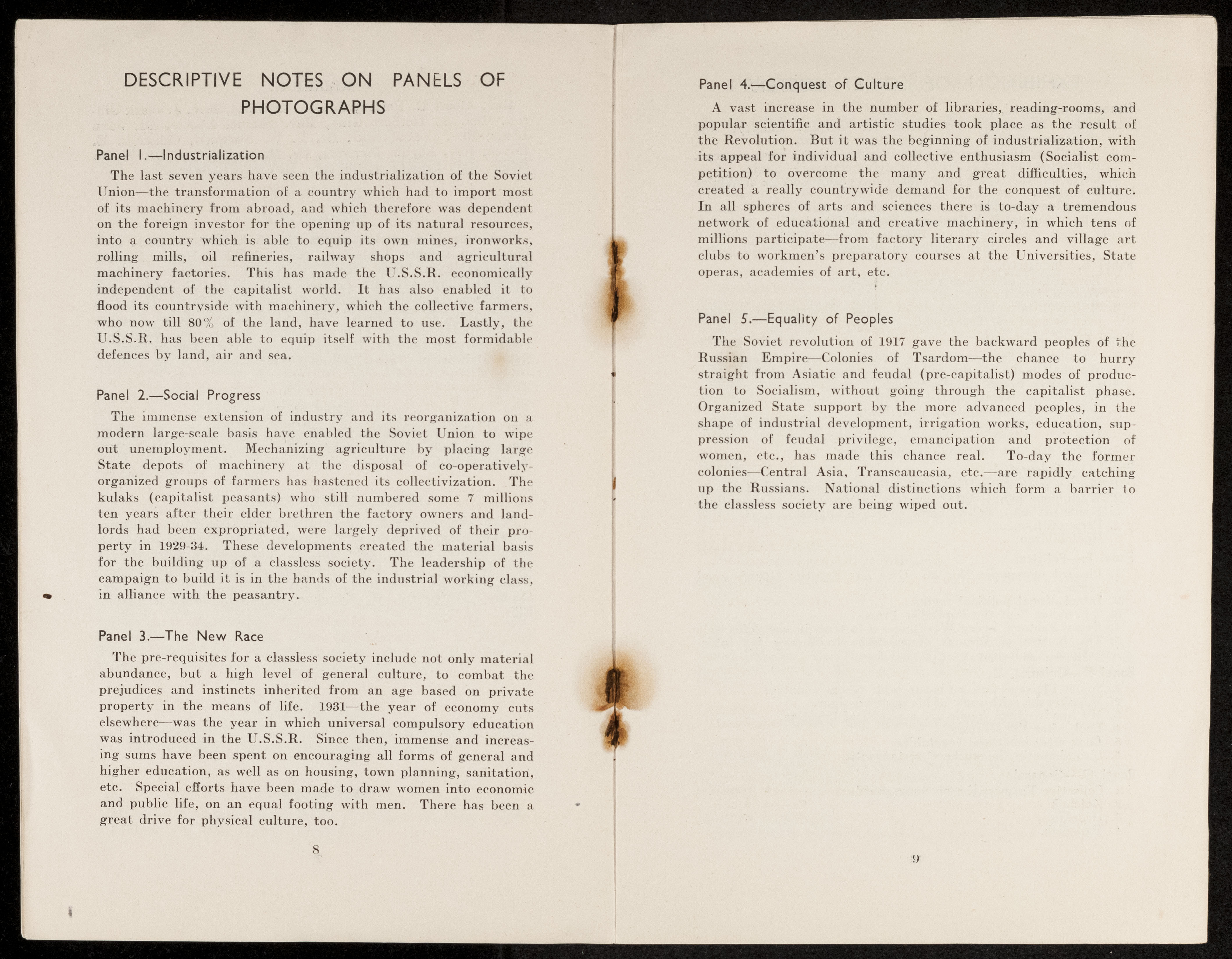
DESCRIPTIVE NOTES ON PANELS OF PHOTOGRAPHS Panel 1.—Industrialization The last seven years have seen the industrialization of the Soviet Union—the transformation of a country which had to import most of its machinery from abroad, and which therefore was dependent on the foreign investor for the opening up of its natural resources, into a country which is able to equip its own mines, ironworks, rolling mills, oil refineries, railway shops and agricultural machinery factories. This has made the U.S.S.R. economically independent of the capitalist world. It has also enabled it to flood its countryside with machinery, which the collective farmers, who now till 80% of the land, have learned to use. Lastly, the U.S.S.R. has been able to equip itself with the most formidable defences by land, air and sea. Panel 2.—Social Progress The immense extension of industry and its reorganization on a modern large-scale basis have enabled the Soviet Union to wipe out unemployment. Mechanizing agriculture by placing large State depots of machinery at the disposal of co-operatively- organized groups of farmers has hastened its collectivization. The kulaks (capitalist peasants) who still numbered some 7 millions ten years after their elder brethren the factory owners and land- lords had been expropriated, were largely deprived of their pro- perty in 1929-34. These developments created the material basis for the building up of a classless society. The leadership of the campaign to build it is in the hands of the industrial working class, in alliance with the peasantry. Panel 3.—The New Race The pre-requisites for a classless society include not only material abundance, but a high level of general culture, to combat the prejudices and instincts inherited from an age based on private property in the means of life. 1931—the year of economy cuts elsewhere—was the year in which universal compulsory education was introduced in the U.S.S.R. Since then, immense and increas- ing sums have been spent on encouraging all forms of general and higher education, as well as on housing, town planning, sanitation, etc. Special efforts have been made to draw women into economic and public life, on an equal footing with men. There has been a great drive for physical culture, too. 8 Panel 4.—Conquest of Culture A vast increase in the number of libraries, reading-rooms, and popular scientific and artistic studies took place as the result of the Revolution. But it was the beginning of industrialization, with its appeal for individual and collective enthusiasm (Socialist com- petition) to overcome the many and great difficulties, which created a really countrywide demand for the conquest of culture. In all spheres of arts and sciences there is to-day a tremendous network of educational and creative machinery, in which tens of millions participate—from factory literary circles and village art clubs to workmen's preparatory courses at the Universities, State operas, academies of art, etc. Panel 5.—Equality of Peoples The Soviet revolution of 1917 gave the backward peoples of the Russian Empire—Colonies of Tsardom—the chance to hurry straight from Asiatic and feudal (pre-capitalist) modes of produc- tion to Socialism, without going through the capitalist phase. Organized State support by the more advanced peoples, in the shape of industrial development, irrigation works, education, sup- pression of feudal privilege, emancipation and protection of women, etc., has made this chance real. To-day the former colonies—Central Asia, Transcaucasia, etc.—are rapidly catching up the Russians. National distinctions which form a barrier to the classless society are being wiped out. 9