
Identity area
Reference code
Title
Date(s)
Level of description
Extent and medium
1 digital image
Context area
Archival history
Immediate source of acquisition or transfer
Content and structure area
Scope and content
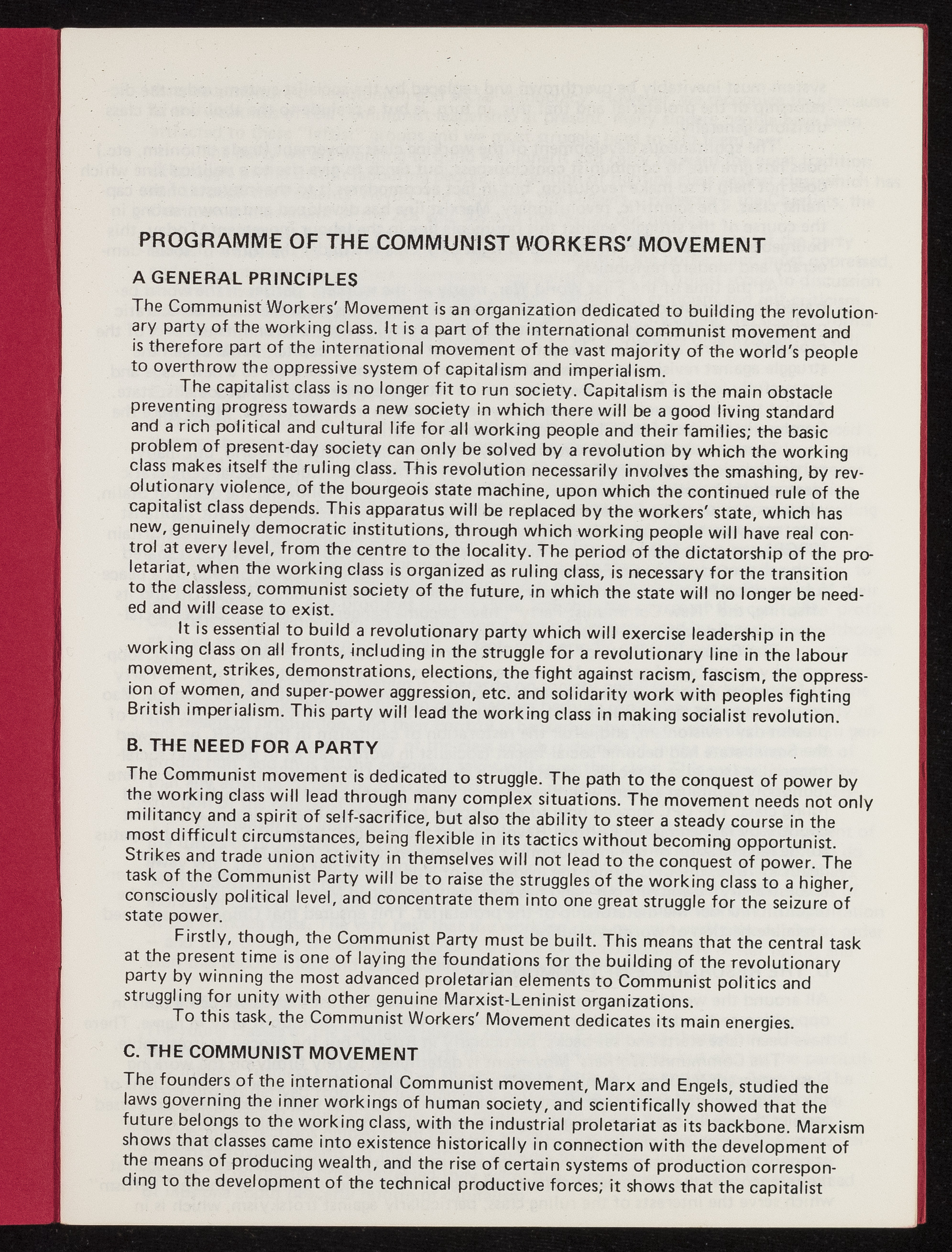
PROGRAMME OF THE COMMUNIST WORKERS' MOVEMENT A GENERAL PRINCIPLES The Communist Workers' Movement is an organization dedicated to building the revolution- ary party of the working class. It is a part of the international communist movement and is therefore part of the international movement of the vast majority of the world's people to overthrow the oppressive system of capitalism and imperialism. The capitalist class is no longer fit to run society. Capitalism is the main obstacle preventing progress towards a new society in which there will be a good living standard and a rich political and cultural life for all working people and their families; the basic problem of present-day society can only be solved by a revolution by which the working class makes itself the ruling class. This revolution necessarily involves the smashing, by rev- olutionary violence, of the bourgeois state machine, upon which the continued rule of the capitalist class depends. This apparatus will be replaced by the workers' state, which has new, genuinely democratic institutions, through which working people will have real con- trol at every level, from the centre to the locality. The period of the dictatorship of the pro- letariat, when the working class is organized as ruling class, is necessary for the transition to the classless, communist society of the future, in which the state will no longer be need- ed and will cease to exist. It is essential to build a revolutionary party which will exercise leadership in the working class on all fronts, including in the struggle for a revolutionary line in the labour movement, strikes, demonstrations, elections, the fight against racism, fascism, the oppress- ion of women, and super-power aggression, etc. and solidarity work with peoples fighting British imperialism. This party will lead the working class in making socialist revolution. B. THE NEED FOR A PARTY The Communist movement is dedicated to struggle. The path to the conquest of power by the working class will lead through many complex situations. The movement needs not only militancy and a spirit of self-sacrifice, but also the ability to steer a steady course in the most difficult circumstances, being flexible in its tactics without becoming opportunist. Strikes and trade union activity in themselves will not lead to the conquest of power. The task of the Communist Party will be to raise the struggles of the working class to a higher, consciously political level, and concentrate them into one great struggle for the seizure of state power. Firstly, though, the Communist Party must be built. This means that the central task at the present time is one of laying the foundations for the building of the revolutionary party by winning the most advanced proletarian elements to Communist politics and struggling for unity with other genuine Marxist-Leninist organizations. To this task, the Communist Workers' Movement dedicates its main energies. C. THE COMMUNIST MOVEMENT The founders of the international Communist movement, Marx and Engels, studied the laws governing the inner workings of human society, and scientifically showed that the future belongs to the working class, with the industrial proletariat as its backbone. Marxism shows that classes came into existence historically in connection with the development of the means of producing wealth, and the rise of certain systems of production correspon- ding to the development of the technical productive forces; it shows that the capitalist
Appraisal, destruction and scheduling
Accruals
System of arrangement
Conditions of access and use area
Conditions governing access
Conditions governing reproduction
Language of material
Script of material
Language and script notes
Physical characteristics and technical requirements
Finding aids
Uploaded finding aid
Allied materials area
Existence and location of originals
full_reference_code