
Identity area
Reference code
Title
Date(s)
Level of description
Extent and medium
1 digital image
Context area
Archival history
Immediate source of acquisition or transfer
Content and structure area
Scope and content
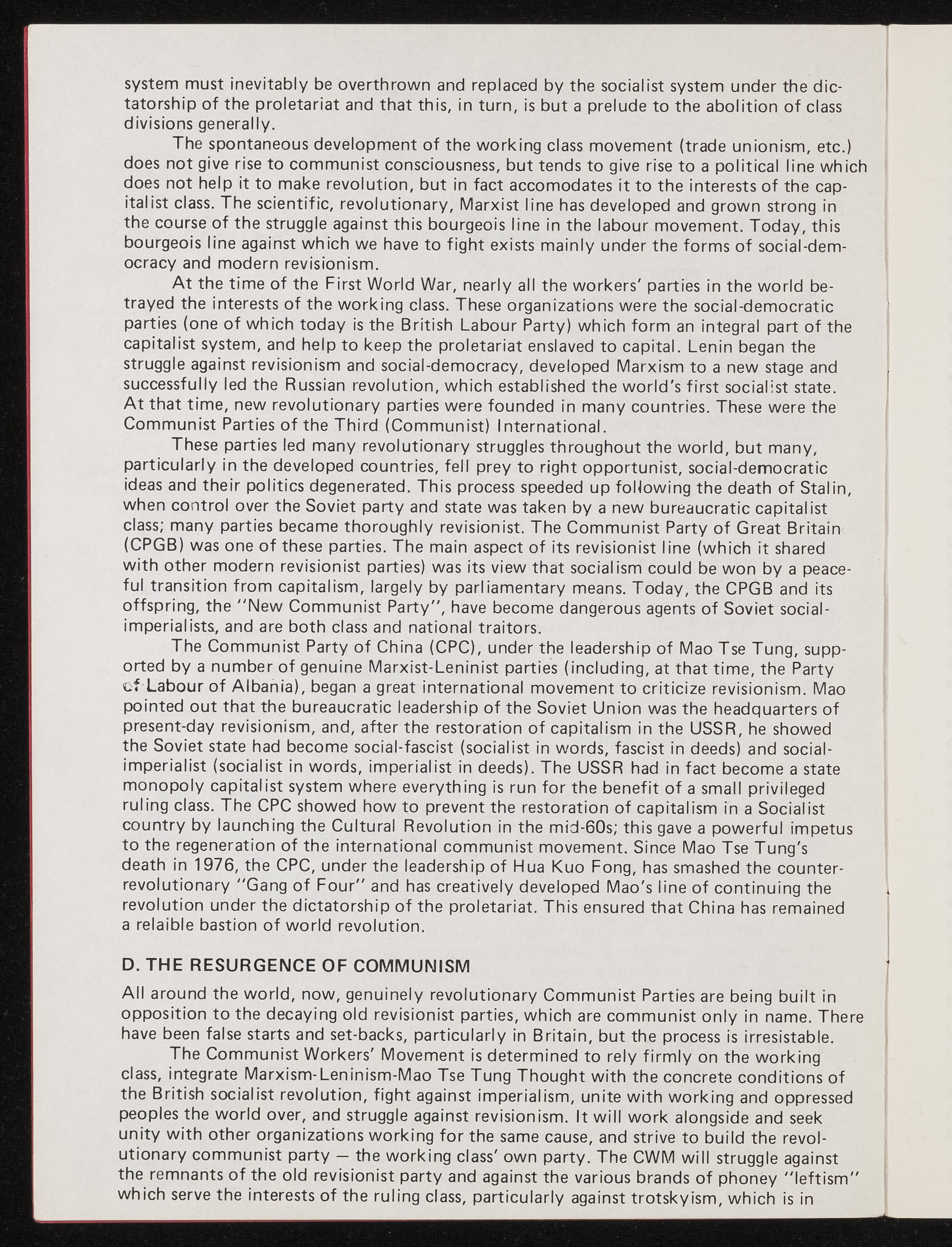
system must inevitably be overthrown and replaced by the socialist system under the dic- tatorship of the proletariat and that this, in turn, is but a prelude to the abolition of class divisions generally. The spontaneous development of the working class movement (trade unionism, etc.) does not give rise to communist consciousness, but tends to give rise to a political line which does not help it to make revolution, but in fact accomodates it to the interests of the cap- italist class. The scientific, revolutionary, Marxist line has developed and grown strong in the course of the struggle against this bourgeois line in the labour movement. Today, this bourgeois line against which we have to fight exists mainly under the forms of social-dem- ocracy and modern revisionism. At the time of the First World War, nearly all the workers' parties in the world be- trayed the interests of the working class. These organizations were the social-democratic parties (one of which today is the British Labour Party) which form an integral part of the capitalist system, and help to keep the proletariat enslaved to capital. Lenin began the struggle against revisionism and social-democracy, developed Marxism to a new stage and successfully led the Russian revolution, which established the world's first socialist state. At that time, new revolutionary parties were founded in many countries. These were the Communist Parties of the Third (Communist) International. These parties led many revolutionary struggles throughout the world, but many, particularly in the developed countries, fell prey to right opportunist, social-democratic ideas and their politics degenerated. This process speeded up following the death of Stalin, when control over the Soviet party and state was taken by a new bureaucratic capitalist class; many parties became thoroughly revisionist. The Communist Party of Great Britain (CPGB) was one of these parties. The main aspect of its revisionist line (which it shared with other modern revisionist parties) was its view that socialism could be won by a peace- ful transition from capitalism, largely by parliamentary means. Today, the CPGB and its offspring, the "New Communist Party", have become dangerous agents of Soviet social- imperialists, and are both class and national traitors. The Communist Party of China (CPC), under the leadership of Mao Tse Tung, supp- orted by a number of genuine Marxist-Leninist parties (including, at that time, the Party of Labour of Albania), began a great international movement to criticize revisionism. Mao pointed out that the bureaucratic leadership of the Soviet Union was the headquarters of present-day revisionism, and, after the restoration of capitalism in the USSR, he showed the Soviet state had become social-fascist (socialist in words, fascist in deeds) and social- imperialist (socialist in words, imperialist in deeds). The USSR had in fact become a state monopoly capitalist system where everything is run for the benefit of a small privileged ruling class. The CPC showed how to prevent the restoration of capitalism in a Socialist country by launching the Cultural Revolution in the mid-60s; this gave a powerful impetus to the regeneration of the international communist movement. Since Mao Tse Tung's death in 1976, the CPC, under the leadership of Hua Kuo Fong, has smashed the counter- revolutionary "Gang of Four" and has creatively developed Mao's line of continuing the revolution under the dictatorship of the proletariat. This ensured that China has remained a relaible bastion of world revolution. D. THE RESURGENCE OF COMMUNISM All around the world, now, genuinely revolutionary Communist Parties are being built in opposition to the decaying old revisionist parties, which are communist only in name. There have been false starts and set-backs, particularly in Britain, but the process is irresistable. The Communist Workers' Movement is determined to rely firmly on the working class, integrate Marxism-Leninism-Mao Tse Tung Thought with the concrete conditions of the British socialist revolution, fight against imperialism, unite with working and oppressed peoples the world over, and struggle against revisionism. It will work alongside and seek unity with other organizations working for the same cause, and strive to build the revol- utionary communist party - the working class' own party. The CWM will struggle against the remnants of the old revisionist party and against the various brands of phoney "leftism" which serve the interests of the ruling class, particularly against trotskyism, which is in
Appraisal, destruction and scheduling
Accruals
System of arrangement
Conditions of access and use area
Conditions governing access
Conditions governing reproduction
Language of material
Script of material
Language and script notes
Physical characteristics and technical requirements
Finding aids
Uploaded finding aid
Allied materials area
Existence and location of originals
full_reference_code