
Zone d'identification
Cote
Titre
Date(s)
Niveau de description
Étendue matérielle et support
1 digital image
Zone du contexte
Histoire archivistique
Source immédiate d'acquisition ou de transfert
Zone du contenu et de la structure
Portée et contenu
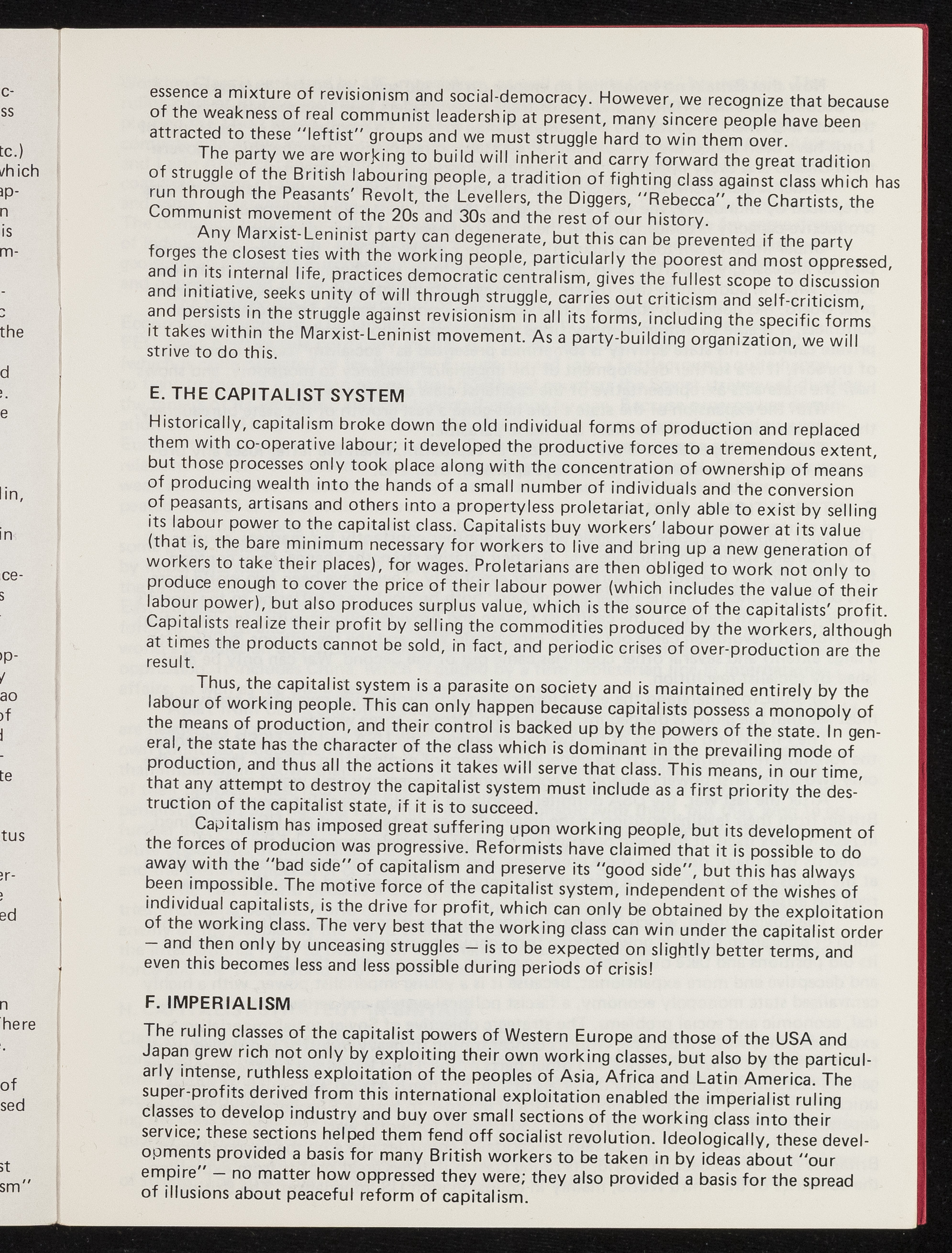
C- SS tc.) which ap- n is m- - C the d e. e in, In ce- S - pp- ao of F - te tus er- a ed n There . of sed st sm" essence a mixture of revisionism and social-democracy. However, we recognize that because of the weakness of real communist leadership at present, many sincere people have been attracted to these "leftist" groups and we must struggle hard to win them over. The party we are working to build will inherit and carry forward the great tradition of struggle of the British labouring people, a tradition of fighting class against class which has run through the Peasants' Revolt, the Levellers, the Diggers, "Rebecca", the Chartists, the Communist movement of the 20s and 30s and the rest of our history. Any Marxist-Leninist party can degenerate, but this can be prevented if the party forges the closest ties with the working people, particularly the poorest and most oppressed, and in its internal life, practices democratic centralism, gives the fullest scope to discussion and initiative, seeks unity of will through struggle, carries out criticism and self-criticism, and persists in the struggle against revisionism in all its forms, including the specific forms it takes within the Marxist-Leninist movement. As a party-building organization, we will strive to do this. E. THE CAPITALIST SYSTEM Historically, capitalism broke down the old individual forms of production and replaced them with co-operative labour; it developed the productive forces to a tremendous extent, but those processes only took place along with the concentration of ownership of means of producing wealth into the hands of a small number of individuals and the conversion of peasants, artisans and others into a propertyless proletariat, only able to exist by selling its labour power to the capitalist class. Capitalists buy workers' labour power at its value (that is, the bare minimum necessary for workers to live and bring up a new generation of workers to take their places), for wages. Proletarians are then obliged to work not only to produce enough to cover the price of their labour power (which includes the value of their labour power), but also produces surplus value, which is the source of the capitalists' profit. Capitalists realize their profit by selling the commodities produced by the workers, although at times the products cannot be sold, in fact, and periodic crises of over-production are the result. Thus, the capitalist system is a parasite on society and is maintained entirely by the labour of working people. This can only happen because capitalists possess a monopoly of the means of production, and their control is backed up by the powers of the state. In gen- eral, the state has the character of the class which is dominant in the prevailing mode of production, and thus all the actions it takes will serve that class. This means, in our time, that any attempt to destroy the capitalist system must include as a first priority the des- truction of the capitalist state, if it is to succeed. Capitalism has imposed great suffering upon working people, but its development of the forces of producion was progressive. Reformists have claimed that it is possible to do away with the "bad side" of capitalism and preserve its "good side", but this has always been impossible. The motive force of the capitalist system, independent of the wishes of individual capitalists, is the drive for profit, which can only be obtained by the exploitation of the working class. The very best that the working class can win under the capitalist order and then only by unceasing struggles is to be expected on slightly better terms, and even this becomes less and less possible during periods of crisis! F. IMPERIALISM The ruling classes of the capitalist powers of Western Europe and those of the USA and Japan grew rich not only by exploiting their own working classes, but also by the particul- arly intense, ruthless exploitation of the peoples of Asia, Africa and Latin America. The super-profits derived from this international exploitation enabled the imperialist ruling classes to develop industry and buy over small sections of the working class into their service; these sections helped them fend off socialist revolution. Ideologically, these devel- opments provided a basis for many British workers to be taken in by ideas about "our empire" no matter how oppressed they were; they also provided a basis for the spread of illusions about peaceful reform of capitalism.
Évaluation, élimination et calendrier de conservation
Accroissements
Mode de classement
Zone des conditions d'accès et d'utilisation
Conditions d'accès
Conditions de reproduction
Langue des documents
Écriture des documents
Notes de langue et graphie
Caractéristiques matérielle et contraintes techniques
Instruments de recherche
Instrument de recherche téléversé
Zone des sources complémentaires
Existence et lieu de conservation des originaux
full_reference_code