
Identity area
Reference code
Title
Date(s)
Level of description
Extent and medium
1 digital image
Context area
Archival history
Immediate source of acquisition or transfer
Content and structure area
Scope and content
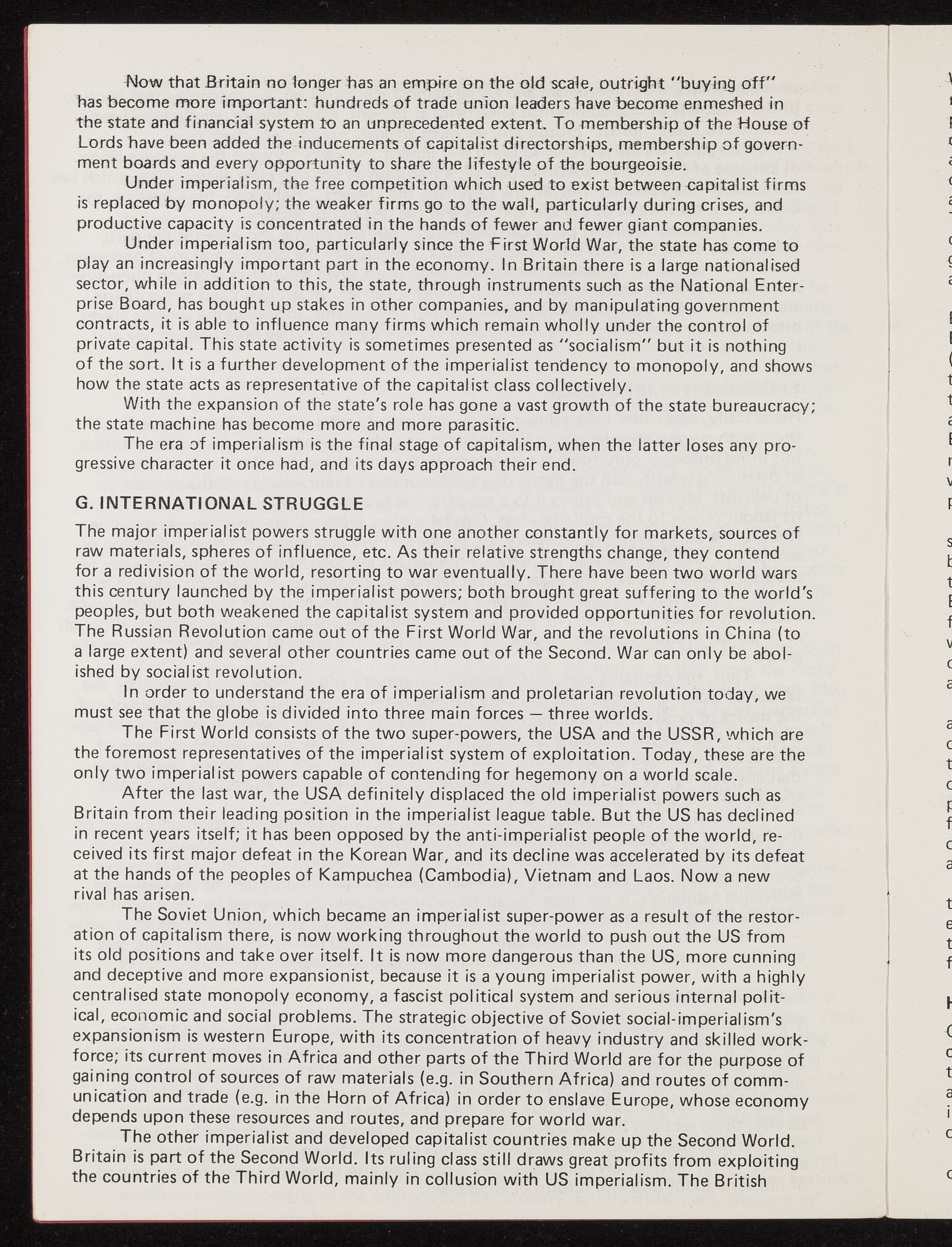
Now that Britain no longer has an empire on the old scale, outright "buying off" has become more important: hundreds of trade union leaders have become enmeshed in the state and financial system to an unprecedented extent. To membership of the House of Lords have been added the inducements of capitalist directorships, membership of govern- ment boards and every opportunity to share the lifestyle of the bourgeoisie. Under imperialism, the free competition which used to exist between capitalist firms is replaced by monopoly; the weaker firms go to the wall, particularly during crises, and productive capacity is concentrated in the hands of fewer and fewer giant companies. Under imperialism too, particularly since the First World War, the state has come to play an increasingly important part in the economy. In Britain there is a large nationalised sector, while in addition to this, the state, through instruments such as the National Enter- prise Board, has bought up stakes in other companies, and by manipulating government contracts, it is able to influence many firms which remain wholly under the control of private capital. This state activity is sometimes presented as "socialism" but it is nothing of the sort. It is a further development of the imperialist tendency to monopoly, and shows how the state acts as representative of the capitalist class collectively. With the expansion of the state's role has gone a vast growth of the state bureaucracy; the state machine has become more and more parasitic. The era of imperialism is the final stage of capitalism, when the latter loses any pro- gressive character it once had, and its days approach their end. G. INTERNATIONAL STRUGGLE The major imperialist powers struggle with one another constantly for markets, sources of raw materials, spheres of influence, etc. As their relative strengths change, they contend for a redivision of the world, resorting to war eventually. There have been two world wars this century launched by the imperialist powers; both brought great suffering to the world's peoples, but both weakened the capitalist system and provided opportunities for revolution. The Russian Revolution came out of the First World War, and the revolutions in China (to a large extent) and several other countries came out of the Second. War can only be abol- ished by socialist revolution. In order to understand the era of imperialism and proletarian revolution today, we must see that the globe is divided into three main forces - three worlds. The First World consists of the two super-powers, the USA and the USSR, which are the foremost representatives of the imperialist system of exploitation. Today, these are the only two imperialist powers capable of contending for hegemony on a world scale. After the last war, the USA definitely displaced the old imperialist powers such as Britain from their leading position in the imperialist league table. But the US has declined in recent years itself; it has been opposed by the anti-imperialist people of the world, re- ceived its first major defeat in the Korean War, and its decline was accelerated by its defeat at the hands of the peoples of Kampuchea (Cambodia), Vietnam and Laos. Now a new rival has arisen. The Soviet Union, which became an imperialist super-power as a result of the restor- ation of capitalism there, is now working throughout the world to push out the US from its old positions and take over itself. It is now more dangerous than the US, more cunning and deceptive and more expansionist, because it is a young imperialist power, with a highly centralised state monopoly economy, a fascist political system and serious internal polit- ical, economic and social problems. The strategic objective of Soviet social-imperialism's expansionism is western Europe, with its concentration of heavy industry and skilled work- force; its current moves in Africa and other parts of the Third World are for the purpose of gaining control of sources of raw materials (e.g. in Southern Africa) and routes of comm- unication and trade (e.g. in the Horn of Africa) in order to enslave Europe, whose economy depends upon these resources and routes, and prepare for world war. The other imperialist and developed capitalist countries make up the Second World. Britain is part of the Second World. Its ruling class still draws great profits from exploiting the countries of the Third World, mainly in collusion with US imperialism. The British
Appraisal, destruction and scheduling
Accruals
System of arrangement
Conditions of access and use area
Conditions governing access
Conditions governing reproduction
Language of material
Script of material
Language and script notes
Physical characteristics and technical requirements
Finding aids
Uploaded finding aid
Allied materials area
Existence and location of originals
full_reference_code