
Identity area
Reference code
Title
Date(s)
Level of description
Extent and medium
1 digital image
Context area
Archival history
Immediate source of acquisition or transfer
Content and structure area
Scope and content
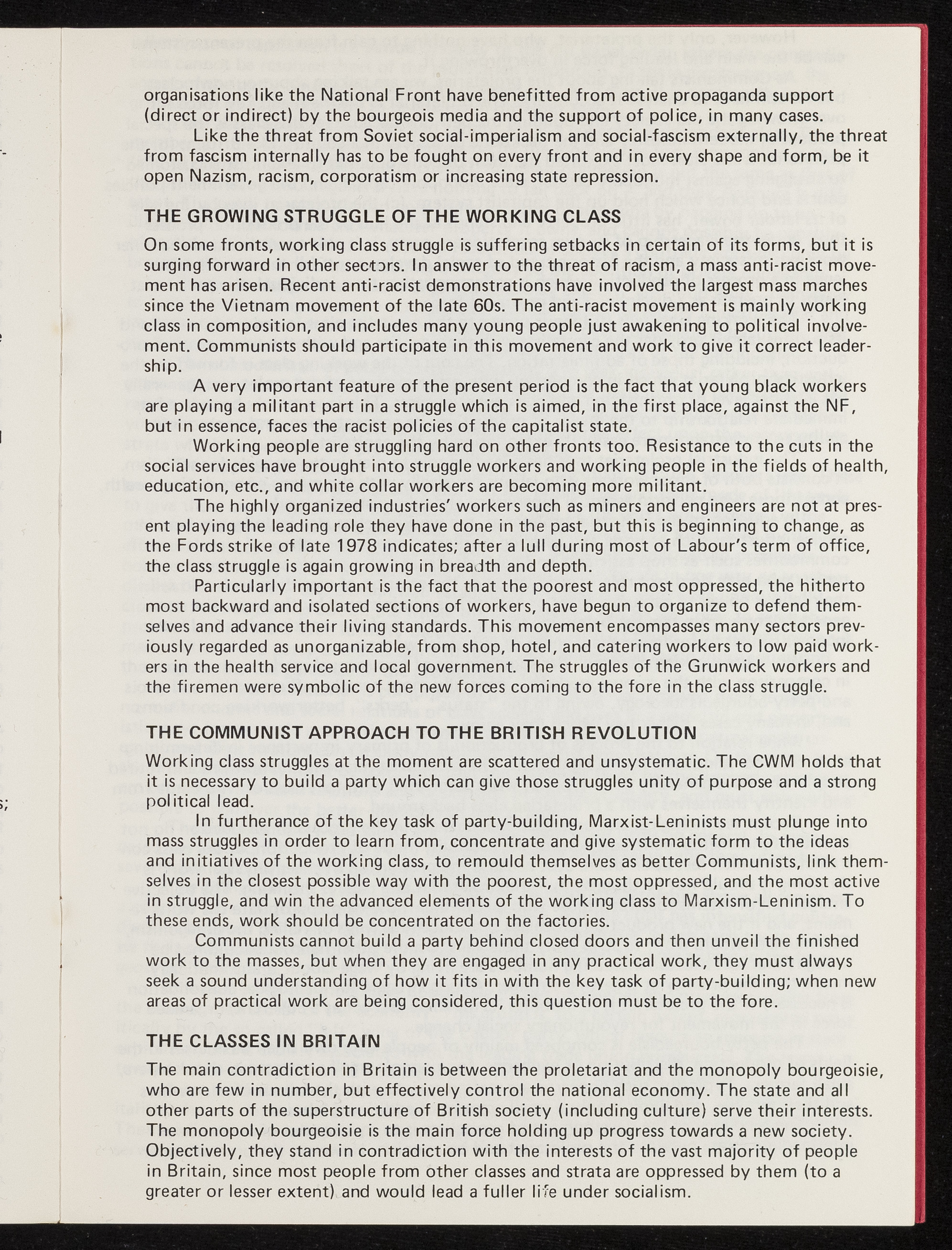
s; organisations like the National Front have benefitted from active propaganda support (direct or indirect) by the bourgeois media and the support of police, in many cases. Like the threat from Soviet social-imperialism and social-fascism externally, the threat from fascism internally has to be fought on every front and in every shape and form, be it open Nazism, racism, corporatism or increasing state repression. THE GROWING STRUGGLE OF THE WORKING CLASS On some fronts, working class struggle is suffering setbacks in certain of its forms, but it is surging forward in other sectors. In answer to the threat of racism, a mass anti-racist move- ment has arisen. Recent anti-racist demonstrations have involved the largest mass marches since the Vietnam movement of the late 60s. The anti-racist movement is mainly working class in composition, and includes many young people just awakening to political involve- ment. Communists should participate in this movement and work to give it correct leader- ship. A very important feature of the present period is the fact that young black workers are playing a militant part in a struggle which is aimed, in the first place, against the NF, but in essence, faces the racist policies of the capitalist state. Working people are struggling hard on other fronts too. Resistance to the cuts in the social services have brought into struggle workers and working people in the fields of health, education, etc., and white collar workers are becoming more militant. The highly organized industries' workers such as miners and engineers are not at pres- ent playing the leading role they have done in the past, but this is beginning to change, as the Fords strike of late 1978 indicates; after a lull during most of Labour's term of office, the class struggle is again growing in breadth and depth. Particularly important is the fact that the poorest and most oppressed, the hitherto most backward and isolated sections of workers, have begun to organize to defend them- selves and advance their living standards. This movement encompasses many sectors prev- iously regarded as unorganizable, from shop, hotel, and catering workers to low paid work- ers in the health service and local government. The struggles of the Grunwick workers and the firemen were symbolic of the new forces coming to the fore in the class struggle. THE COMMUNIST APPROACH TO THE BRITISH REVOLUTION Working class struggles at the moment are scattered and unsystematic. The CWM holds that it is necessary to build a party which can give those struggles unity of purpose and a strong political lead. In furtherance of the key task of party-building, Marxist-Leninists must plunge into mass struggles in order to learn from, concentrate and give systematic form to the ideas and initiatives of the working class, to remould themselves as better Communists, link them- selves in the closest possible way with the poorest, the most oppressed, and the most active in struggle, and win the advanced elements of the working class to Marxism-Leninism. To these ends, work should be concentrated on the factories. Communists cannot build a party behind closed doors and then unveil the finished work to the masses, but when they are engaged in any practical work, they must always seek a sound understanding of how it fits in with the key task of party-building; when new areas of practical work are being considered, this question must be to the fore. THE CLASSES IN BRITAIN The main contradiction in Britain is between the proletariat and the monopoly bourgeoisie, who are few in number, but effectively control the national economy. The state and all other parts of the superstructure of British society (including culture) serve their interests. The monopoly bourgeoisie is the main force holding up progress towards a new society. Objectively, they stand in contradiction with the interests of the vast majority of people in Britain, since most people from other classes and strata are oppressed by them (to a greater or lesser extent) and would lead a fuller life under socialism.
Appraisal, destruction and scheduling
Accruals
System of arrangement
Conditions of access and use area
Conditions governing access
Conditions governing reproduction
Language of material
Script of material
Language and script notes
Physical characteristics and technical requirements
Finding aids
Uploaded finding aid
Allied materials area
Existence and location of originals
full_reference_code