
Zone d'identification
Cote
Titre
Date(s)
Niveau de description
Étendue matérielle et support
1 digital image
Zone du contexte
Histoire archivistique
Source immédiate d'acquisition ou de transfert
Zone du contenu et de la structure
Portée et contenu
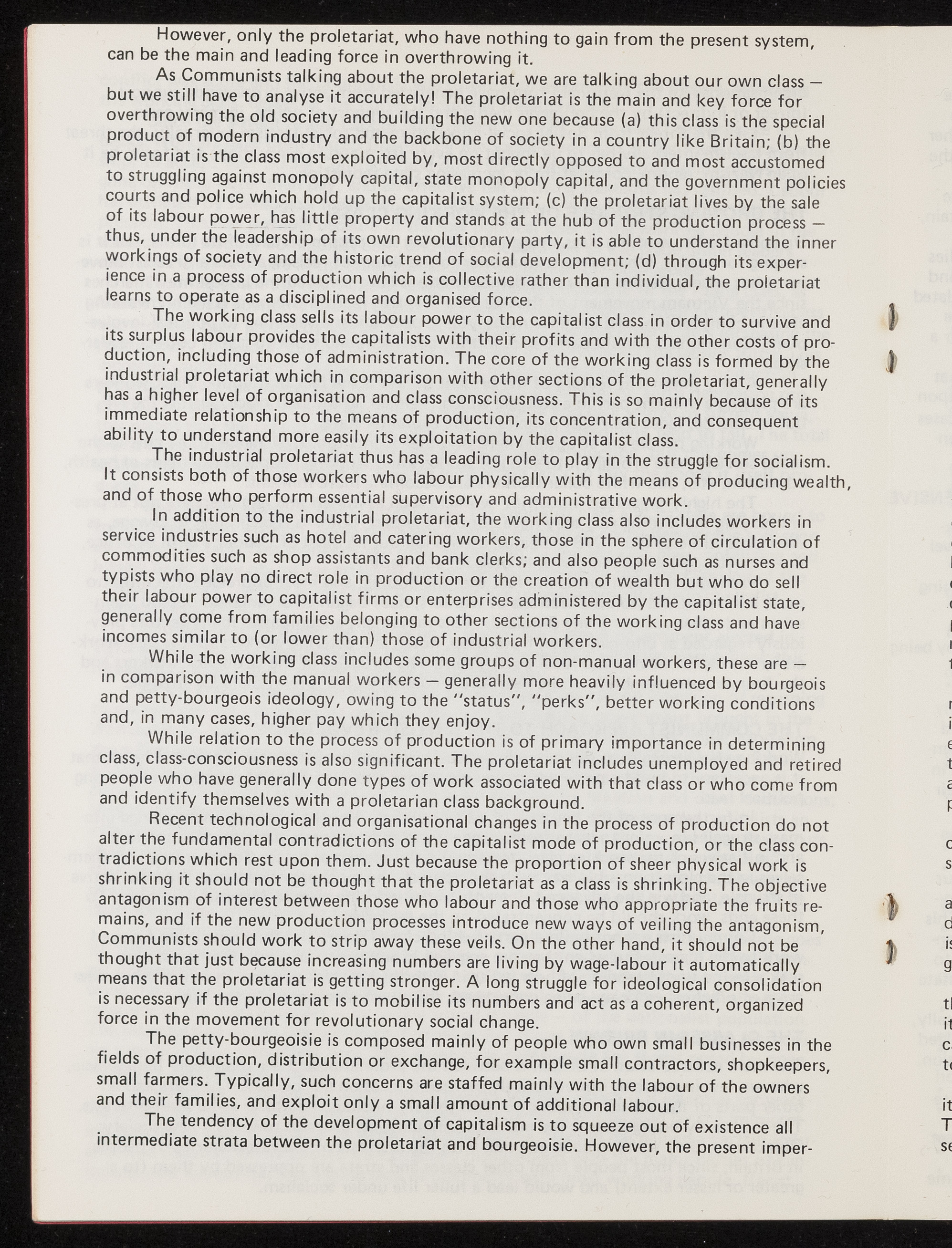
However, only the proletariat, who have nothing to gain from the present system, can be the main and leading force in overthrowing it. As Communists talking about the proletariat, we are talking about our own class — but we still have to analyse it accurately! The proletariat is the main and key force for overthrowing the old society and building the new one because (a) this class is the special product of modern industry and the backbone of society in a country like Britain; (b) the proletariat is the class most exploited by, most directly opposed to and most accustomed to struggling against monopoly capital, state monopoly capital, and the government policies courts and police which hold up the capitalist system; (c) the proletariat lives by the sale of its labour power, has little property and stands at the hub of the production process — thus, under the leadership of its own revolutionary party, it is able to understand the inner workings of society and the historic trend of social development; (d) through its exper- ience in a process of production which is collective rather than individual, the proletariat learns to operate as a disciplined and organised force. The working class sells its labour power to the capitalist class in order to survive and its surplus labour provides the capitalists with their profits and with the other costs of pro- duction, including those of administration. The core of the working class is formed by the industrial proletariat which in comparison with other sections of the proletariat, generally has a higher level of organisation and class consciousness. This is so mainly because of its immediate relationship to the means of production, its concentration, and consequent ability to understand more easily its exploitation by the capitalist class. The industrial proletariat thus has a leading role to play in the struggle for socialism. It consists both of those workers who labour physically with the means of producing wealth, and of those who perform essential supervisory and administrative work. In addition to the industrial proletariat, the working class also includes workers in service industries such as hotel and catering workers, those in the sphere of circulation of commodities such as shop assistants and bank clerks; and also people such as nurses and typists who play no direct role in production or the creation of wealth but who do sell their labour power to capitalist firms or enterprises administered by the capitalist state, generally come from families belonging to other sections of the working class and have incomes similar to (or lower than) those of industrial workers. While the working class includes some groups of non-manual workers, these are — in comparison with the manual workers — generally more heavily influenced by bourgeois and petty-bourgeois ideology, owing to the "status", "perks", better working conditions and, in many cases, higher pay which they enjoy. While relation to the process of production is of primary importance in determining class, class-consciousness is also significant. The proletariat includes unemployed and retired people who have generally done types of work associated with that class or who come from and identify themselves with a proletarian class background. Recent technological and organisational changes in the process of production do not alter the fundamental contradictions of the capitalist mode of production, or the class con- tradictions which rest upon them. Just because the proportion of sheer physical work is shrinking it should not be thought that the proletariat as a class is shrinking. The objective antagonism of interest between those who labour and those who appropriate the fruits re- mains, and if the new production processes introduce new ways of veiling the antagonism, Communists should work to strip away these veils. On the other hand, it should not be thought that just because increasing numbers are living by wage-labour it automatically means that the proletariat is getting stronger. A long struggle for ideological consolidation is necessary if the proletariat is to mobilise its numbers and act as a coherent, organized force in the movement for revolutionary social change. The petty-bourgeoisie is composed mainly of people who own small businesses in the fields of production, distribution or exchange, for example small contractors, shopkeepers, small farmers. Typically, such concerns are staffed mainly with the labour of the owners and their families, and exploit only a small amount of additional labour. The tendency of the development of capitalism is to squeeze out of existence all intermediate strata between the proletariat and bourgeoisie. However, the present imper- r i E t a d C S a C is g t it C to it T Se