
Identificatie
referentie code
Titel
Datum(s)
Beschrijvingsniveau
Omvang en medium
1 digital image
Context
Geschiedenis van het archief
Directe bron van verwerving of overbrenging
Inhoud en structuur
Bereik en inhoud
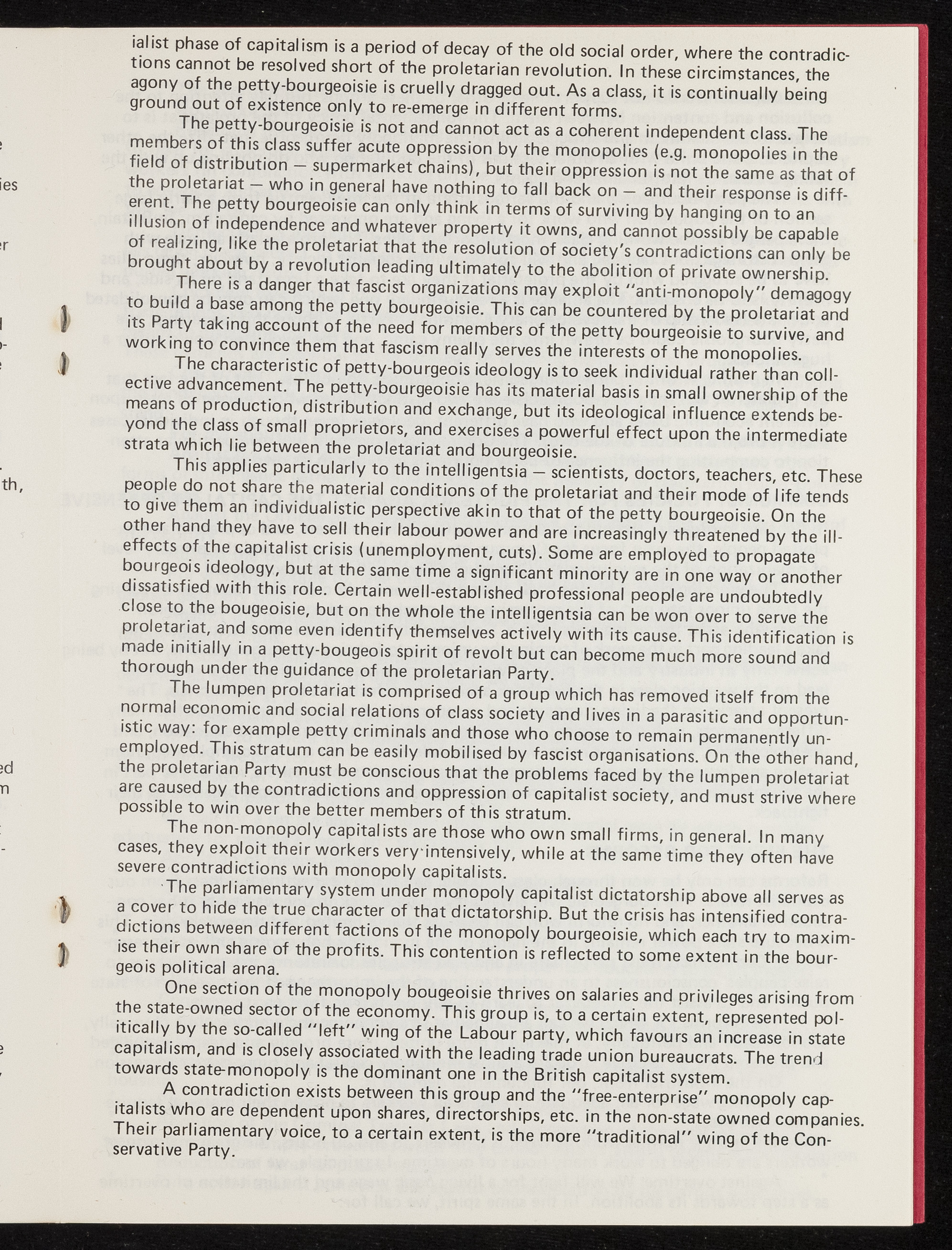
er er es - - th, ed ท 5 ialist phase of capitalism is a period of decay of the old social order, where the contradic- tions cannot be resolved short of the proletarian revolution. In these circimstances, the agony of the petty-bourgeoisie is cruelly dragged out. As a class, it is continually being ground out of existence only to re-emerge in different forms. The petty-bourgeoisie is not and cannot act as a coherent independent class. The members of this class suffer acute oppression by the monopolies (e.g. monopolies in the field of distribution — supermarket chains), but their oppression is not the same as that of the proletariat — who in general have nothing to fall back on — and their response is diff- erent. The petty bourgeoisie can only think in terms of surviving by hanging on to an illusion of independence and whatever property it owns, and cannot possibly be capable of realizing, like the proletariat that the resolution of society's contradictions can only be brought about by a revolution leading ultimately to the abolition of private ownership. There is a danger that fascist organizations may exploit "anti-monopoly" demagogy to build a base among the petty bourgeoisie. This can be countered by the proletariat and its Party taking account of the need for members of the petty bourgeoisie to survive, and working to convince them that fascism really serves the interests of the monopolies. The characteristic of petty-bourgeois ideology is to seek individual rather than coll- ective advancement. The petty-bourgeoisie has its material basis in small ownership of the means of production, distribution and exchange, but its ideological influence extends be- yond the class of small proprietors, and exercises a powerful effect upon the intermediate strata which lie between the proletariat and bourgeoisie. This applies particularly to the intelligentsia — scientists, doctors, teachers, etc. These people do not share the material conditions of the proletariat and their mode of life tends to give them an individualistic perspective akin to that of the petty bourgeoisie. On the other hand they have to sell their labour power and are increasingly threatened by the ill- effects of the capitalist crisis (unemployment, cuts). Some are employed to propagate bourgeois ideology, but at the same time a significant minority are in one way or another dissatisfied with this role. Certain well-established professional people are undoubtedly close to the bougeoisie, but on the whole the intelligentsia can be won over to serve the proletariat, and some even identify themselves actively with its cause. This identification is made initially in a petty-bougeois spirit of revolt but can become much more sound and thorough under the guidance of the proletarian Party. The lumpen proletariat is comprised of a group which has removed itself from the normal economic and social relations of class society and lives in a parasitic and opportun- istic way: for example petty criminals and those who choose to remain permanently un- employed. This stratum can be easily mobilised by fascist organisations. On the other hand, the proletarian Party must be conscious that the problems faced by the lumpen proletariat are caused by the contradictions and oppression of capitalist society, and must strive where possible to win over the better members of this stratum. The non-monopoly capitalists are those who own small firms, in general. In many cases, they exploit their workers very intensively, while at the same time they often have severe contradictions with monopoly capitalists. The parliamentary system under monopoly capitalist dictatorship above all serves as a cover to hide the true character of that dictatorship. But the crisis has intensified contra- dictions between different factions of the monopoly bourgeoisie, which each try to maxim- ise their own share of the profits. This contention is reflected to some extent in the bour- geois political arena. One section of the monopoly bougeoisie thrives on salaries and privileges arising from the state-owned sector of the economy. This group is, to a certain extent, represented pol- itically by the so-called "left" wing of the Labour party, which favours an increase in state capitalism, and is closely associated with the leading trade union bureaucrats. The trend towards state-monopoly is the dominant one in the British capitalist system. A contradiction exists between this group and the "free-enterprise" monopoly cap- italists who are dependent upon shares, directorships, etc. in the non-state owned companies. Their parliamentary voice, to a certain extent, is the more "traditional" wing of the Con- servative Party.
Waardering, vernietiging en slectie
Aanvullingen
Ordeningstelsel
Voorwaarden voor toegang en gebruik
Voorwaarden voor raadpleging
Voorwaarden voor reproductie
Taal van het materiaal
Schrift van het materiaal
Taal en schrift aantekeningen
Fysieke eigenschappen en technische eisen
Toegangen
Uploaded finding aid
Verwante materialen
Bestaan en verblifplaats van originelen
full_reference_code