
Identity area
Reference code
Title
Date(s)
Level of description
Extent and medium
1 digital image
Context area
Archival history
Immediate source of acquisition or transfer
Content and structure area
Scope and content
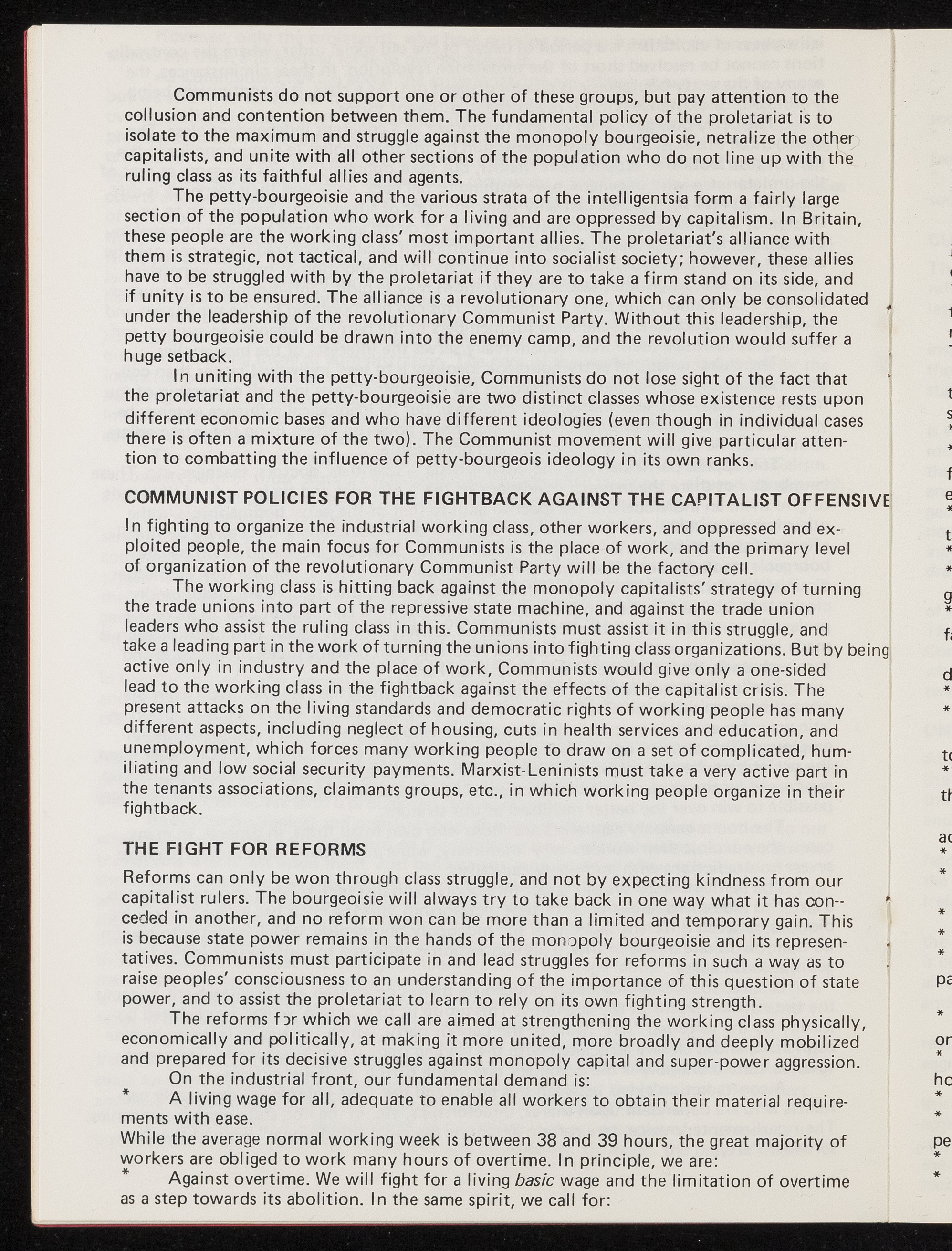
Communists do not support one or other of these groups, but pay attention to the collusion and contention between them. The fundamental policy of the proletariat is to isolate to the maximum and struggle against the monopoly bourgeoisie, netralize the other capitalists, and unite with all other sections of the population who do not line up with the ruling class as its faithful allies and agents. The petty-bourgeoisie and the various strata of the intelligentsia form a fairly large section of the population who work for a living and are oppressed by capitalism. In Britain, these people are the working class' most important allies. The proletariat's alliance with them is strategic, not tactical, and will continue into socialist society; however, these allies have to be struggled with by the proletariat if they are to take a firm stand on its side, and if unity is to be ensured. The alliance is a revolutionary one, which can only be consolidated under the leadership of the revolutionary Communist Party. Without this leadership, the petty bourgeoisie could be drawn into the enemy camp, and the revolution would suffer a huge setback. In uniting with the petty-bourgeoisie, Communists do not lose sight of the fact that the proletariat and the petty-bourgeoisie are two distinct classes whose existence rests upon different economic bases and who have different ideologies (even though in individual cases there is often a mixture of the two). The Communist movement will give particular atten- tion to combatting the influence of petty-bourgeois ideology in its own ranks. COMMUNIST POLICIES FOR THE FIGHTBACK AGAINST THE CAPITALIST OFFENSIVE In fighting to organize the industrial working class, other workers, and oppressed and ex- ploited people, the main focus for Communists is the place of work, and the primary level of organization of the revolutionary Communist Party will be the factory cell. The working class is hitting back against the monopoly capitalists' strategy of turning the trade unions into part of the repressive state machine, and against the trade union leaders who assist the ruling class in this. Communists must assist it in this struggle, and take a leading part in the work of turning the unions into fighting class organizations. But by being active only in industry and the place of work, Communists would give only a one-sided lead to the working class in the fightback against the effects of the capitalist crisis. The present attacks on the living standards and democratic rights of working people has many different aspects, including neglect of housing, cuts in health services and education, and unemployment, which forces many working people to draw on a set of complicated, hum- iliating and low social security payments. Marxist-Leninists must take a very active part in the tenants associations, claimants groups, etc., in which working people organize in their fightback. THE FIGHT FOR REFORMS Reforms can only be won through class struggle, and not by expecting kindness from our capitalist rulers. The bourgeoisie will always try to take back in one way what it has con-- ceded in another, and no reform won can be more than a limited and temporary gain. This is because state power remains in the hands of the monopoly bourgeoisie and its represen- tatives. Communists must participate in and lead struggles for reforms in such a way as to raise peoples' consciousness to an understanding of the importance of this question of state power, and to assist the proletariat to learn to rely on its own fighting strength. The reforms for which we call are aimed at strengthening the working class physically, economically and politically, at making it more united, more broadly and deeply mobilized and prepared for its decisive struggles against monopoly capital and super-power aggression. On the industrial front, our fundamental demand is: A living wage for all, adequate to enable all workers to obtain their material require- ments with ease. While the average normal working week is between 38 and 39 hours, the great majority of workers are obliged to work many hours of overtime. In principle, we are: Against overtime. We will fight for a living basic wage and the limitation of overtime as a step towards its abolition. In the same spirit, we call for: