
Identity area
Reference code
Title
Date(s)
Level of description
Extent and medium
1 digital image
Context area
Archival history
Immediate source of acquisition or transfer
Content and structure area
Scope and content
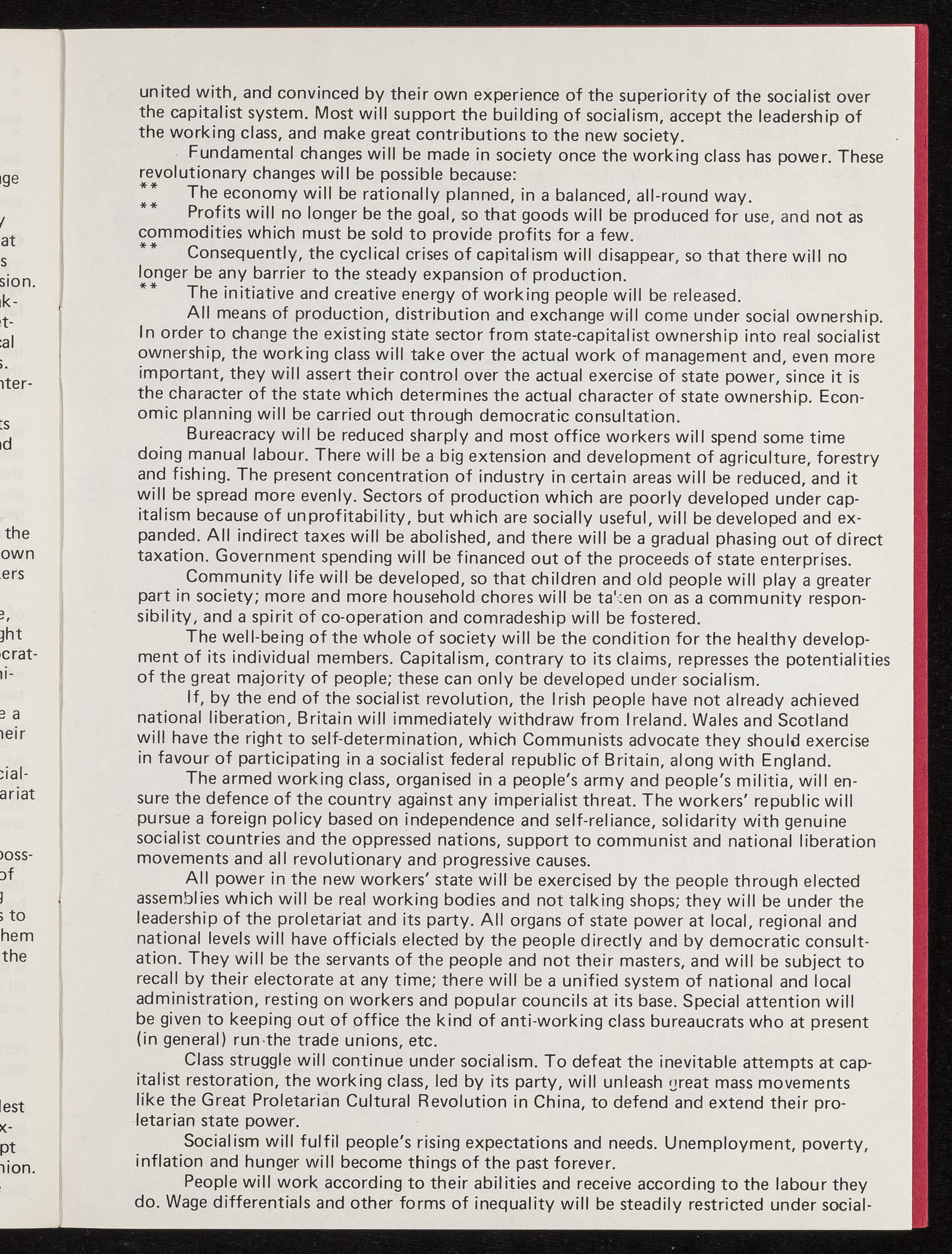
ge at S sion. k- et- cal S. nter- S d the own Cers e, ght crat- ni- ea neir cial- ariat DOSS- of E s to hem the lest x- pt nion. united with, and convinced by their own experience of the superiority of the socialist over the capitalist system. Most will support the building of socialism, accept the leadership of the working class, and make great contributions to the new society. Fundamental changes will be made in society once the working class has power. These revolutionary changes will be possible because: The economy will be rationally planned, in a balanced, all-round way. Profits will no longer be the goal, so that goods will be produced for use, and not as commodities which must be sold to provide profits for a few. Consequently, the cyclical crises of capitalism will disappear, so that there will no longer be any barrier to the steady expansion of production. The initiative and creative energy of working people will be released. All means of production, distribution and exchange will come under social ownership. In order to change the existing state sector from state-capitalist ownership into real socialist ownership, the working class will take over the actual work of management and, even more important, they will assert their control over the actual exercise of state power, since it is the character of the state which determines the actual character of state ownership. Econ- omic planning will be carried out through democratic consultation. Bureacracy will be reduced sharply and most office workers will spend some time doing manual labour. There will be a big extension and development of agriculture, forestry and fishing. The present concentration of industry in certain areas will be reduced, and it will be spread more evenly. Sectors of production which are poorly developed under cap- italism because of unprofitability, but which are socially useful, will be developed and ex- panded. All indirect taxes will be abolished, and there will be a gradual phasing out of direct taxation. Government spending will be financed out of the proceeds of state enterprises. Community life will be developed, so that children and old people will play a greater part in society; more and more household chores will be taken on as a community respon- sibility, and a spirit of co-operation and comradeship will be fostered. The well-being of the whole of society will be the condition for the healthy develop- ment of its individual members. Capitalism, contrary to its claims, represses the potentialities of the great majority of people; these can only be developed under socialism. If, by the end of the socialist revolution, the Irish people have not already achieved national liberation, Britain will immediately withdraw from Ireland. Wales and Scotland will have the right to self-determination, which Communists advocate they should exercise in favour of participating in a socialist federal republic of Britain, along with England. The armed working class, organised in a people's army and people's militia, will en- sure the defence of the country against any imperialist threat. The workers' republic will pursue a foreign policy based on independence and self-reliance, solidarity with genuine socialist countries and the oppressed nations, support to communist and national liberation movements and all revolutionary and progressive causes. All power in the new workers' state will be exercised by the people through elected assemblies which will be real working bodies and not talking shops; they will be under the leadership of the proletariat and its party. All organs of state power at local, regional and national levels will have officials elected by the people directly and by democratic consult- ation. They will be the servants of the people and not their masters, and will be subject to recall by their electorate at any time; there will be a unified system of national and local administration, resting on workers and popular councils at its base. Special attention will be given to keeping out of office the kind of anti-working class bureaucrats who at present (in general) run the trade unions, etc. Class struggle will continue under socialism. To defeat the inevitable attempts at cap- italist restoration, the working class, led by its party, will unleash great mass movements like the Great Proletarian Cultural Revolution in China, to defend and extend their pro- letarian state power. Socialism will fulfil people's rising expectations and needs. Unemployment, poverty, inflation and hunger will become things of the past forever. People will work according to their abilities and receive according to the labour they do. Wage differentials and other forms of inequality will be steadily restricted under social-