
Identificatie
referentie code
Titel
Datum(s)
Beschrijvingsniveau
Omvang en medium
1 digital image
Context
Naam van de archiefvormer
Geschiedenis van het archief
Directe bron van verwerving of overbrenging
Inhoud en structuur
Bereik en inhoud
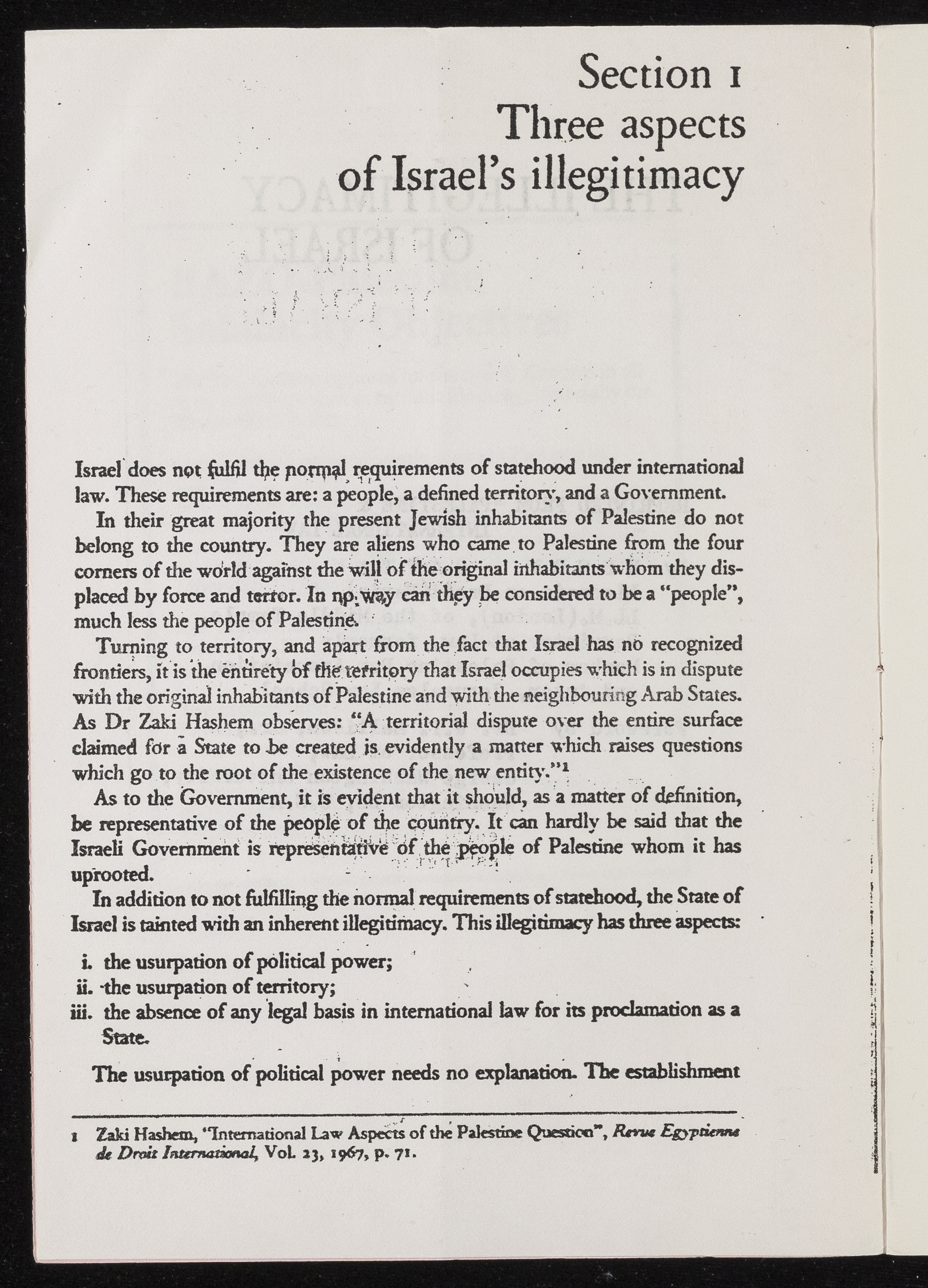
Section I Three aspects of Israel's illegitimacy Israel does not fulfil the normal requirements of statehood under international law. These requirements are: a people, a defined territory, and a Government. In their great majority the present Jewish inhabitants of Palestine do not belong to the country. They are aliens who came to Palestine from the four corners of the world against the will of the original inhabitants whom they dis- placed by force and terror. In no way can they be considered to be a "people", much less the people of Palestine. Turning to territory, and apart from the fact that Israel has no recognized frontiers, it is the entirety of the territory that Israel occupies which is in dispute with the original inhabitants of Palestine and with the neighbouring Arab States. As Dr Zaki Hashem observes: "A territorial dispute over the entire surface claimed for a State to be created is evidently a matter which raises questions which go to the root of the existence of the new entity."¹ As to the Government, it is evident that it should, as a matter of definition, be representative of the people of the country. It can hardly be said that the Israeli Government is representative of the people of Palestine whom it has uprooted. In addition to not fulfilling the normal requirements of statehood, the State of Israel is tainted with an inherent illegitimacy. This illegitimacy has three aspects: i. the usurpation of political power; ii. the usurpation of territory; iii. the absence of any legal basis in international law for its proclamation as a State. The usurpation of political power needs no explanation. The establishment 1 Zaki Hashem, "International Law Aspects of the Palestine Question", Revue Egyptienne de Droit International, Vol. 23, 1967, p. 71.