
Identity area
Reference code
Title
Date(s)
Level of description
Extent and medium
1 digital image
Context area
Name of creator
Archival history
Immediate source of acquisition or transfer
Content and structure area
Scope and content
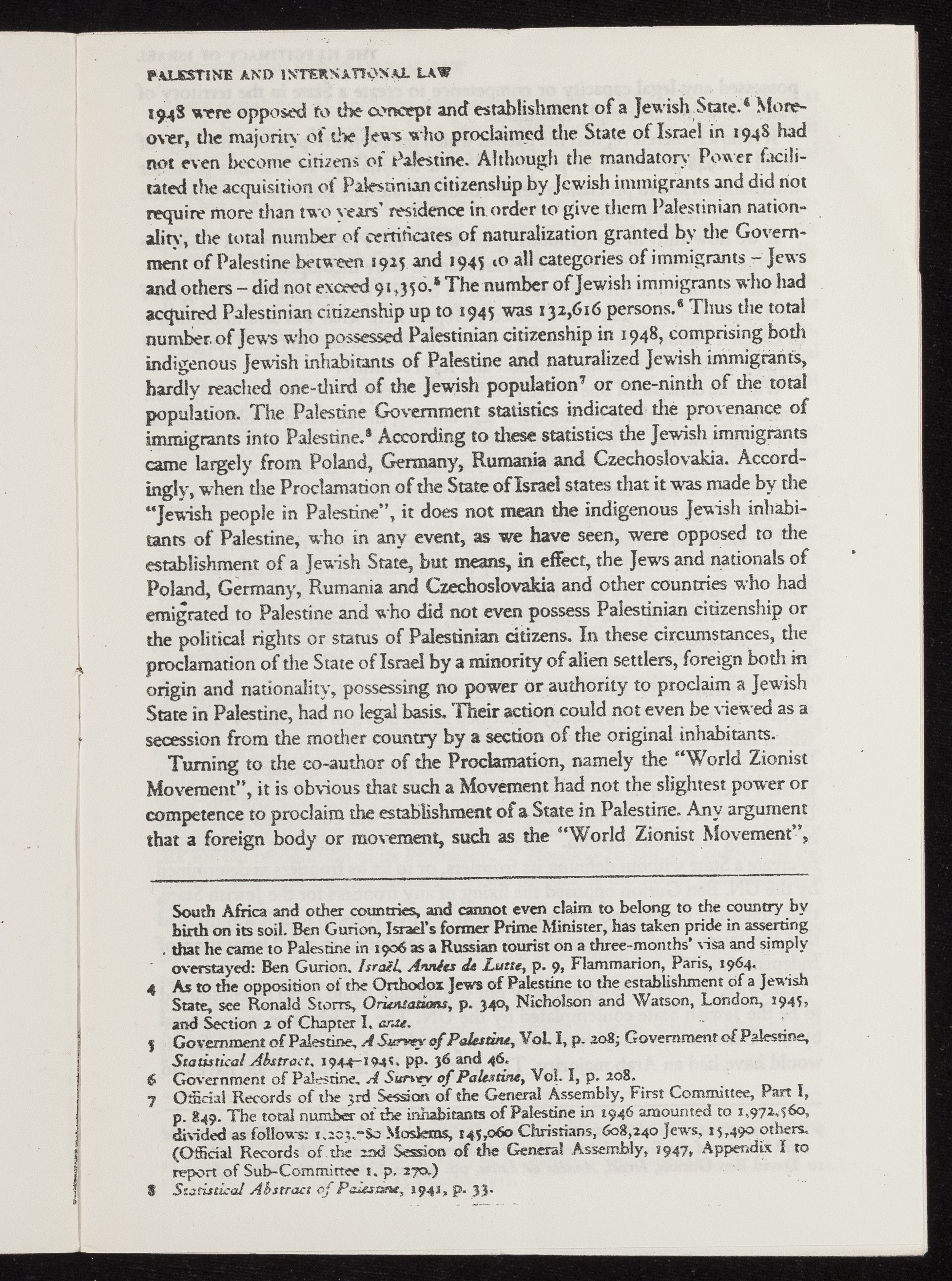
PALESTINE AND INTERNATIONAL LAW 1948 were opposed to the concept and establishment of a Jewish State.⁴ More- over, the majority of the Jews who proclaimed the State of Israel in 1948 had not even become citizens of Palestine. Although the mandatory Power facili- tated the acquisition of Palestinian citizenship by Jewish immigrants and did not require more than two years' residence in order to give them Palestinian nation- ality, the total number of certificates of naturalization granted by the Govern- ment of Palestine between 1925 and 1945 to all categories of immigrants – Jews and others – did not exceed 91,350.⁵ The number of Jewish immigrants who had acquired Palestinian citizenship up to 1945 was 132,616 persons.⁶ Thus the total number of Jews who possessed Palestinian citizenship in 1948, comprising both indigenous Jewish inhabitants of Palestine and naturalized Jewish immigrants, hardly reached one-third of the Jewish population⁷ or one-ninth of the total population. The Palestine Government statistics indicated the provenance of immigrants into Palestine.⁸ According to these statistics the Jewish immigrants came largely from Poland, Germany, Rumania and Czechoslovakia. Accord- ingly, when the Proclamation of the State of Israel states that it was made by the "Jewish people in Palestine", it does not mean the indigenous Jewish inhabi- tants of Palestine, who in any event, as we have seen, were opposed to the establishment of a Jewish State, but means, in effect, the Jews and nationals of Poland, Germany, Rumania and Czechoslovakia and other countries who had emigrated to Palestine and who did not even possess Palestinian citizenship or the political rights or status of Palestinian citizens. In these circumstances, the proclamation of the State of Israel by a minority of alien settlers, foreign both in origin and nationality, possessing no power or authority to proclaim a Jewish State in Palestine, had no legal basis. Their action could not even be viewed as a secession from the mother country by a section of the original inhabitants. Turning to the co-author of the Proclamation, namely the "World Zionist Movement", it is obvious that such a Movement had not the slightest power or competence to proclaim the establishment of a State in Palestine. Any argument that a foreign body or movement, such as the "World Zionist Movement", South Africa and other countries, and cannot even claim to belong to the country by birth on its soil. Ben Gurion, Israel's former Prime Minister, has taken pride in asserting that he came to Palestine in 1906 as a Russian tourist on a three-months' visa and simply overstayed: Ben Gurion, Israël, Années de Lutte, p. 9, Flammarion, Paris, 1964. 4 As to the opposition of the Orthodox Jews of Palestine to the establishment of a Jewish State, see Ronald Storrs, Orientations, p. 340, Nicholson and Watson, London, 1945, and Section 2 of Chapter I, ante. 5 Government of Palestine, A Survey of Palestine, Vol. I, p. 208; Government of Palestine, Statistical Abstract, 1944–1945, pp. 36 and 46. 6 Government of Palestine, A Survey of Palestine, Vol. I, p. 208. 7 Official Records of the 3rd Session of the General Assembly, First Committee, Part I, p. 849. The total number of the inhabitants of Palestine in 1946 amounted to 1,972,560, divided as follows: 1,203,850 Moslems, 145,060 Christians, 608,240 Jews, 15,490 others. (Official Records of the 2nd Session of the General Assembly, 1947, Appendix I to report of Sub-Committee 1, p. 270.) 8 Statistical Abstract of Palestine, 1941, p. 33.
Appraisal, destruction and scheduling
Accruals
System of arrangement
Conditions of access and use area
Conditions governing access
Conditions governing reproduction
Language of material
Script of material
Language and script notes
Physical characteristics and technical requirements
Finding aids
Uploaded finding aid
Allied materials area
Existence and location of originals
full_reference_code