
Identity area
Reference code
Title
Date(s)
Level of description
Extent and medium
1 digital image
Context area
Name of creator
Archival history
Immediate source of acquisition or transfer
Content and structure area
Scope and content
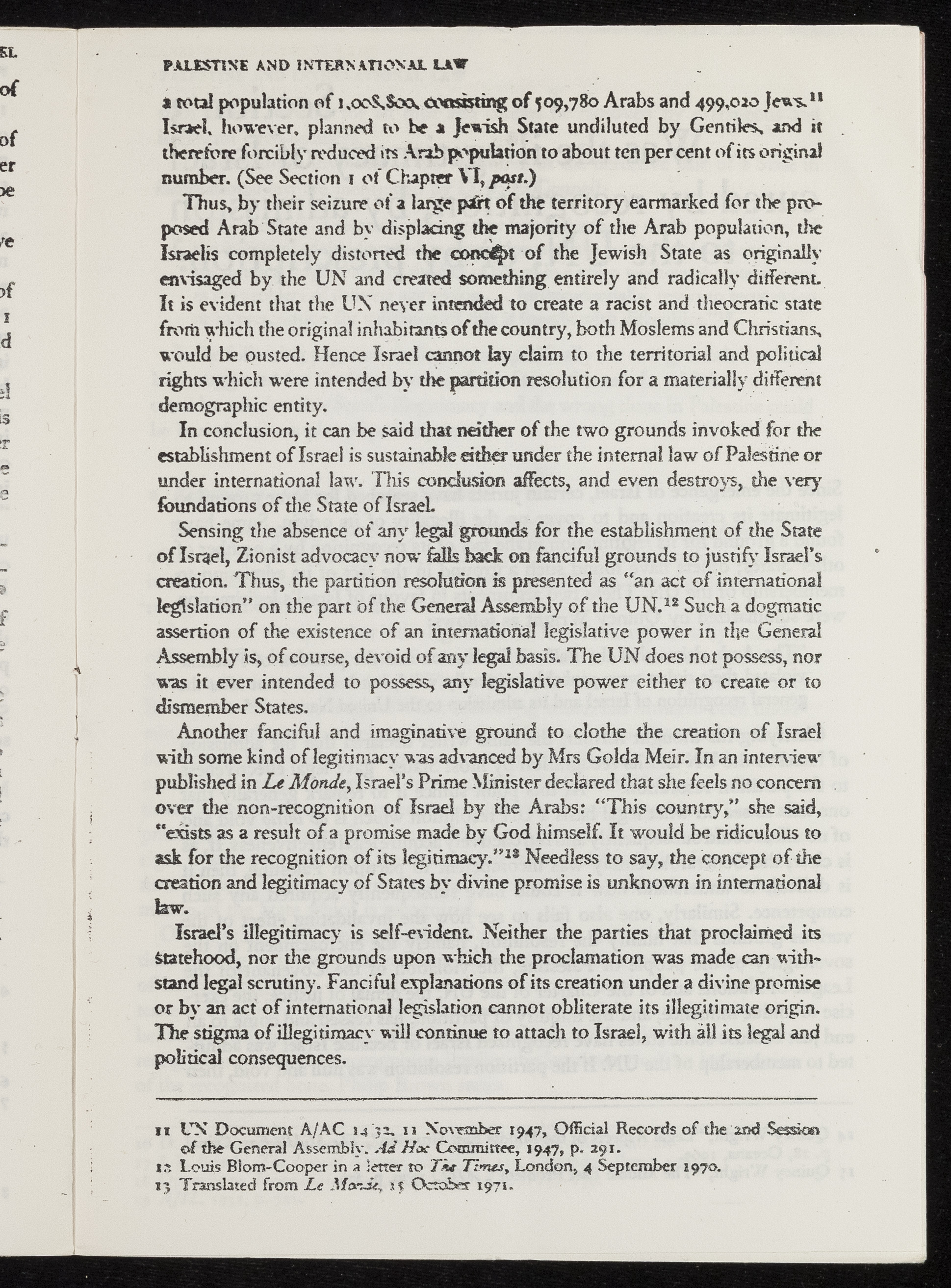
EL of of er De re of d el S r e e 3 f E 1 PALESTINE AND INTERNATIONAL LAW a total population of 1,008,500, consisting of 509,780 Arabs and 499,020 Jews.¹¹ Israel, however, planned to be a Jewish State undiluted by Gentiles, and it therefore forcibly reduced its Arab population to about ten per cent of its original number. (See Section 1 of Chapter VI, post.) Thus, by their seizure of a large part of the territory earmarked for the pro- posed Arab State and by displacing the majority of the Arab population, the Israelis completely distorted the concept of the Jewish State as originally envisaged by the UN and created something entirely and radically different. It is evident that the UN never intended to create a racist and theocratic state from which the original inhabitants of the country, both Moslems and Christians, would be ousted. Hence Israel cannot lay claim to the territorial and political rights which were intended by the partition resolution for a materially different demographic entity. In conclusion, it can be said that neither of the two grounds invoked for the establishment of Israel is sustainable either under the internal law of Palestine or under international law. This conclusion affects, and even destroys, the very foundations of the State of Israel. Sensing the absence of any legal grounds for the establishment of the State of Israel, Zionist advocacy now falls back on fanciful grounds to justify Israel's creation. Thus, the partition resolution is presented as "an act of international legislation" on the part of the General Assembly of the UN.¹² Such a dogmatic assertion of the existence of an international legislative power in the General Assembly is, of course, devoid of any legal basis. The UN does not possess, nor was it ever intended to possess, any legislative power either to create or to dismember States. Another fanciful and imaginative ground to clothe the creation of Israel with some kind of legitimacy was advanced by Mrs Golda Meir. In an interview published in Le Monde, Israel's Prime Minister declared that she feels no concern over the non-recognition of Israel by the Arabs: "This country," she said, "exists as a result of a promise made by God himself. It would be ridiculous to ask for the recognition of its legitimacy."¹³ Needless to say, the concept of the creation and legitimacy of States by divine promise is unknown in international law. Israel's illegitimacy is self-evident. Neither the parties that proclaimed its statehood, nor the grounds upon which the proclamation was made can with- stand legal scrutiny. Fanciful explanations of its creation under a divine promise or by an act of international legislation cannot obliterate its illegitimate origin. The stigma of illegitimacy will continue to attach to Israel, with all its legal and political consequences. ¹¹ UN Document A/AC 14/32, 11 November 1947, Official Records of the 2nd Session of the General Assembly. Ad Hoc Committee, 1947, p. 291. ¹² Louis Blom-Cooper in a letter to The Times, London, 4 September 1970. ¹³ Translated from Le Monde, 15 October 1971.
Appraisal, destruction and scheduling
Accruals
System of arrangement
Conditions of access and use area
Conditions governing access
Conditions governing reproduction
Language of material
Script of material
Language and script notes
Physical characteristics and technical requirements
Finding aids
Uploaded finding aid
Allied materials area
Existence and location of originals
full_reference_code