
Identity area
Reference code
Title
Date(s)
Level of description
Extent and medium
1 digital image
Context area
Name of creator
Archival history
Immediate source of acquisition or transfer
Content and structure area
Scope and content
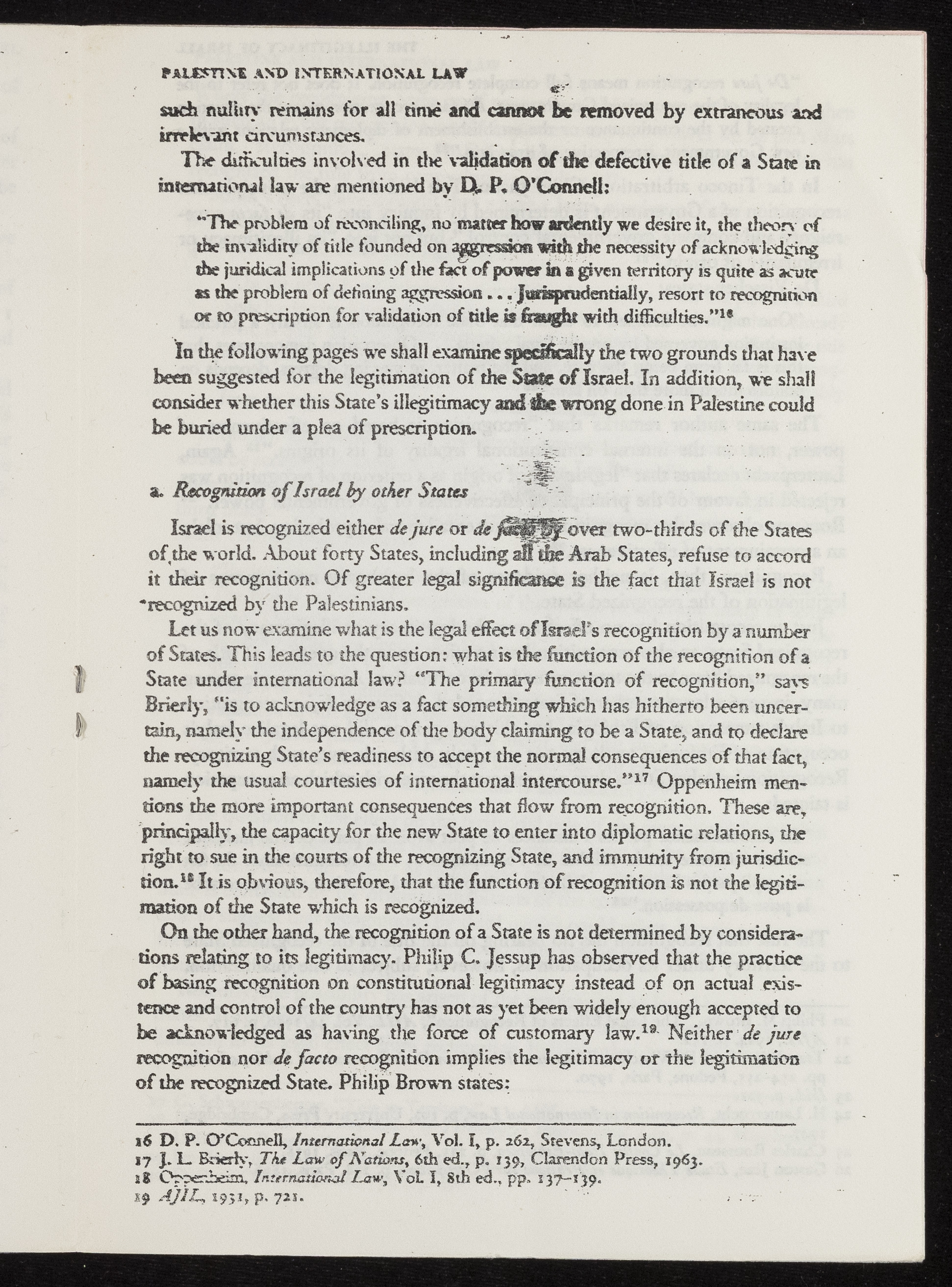
PALESTINE AND INTERNATIONAL LAW such nullity remains for all time and cannot be removed by extraneous and irrelevant circumstances. The difficulties involved in the validation of the defective title of a State in international law are mentioned by D. P. O'Connell: "The problem of reconciling, no matter how ardently we desire it, the theory of the invalidity of title founded on aggression with the necessity of acknowledging the juridical implications of the fact of power in a given territory is quite as acute as the problem of defining aggression... Jurisprudentially, resort to recognition or to prescription for validation of title is fraught with difficulties."¹⁶ In the following pages we shall examine specifically the two grounds that have been suggested for the legitimation of the State of Israel. In addition, we shall consider whether this State's illegitimacy and the wrong done in Palestine could be buried under a plea of prescription. a. Recognition of Israel by other States Israel is recognized either de jure or de facto by over two-thirds of the States of the world. About forty States, including all the Arab States, refuse to accord it their recognition. Of greater legal significance is the fact that Israel is not *recognized by the Palestinians. Let us now examine what is the legal effect of Israel's recognition by a number of States. This leads to the question: what is the function of the recognition of a State under international law? "The primary function of recognition," says Brierly, "is to acknowledge as a fact something which has hitherto been uncer- tain, namely the independence of the body claiming to be a State, and to declare the recognizing State's readiness to accept the normal consequences of that fact, namely the usual courtesies of international intercourse."¹⁷ Oppenheim men- tions the more important consequences that flow from recognition. These are, principally, the capacity for the new State to enter into diplomatic relations, the right to sue in the courts of the recognizing State, and immunity from jurisdic- tion.¹⁸ It is obvious, therefore, that the function of recognition is not the legiti- mation of the State which is recognized. On the other hand, the recognition of a State is not determined by considera- tions relating to its legitimacy. Philip C. Jessup has observed that the practice of basing recognition on constitutional legitimacy instead of on actual exis- tence and control of the country has not as yet been widely enough accepted to be acknowledged as having the force of customary law.¹⁹ Neither de jure recognition nor de facto recognition implies the legitimacy or the legitimation of the recognized State. Philip Brown states: ¹⁶ D. P. O'Connell, International Law, Vol. I, p. 262, Stevens, London. ¹⁷ J. L. Brierly, The Law of Nations, 6th ed., p. 139, Clarendon Press, 1963. ¹⁸ Oppenheim, International Law, Vol. I, 8th ed., pp. 137-139. ¹⁹ AJIL, 1931, p. 721.
Appraisal, destruction and scheduling
Accruals
System of arrangement
Conditions of access and use area
Conditions governing access
Conditions governing reproduction
Language of material
Script of material
Language and script notes
Physical characteristics and technical requirements
Finding aids
Uploaded finding aid
Allied materials area
Existence and location of originals
full_reference_code