
Identity area
Reference code
Title
Date(s)
Level of description
Extent and medium
1 digital image
Context area
Name of creator
Archival history
Immediate source of acquisition or transfer
Content and structure area
Scope and content
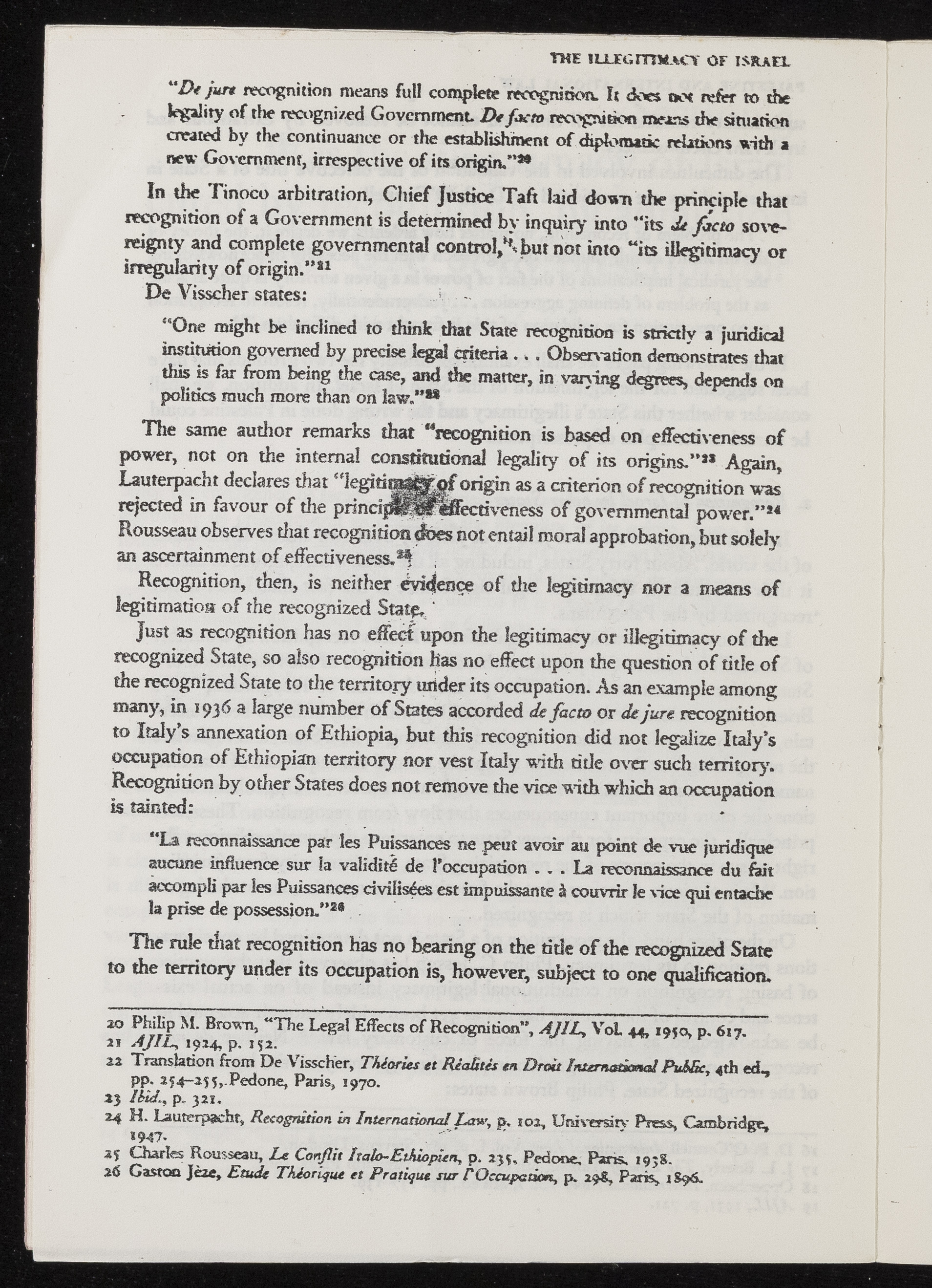
THE ILLEGITIMACY OF ISRAEL "De jure recognition means full complete recognition. It does not refer to the legality of the recognized Government. De facto recognition means the situation created by the continuance or the establishment of diplomatic relations with a new Government, irrespective of its origin."20 In the Tinoco arbitration, Chief Justice Taft laid down the principle that recognition of a Government is determined by inquiry into "its de facto sove- reignty and complete governmental control," but not into "its illegitimacy or irregularity of origin."21 De Visscher states: "One might be inclined to think that State recognition is strictly a juridical institution governed by precise legal criteria . . . Observation demonstrates that this is far from being the case, and the matter, in varying degrees, depends on politics much more than on law."22 The same author remarks that "recognition is based on effectiveness of power, not on the internal constitutional legality of its origins."23 Again, Lauterpacht declares that "legitimacy of origin as a criterion of recognition was rejected in favour of the principle of effectiveness of governmental power."24 Rousseau observes that recognition does not entail moral approbation, but solely an ascertainment of effectiveness.25 Recognition, then, is neither evidence of the legitimacy nor a means of legitimation of the recognized State. Just as recognition has no effect upon the legitimacy or illegitimacy of the recognized State, so also recognition has no effect upon the question of title of the recognized State to the territory under its occupation. As an example among many, in 1936 a large number of States accorded de facto or de jure recognition to Italy's annexation of Ethiopia, but this recognition did not legalize Italy's occupation of Ethiopian territory nor vest Italy with title over such territory. Recognition by other States does not remove the vice with which an occupation is tainted: "La reconnaissance par les Puissances ne peut avoir au point de vue juridique aucune influence sur la validité de l'occupation . . . La reconnaissance du fait accompli par les Puissances civilisées est impuissante à couvrir le vice qui entache la prise de possession."26 The rule that recognition has no bearing on the title of the recognized State to the territory under its occupation is, however, subject to one qualification. 20 Philip M. Brown, "The Legal Effects of Recognition", AJIL, Vol. 44, 1950, p. 617. 21 AJIL, 1924, p. 152. 22 Translation from De Visscher, Théories et Réalités en Droit International Public, 4th ed., pp. 254-255, Pedone, Paris, 1970. 23 Ibid., p. 321. 24 H. Lauterpacht, Recognition in International Law, p. 102, University Press, Cambridge, 1947. 25 Charles Rousseau, Le Conflit Italo-Ethiopien, p. 235, Pedone, Paris, 1938. 26 Gaston Jèze, Etude Théorique et Pratique sur l'Occupation, p. 298, Paris, 1896.
Appraisal, destruction and scheduling
Accruals
System of arrangement
Conditions of access and use area
Conditions governing access
Conditions governing reproduction
Language of material
Script of material
Language and script notes
Physical characteristics and technical requirements
Finding aids
Uploaded finding aid
Allied materials area
Existence and location of originals
full_reference_code