
Identity area
Reference code
Title
Date(s)
Level of description
Extent and medium
1 digital image
Context area
Name of creator
Archival history
Immediate source of acquisition or transfer
Content and structure area
Scope and content
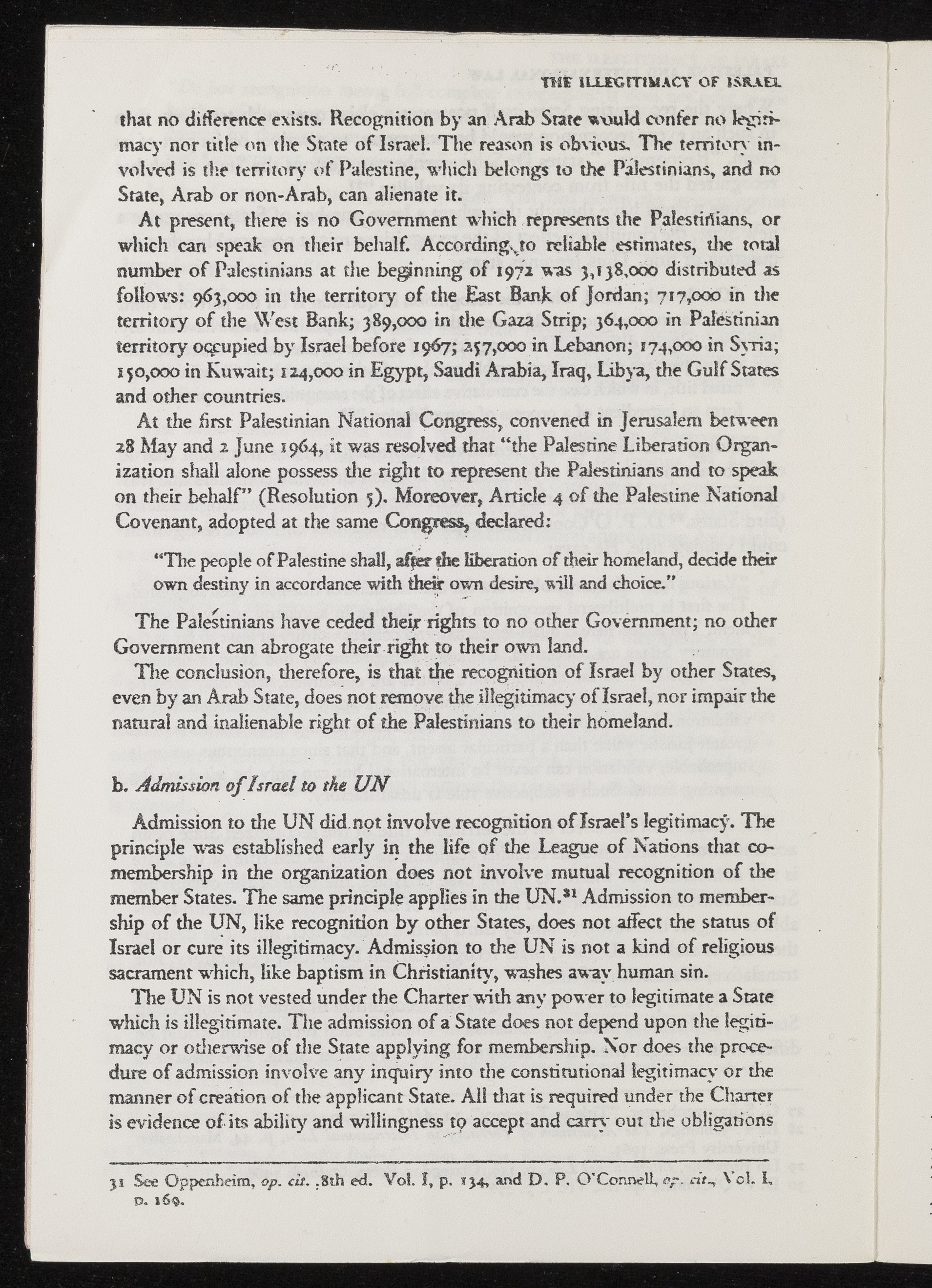
THE ILLEGITIMACY OF ISRAEL that no difference exists. Recognition by an Arab State would confer no legiti- macy nor title on the State of Israel. The reason is obvious. The territory in- volved is the territory of Palestine, which belongs to the Palestinians, and no State, Arab or non-Arab, can alienate it. At present, there is no Government which represents the Palestinians, or which can speak on their behalf. According to reliable estimates, the total number of Palestinians at the beginning of 1972 was 3,138,000 distributed as follows: 963,000 in the territory of the East Bank of Jordan; 717,000 in the territory of the West Bank; 389,000 in the Gaza Strip; 364,000 in Palestinian territory occupied by Israel before 1967; 257,000 in Lebanon; 174,000 in Syria; 150,000 in Kuwait; 124,000 in Egypt, Saudi Arabia, Iraq, Libya, the Gulf States and other countries. At the first Palestinian National Congress, convened in Jerusalem between 28 May and 2 June 1964, it was resolved that "the Palestine Liberation Organ- ization shall alone possess the right to represent the Palestinians and to speak on their behalf" (Resolution 5). Moreover, Article 4 of the Palestine National Covenant, adopted at the same Congress, declared: "The people of Palestine shall, after the liberation of their homeland, decide their own destiny in accordance with their own desire, will and choice." The Palestinians have ceded their rights to no other Government; no other Government can abrogate their right to their own land. The conclusion, therefore, is that the recognition of Israel by other States, even by an Arab State, does not remove the illegitimacy of Israel, nor impair the natural and inalienable right of the Palestinians to their homeland. b. Admission of Israel to the UN Admission to the UN did not involve recognition of Israel's legitimacy. The principle was established early in the life of the League of Nations that co- membership in the organization does not involve mutual recognition of the member States. The same principle applies in the UN. ³¹ Admission to member- ship of the UN, like recognition by other States, does not affect the status of Israel or cure its illegitimacy. Admission to the UN is not a kind of religious sacrament which, like baptism in Christianity, washes away human sin. The UN is not vested under the Charter with any power to legitimate a State which is illegitimate. The admission of a State does not depend upon the legiti- macy or otherwise of the State applying for membership. Nor does the proce- dure of admission involve any inquiry into the constitutional legitimacy or the manner of creation of the applicant State. All that is required under the Charter is evidence of its ability and willingness to accept and carry out the obligations ³¹ See Oppenheim, op. cit., 8th ed. Vol. I, p. 134, and D. P. O'Connell, op. cit., Vol. I, p. 169.
Appraisal, destruction and scheduling
Accruals
System of arrangement
Conditions of access and use area
Conditions governing access
Conditions governing reproduction
Language of material
Script of material
Language and script notes
Physical characteristics and technical requirements
Finding aids
Uploaded finding aid
Allied materials area
Existence and location of originals
full_reference_code