
Identity area
Reference code
Title
Date(s)
Level of description
Extent and medium
1 digital image
Context area
Name of creator
Archival history
Immediate source of acquisition or transfer
Content and structure area
Scope and content
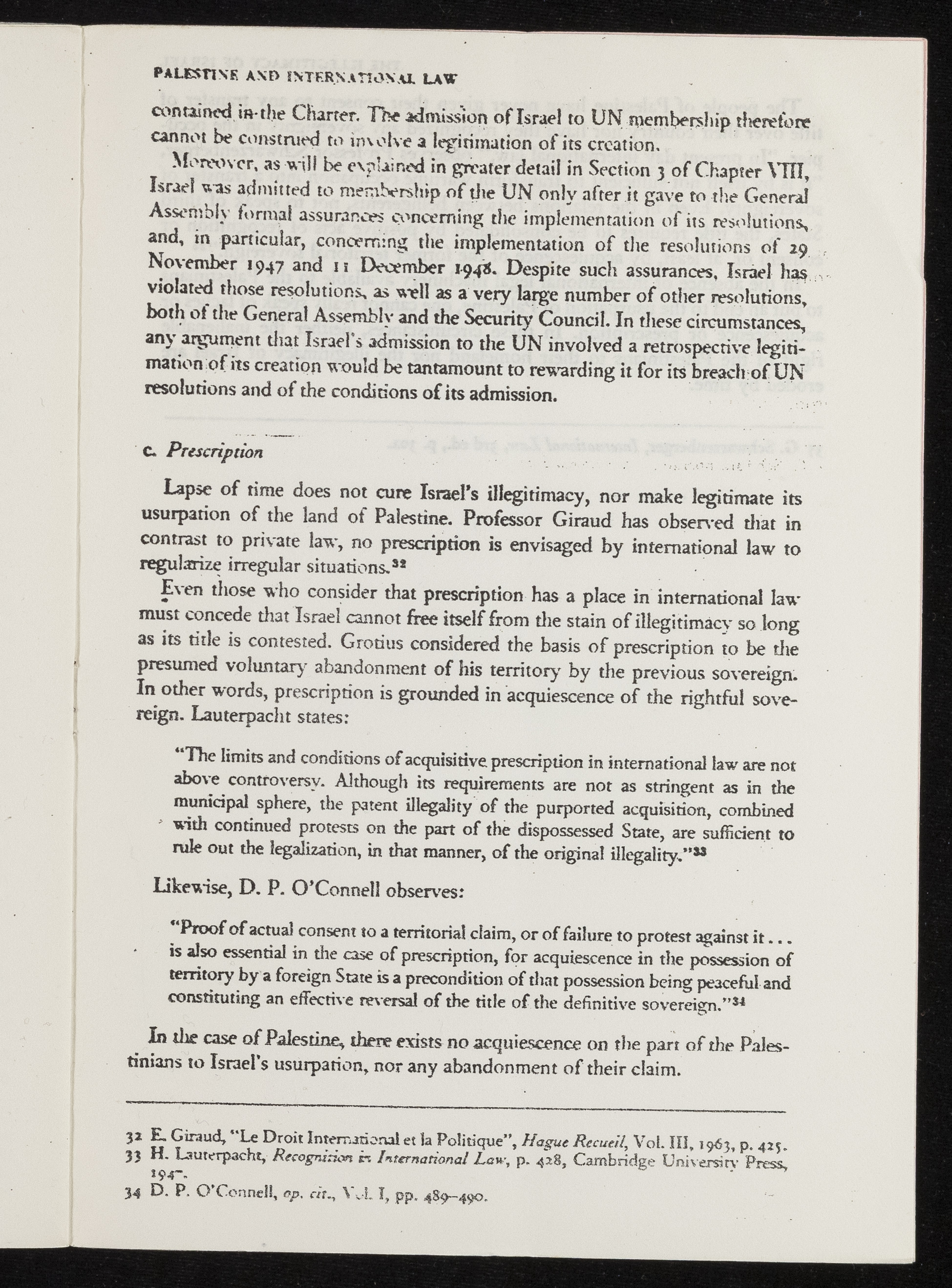
PALESTINE AND INTERNATIONAL LAW contained in the Charter. The admission of Israel to UN membership therefore cannot be construed to involve a legitimation of its creation. Moreover, as will be explained in greater detail in Section 3 of Chapter VIII, Israel was admitted to membership of the UN only after it gave to the General Assembly formal assurances concerning the implementation of its resolutions, and, in particular, concerning the implementation of the resolutions of 29 November 1947 and 11 December 1948. Despite such assurances, Israel has violated those resolutions, as well as a very large number of other resolutions, both of the General Assembly and the Security Council. In these circumstances, any argument that Israel's admission to the UN involved a retrospective legiti- mation of its creation would be tantamount to rewarding it for its breach of UN resolutions and of the conditions of its admission. c. Prescription Lapse of time does not cure Israel's illegitimacy, nor make legitimate its usurpation of the land of Palestine. Professor Giraud has observed that in contrast to private law, no prescription is envisaged by international law to regularize irregular situations.32 Even those who consider that prescription has a place in international law must concede that Israel cannot free itself from the stain of illegitimacy so long as its title is contested. Grotius considered the basis of prescription to be the presumed voluntary abandonment of his territory by the previous sovereign. In other words, prescription is grounded in acquiescence of the rightful sove- reign. Lauterpacht states: "The limits and conditions of acquisitive prescription in international law are not above controversy. Although its requirements are not as stringent as in the municipal sphere, the patent illegality of the purported acquisition, combined with continued protests on the part of the dispossessed State, are sufficient to rule out the legalization, in that manner, of the original illegality."33 Likewise, D. P. O'Connell observes: "Proof of actual consent to a territorial claim, or of failure to protest against it . . . is also essential in the case of prescription, for acquiescence in the possession of territory by a foreign State is a precondition of that possession being peaceful and constituting an effective reversal of the title of the definitive sovereign."34 In the case of Palestine, there exists no acquiescence on the part of the Pales- tinians to Israel's usurpation, nor any abandonment of their claim. 32 E. Giraud, "Le Droit International et la Politique", Hague Recueil, Vol. III, 1963, p. 425. 33 H. Lauterpacht, Recognition in International Law, p. 428, Cambridge University Press, 1947. 34 D. P. O'Connell, op. cit., Vol. I, pp. 489-490.
Appraisal, destruction and scheduling
Accruals
System of arrangement
Conditions of access and use area
Conditions governing access
Conditions governing reproduction
Language of material
Script of material
Language and script notes
Physical characteristics and technical requirements
Finding aids
Uploaded finding aid
Allied materials area
Existence and location of originals
full_reference_code