
Identity area
Reference code
008
Title
PAMPHLET 036 008
Date(s)
Level of description
Part
Extent and medium
1 digital image
Context area
Name of creator
Name of creator
Archival history
Immediate source of acquisition or transfer
Content and structure area
Scope and content
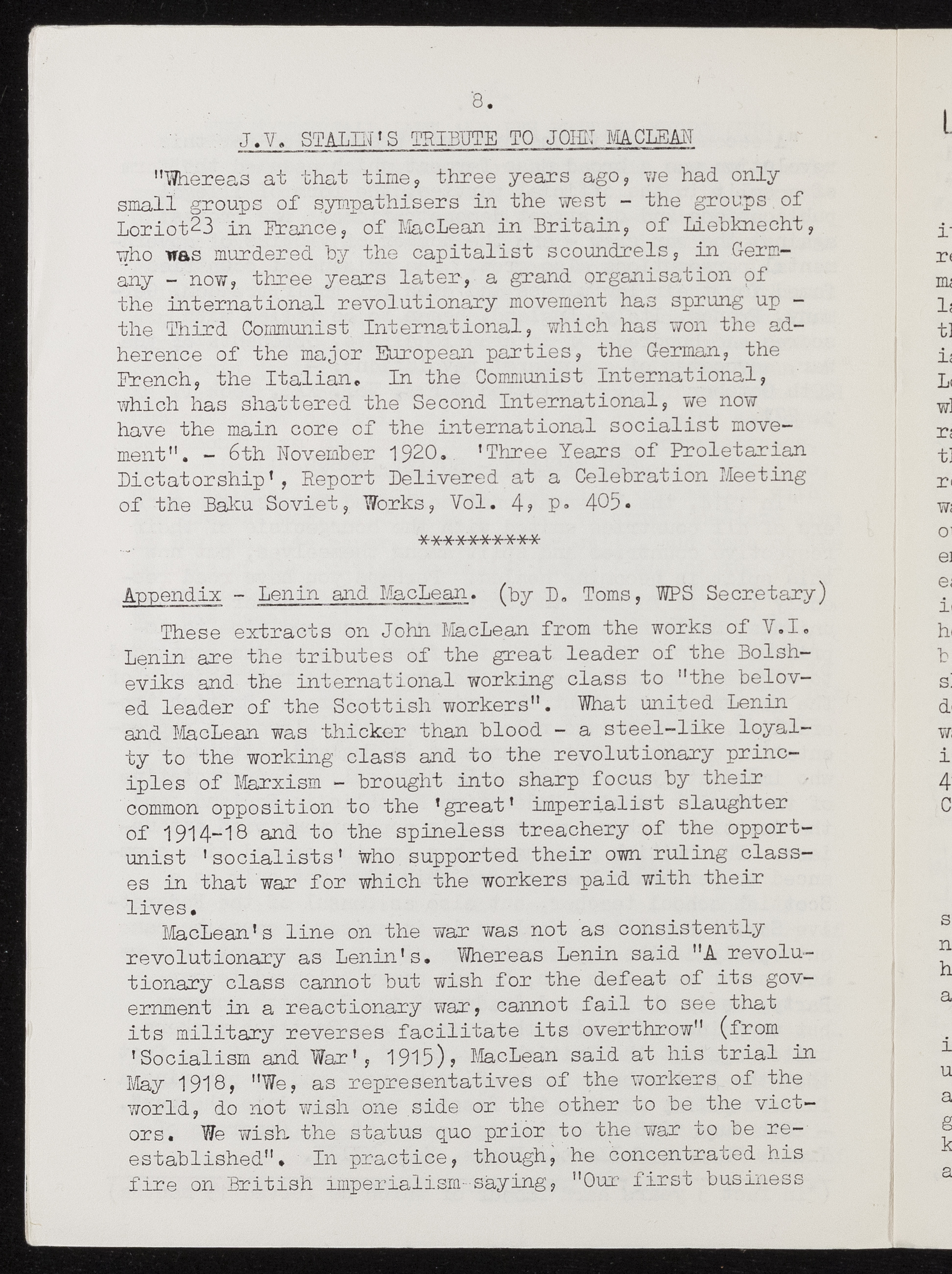
- J.V. STALIN'S TRIBUTE TO JOHN MACLEAN L "Whereas at that time, three years ago, we had only small groups of sympathisers in the west - the groups of Loriot23 in France, of MacLean in Britain, of Liebknecht, who was murdered by the capitalist scoundrels, in Germ- any - now, three years later, a grand organisation of the international revolutionary movement has sprung up - the Third Communist International, which has won the ad- herence of the major European parties, the German, the French, the Italian. In the Communist International, which has shattered the Second International, we now have the main core of the international socialist move- ment". - 6th November 1920. 'Three Years of Proletarian Dictatorship', Report Delivered at a Celebration Meeting of the Baku Soviet, Works, Vol. 4, p. 405. i re ma - la t ia L W ra t r Wa O e e i h b S. d W i 4 C **** Appendix - Lenin and MacLean. (by D. Toms, WPS Secretary) These extracts on John MacLean from the works of V.I. Lenin are the tributes of the great leader of the Bolsh- eviks and the international working class to "the belov- ed leader of the Scottish workers". What united Lenin and MacLean was thicker than blood - a steel-like loyal- ty to the working class and to the revolutionary princ- iples of Marxism - brought into sharp focus by their common opposition to the 'great' imperialist slaughter of 1914-18 and to the spineless treachery of the opport- unist 'socialists' who supported their own ruling class- es in that war for which the workers paid with their lives. MacLean's line on the war was not as consistently revolutionary as Lenin's. Whereas Lenin said "A revolu- tionary class cannot but wish for the defeat of its gov- ernment in a reactionary war, cannot fail to see that its military reverses facilitate its overthrow" (from 'Socialism and War', 1915), MacLean said at his trial in May 1918, "We, as representatives of the workers of the world, do not wish one side or the other to be the vict- ors. We wish the status quo prior to the war to be re- established". In practice, though, he concentrated his fire on British imperialism saying, "Our first business S n h a i u a g k a
Appraisal, destruction and scheduling
Accruals
System of arrangement
Conditions of access and use area
Conditions governing access
Conditions governing reproduction
Language of material
Script of material
Language and script notes
Physical characteristics and technical requirements
Finding aids
Uploaded finding aid
Allied materials area
Existence and location of originals
full_reference_code