
Identity area
Reference code
013
Title
PAMPHLET 036 013
Date(s)
Level of description
Part
Extent and medium
1 digital image
Context area
Name of creator
Name of creator
Archival history
Immediate source of acquisition or transfer
Content and structure area
Scope and content
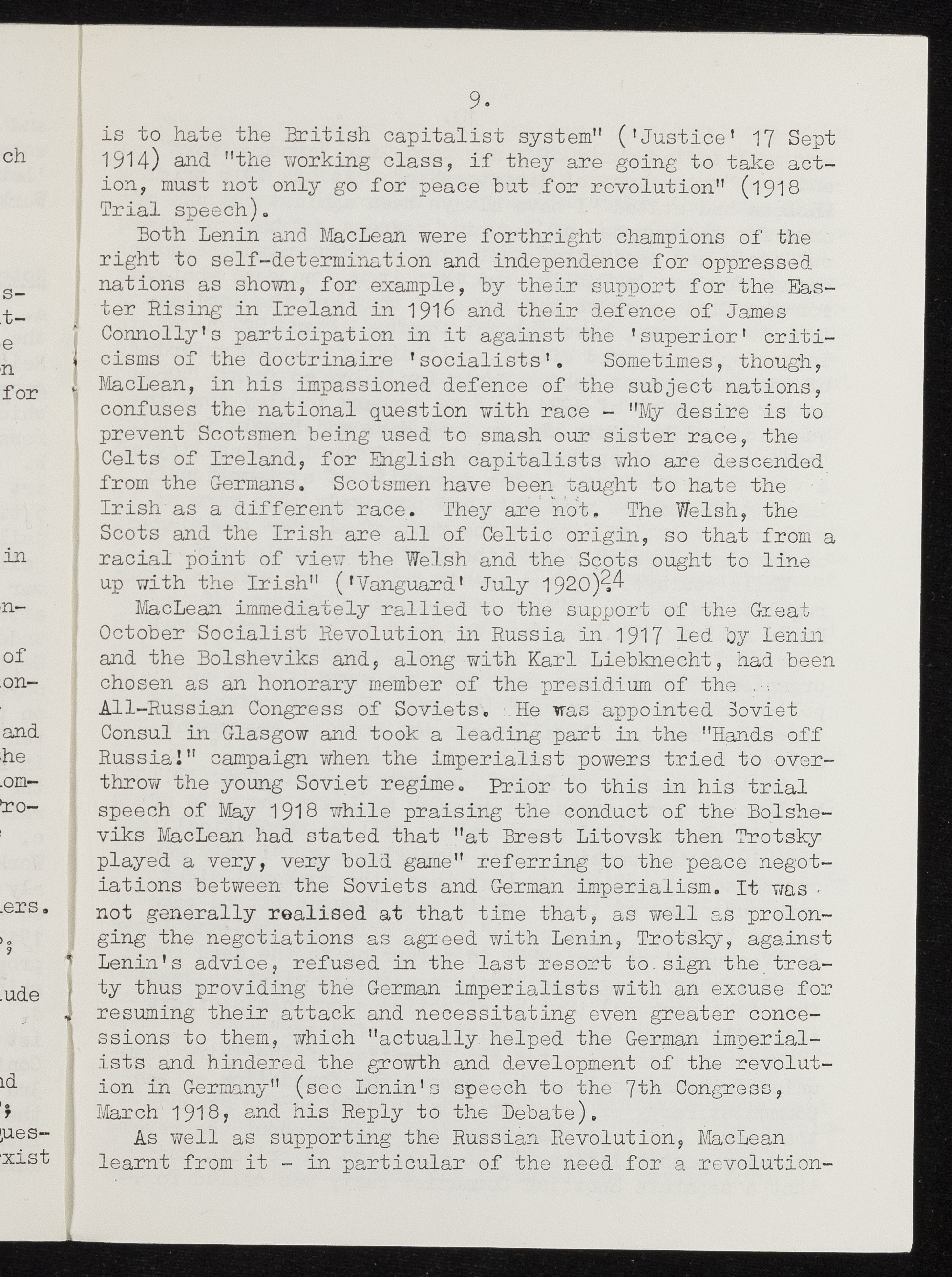
- is to hate the British capitalist system" ('Justice' 17 Sept 1914) and "the working class, if they are going to take act- ion, must not only go for peace but for revolution" (1918 Trial speech). Both Lenin and MacLean were forthright champions of the right to self-determination and independence for oppressed nations as shown, for example, by their support for the Eas- ter Rising in Ireland in 1916 and their defence of James Connolly's participation in it against the 'superior' criti- cisms of the doctrinaire 'socialists'. Sometimes, though, MacLean, in his impassioned defence of the subject nations, confuses the national question with race - "My desire is to prevent Scotsmen being used to smash our sister race, the Celts of Ireland, for English capitalists who are descended from the Germans. Scotsmen have been taught to hate the Irish as a different race. They are not. The Welsh, the Scots and the Irish are all of Celtic origin, so that from a racial point of view the Welsh and the Scots ought to line up with the Irish" ('Vanguard' July 1920)24 MacLean immediately rallied to the support of the Great October Socialist Revolution in Russia in 1917 led by Lenin and the Bolsheviks and, along with Karl Liebknecht, had been chosen as an honorary member of the presidium of the All-Russian Congress of Soviets. He was appointed Soviet Consul in Glasgow and took a leading part in the "Hands off Russia!" campaign when the imperialist powers tried to over- throw the young Soviet regime. Prior to this in his trial speech of May 1918 while praising the conduct of the Bolshe- viks MacLean had stated that "at Brest Litovsk then Trotsky played a very, very bold game" referring to the peace negot- iations between the Soviets and German imperialism. It was. not generally realised at that time that, as well as prolon- ging the negotiations as agreed with Lenin, Trotsky, against Lenin's advice, refused in the last resort to sign the trea- ty thus providing the German imperialists with an excuse for resuming their attack and necessitating even greater conce- ssions to them, which "actually helped the German imperial- ists and hindered the growth and development of the revolut- ion in Germany" (see Lenin's speech to the 7th Congress, March 1918, and his Reply to the Debate). As well as supporting the Russian Revolution, MacLean learnt from it - in particular of the need for a revolution-
Appraisal, destruction and scheduling
Accruals
System of arrangement
Conditions of access and use area
Conditions governing access
Conditions governing reproduction
Language of material
Script of material
Language and script notes
Physical characteristics and technical requirements
Finding aids
Uploaded finding aid
Allied materials area
Existence and location of originals
full_reference_code