
Identity area
Reference code
014
Title
PAMPHLET 036 014
Date(s)
Level of description
Part
Extent and medium
1 digital image
Context area
Name of creator
Name of creator
Archival history
Immediate source of acquisition or transfer
Content and structure area
Scope and content
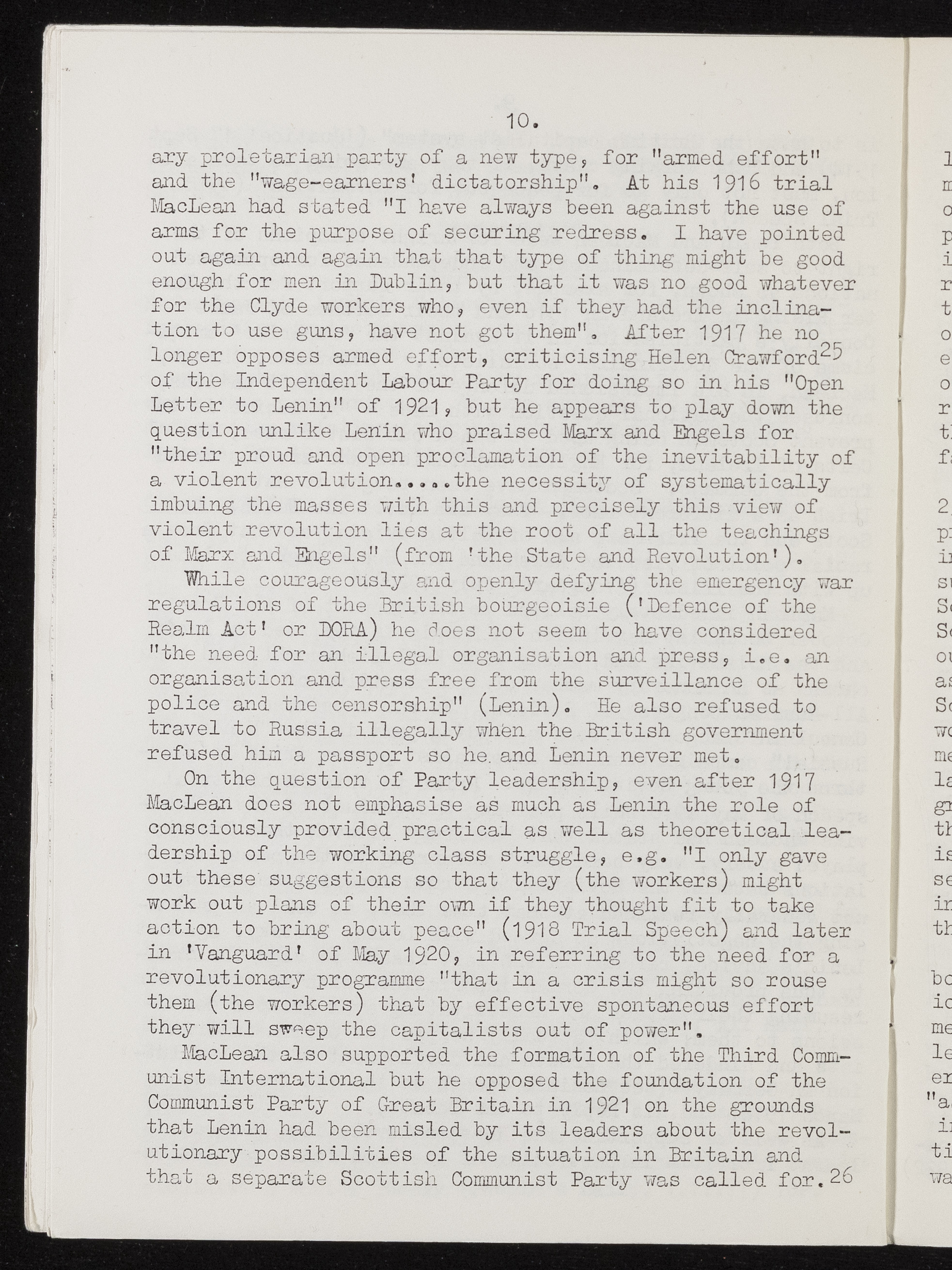
- ary proletarian party of a new type, for "armed effort" and the "wage-earners' dictatorship". At his 1916 trial MacLean had stated "I have always been against the use of arms for the purpose of securing redress. I have pointed out again and again that that type of thing might be good enough for men in Dublin, but that it was no good whatever for the Clyde workers who, even if they had the inclina- tion to use guns, have not got them". After 1917 he no longer opposes armed effort, criticising Helen Crawford 25 of the Independent Labour Party for doing so in his "Open Letter to Lenin" of 1921, but he appears to play down the question unlike Lenin who praised Marx and Engels for "their proud and open proclamation of the inevitability of a violent revolution.....the necessity of systematically imbuing the masses with this and precisely this view of violent revolution lies at the root of all the teachings of Marx and Engels" (from the State and Revolution'). While courageously and openly defying the emergency war regulations of the British bourgeoisie ('Defence of the Realm Act' or DORA) he does not seem to have considered "the need for an illegal organisation and press, i.e. an organisation and press free from the surveillance of the police and the censorship" (Lenin). He also refused to travel to Russia illegally when the British government refused him a passport so he and Lenin never met. On the question of Party leadership, even after 1917 MacLean does not emphasise as much as Lenin the role of consciously provided practical as well as theoretical lea- dership of the working class struggle, e.g. "I only gave out these suggestions so that they (the workers) might work out plans of their own if they thought fit to take action to bring about peace" (1918 Trial Speech) and later in 'Vanguard' of May 1920, in referring to the need for a revolutionary programme "that in a crisis might so rouse them (the workers) that by effective spontaneous effort they will sweep the capitalists out of power". MacLean also supported the formation of the Third Comm- unist International but he opposed the foundation of the Communist Party of Great Britain in 1921 on the grounds that Lenin had been misled by its leaders about the revol- utionary possibilities of the situation in Britain and that a separate Scottish Communist Party was called for. 26 1 m o p 4 i r t o e o r t f 2 p in S S Sc ou as Sc wo me la gr th is se in th bo ic me le er a in ti wa
Appraisal, destruction and scheduling
Accruals
System of arrangement
Conditions of access and use area
Conditions governing access
Conditions governing reproduction
Language of material
Script of material
Language and script notes
Physical characteristics and technical requirements
Finding aids
Uploaded finding aid
Allied materials area
Existence and location of originals
full_reference_code