
Identity area
Reference code
017
Title
PAMPHLET 036 017
Date(s)
Level of description
Part
Extent and medium
1 digital image
Context area
Name of creator
Name of creator
Archival history
Immediate source of acquisition or transfer
Content and structure area
Scope and content
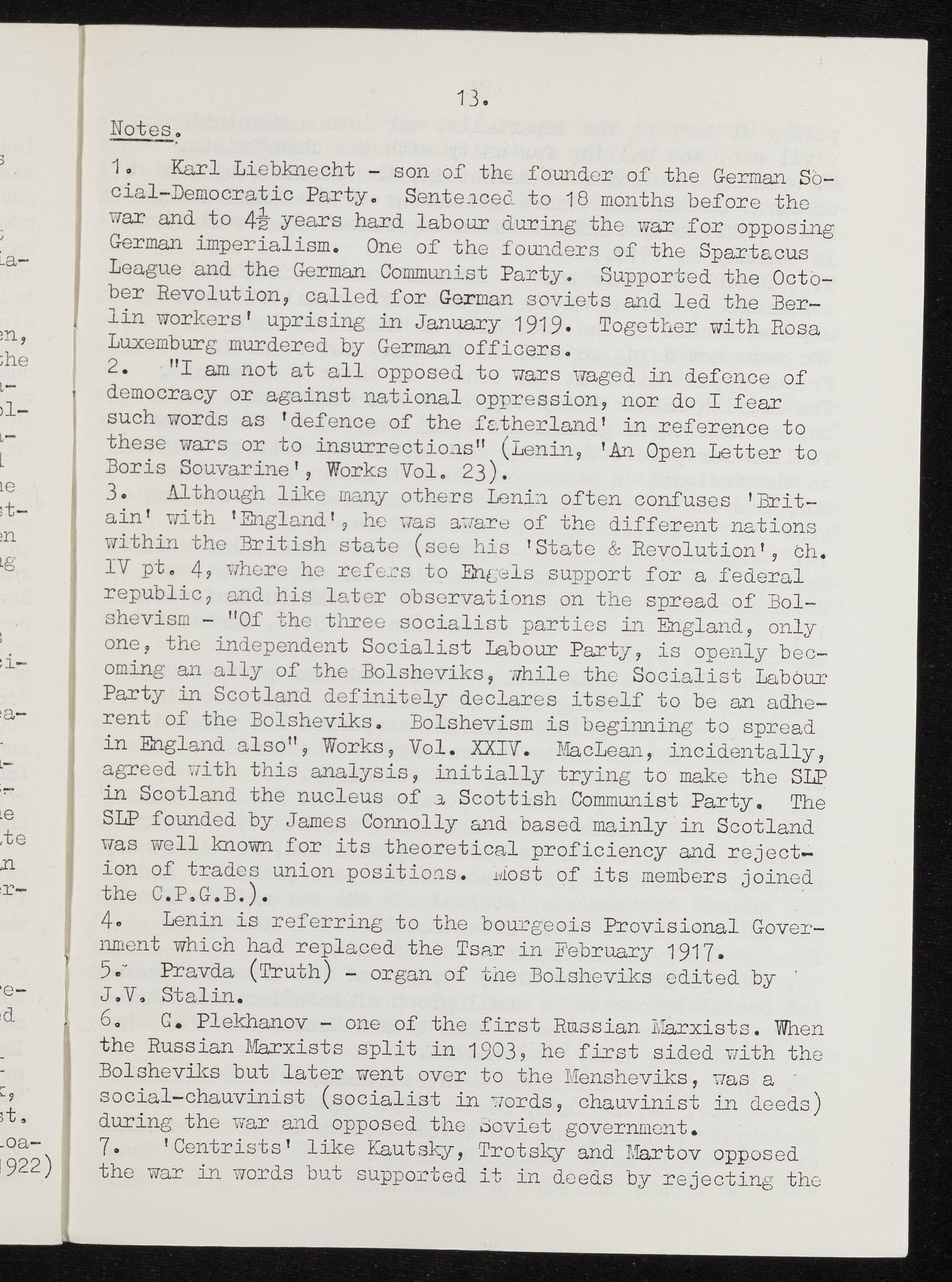
- Notes. 1. Karl Liebknecht - son of the founder of the German So- cial-Democratic Party. Sentenced to 18 months before the war and to 4½ years hard labour during the war for opposing German imperialism. One of the founders of the Spartacus League and the German Communist Party. Supported the Octo- ber Revolution, called for German soviets and led the Ber- lin workers' uprising in January 1919. Together with Rosa Luxemburg murdered by German officers. 2. "I am not at all opposed to wars waged in defence of democracy or against national oppression, nor do I fear such words as 'defence of the fatherland' in reference to these wars or to insurrections" (Lenin, 'An Open Letter to Boris Souvarine', Works Vol. 23). 3. Although like many others Lenin often confuses 'Brit- ain' with 'England', he was aware of the different nations within the British state (see his 'State & Revolution', ch. IV pt. 4, where he refers to Engels support for a federal republic, and his later observations on the spread of Bol- shevism - "Of the three socialist parties in England, only one, the independent Socialist Labour Party, is openly bec- oming an ally of the Bolsheviks, while the Socialist Labour Party in Scotland definitely declares itself to be an adhe- rent of the Bolsheviks. Bolshevism is beginning to spread in England also", Works, Vol. XXIV. MacLean, incidentally, agreed with this analysis, initially trying to make the SLP in Scotland the nucleus of a Scottish Communist Party. The SLP founded by James Connolly and based mainly in Scotland was well known for its theoretical proficiency and reject- ion of trades union positions. Most of its members joined the C.P.G.B.). 4. Lenin is referring to the bourgeois Provisional Gover- nment which had replaced the Tsar in February 1917. 5. Pravda (Truth) - organ of the Bolsheviks edited by J.V. Stalin. 6. G. Plekhanov - one of the first Russian Marxists. When the Russian Marxists split in 1903, he first sided with the Bolsheviks but later went over to the Mensheviks, was a social-chauvinist (socialist in words, chauvinist in deeds) during the war and opposed the Soviet government. 7. 'Centrists' like Kautsky, Trotsky and Martov opposed the war in words but supported it in deeds by rejecting the
Appraisal, destruction and scheduling
Accruals
System of arrangement
Conditions of access and use area
Conditions governing access
Conditions governing reproduction
Language of material
Script of material
Language and script notes
Physical characteristics and technical requirements
Finding aids
Uploaded finding aid
Allied materials area
Existence and location of originals
full_reference_code