
Identity area
Reference code
019
Title
PAMPHLET 036 019
Date(s)
Level of description
Part
Extent and medium
1 digital image
Context area
Name of creator
Name of creator
Archival history
Immediate source of acquisition or transfer
Content and structure area
Scope and content
-
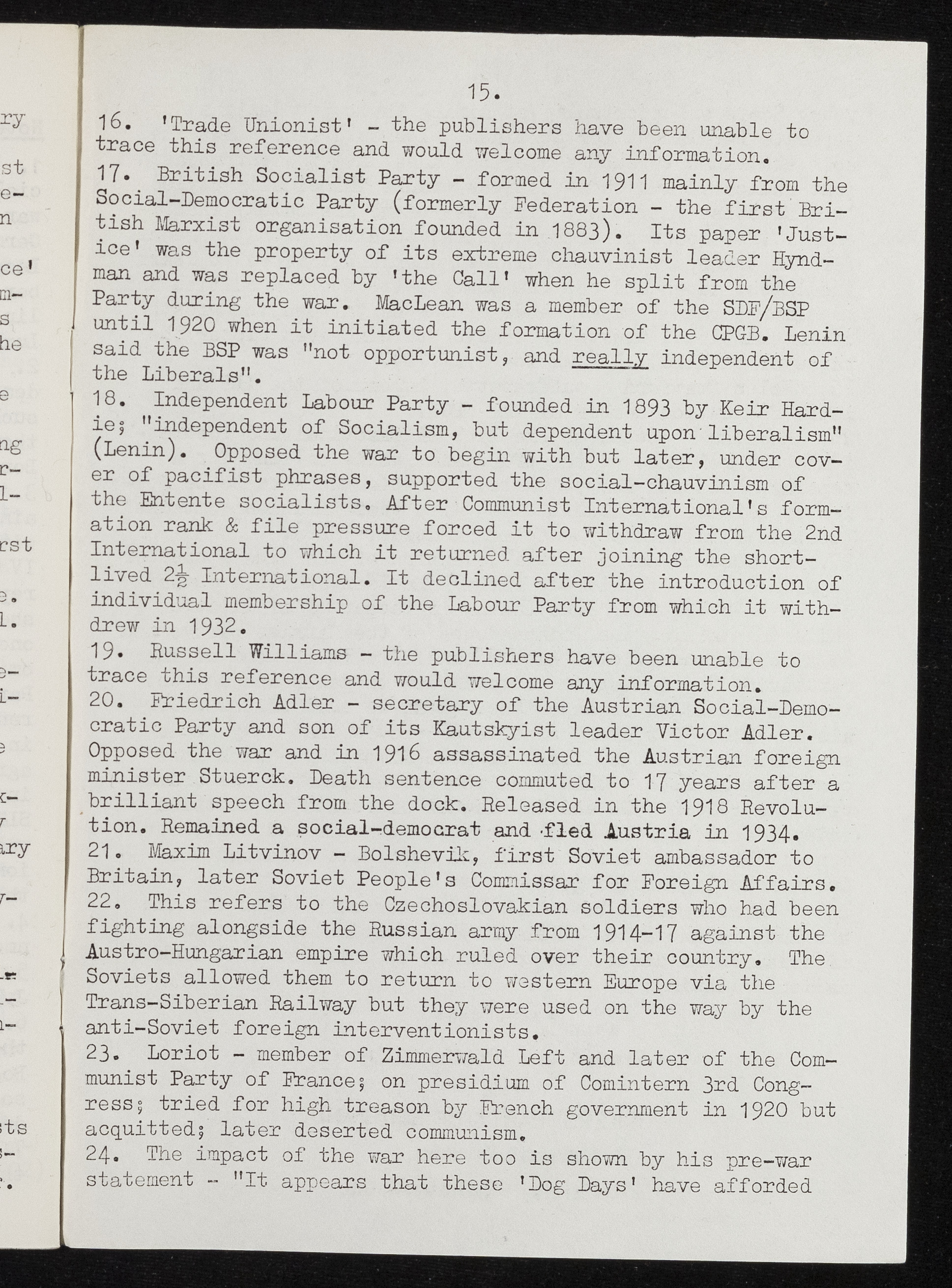
- 'Trade Unionist' - the publishers have been unable to trace this reference and would welcome any information. 17. British Socialist Party - formed in 1911 mainly from the Social-Democratic Party (formerly Federation - the first Bri- tish Marxist organisation founded in 1883). Its paper 'Just- ice' was the property of its extreme chauvinist leader Hynd- man and was replaced by 'the Call' when he split from the Party during the war. MacLean was a member of the SDF/BSP until 1920 when it initiated the formation of the CPGB. Lenin said the BSP was "not opportunist, and really independent of the Liberals". 18. Independent Labour Party - founded in 1893 by Keir Hard- ie; "independent of Socialism, but dependent upon liberalism" (Lenin). Opposed the war to begin with but later, under cov- er of pacifist phrases, supported the social-chauvinism of the Entente socialists. After Communist International's form- ation rank & file pressure forced it to withdraw from the 2nd International to which it returned after joining the short- lived 2½ International. It declined after the introduction of individual membership of the Labour Party from which it with- drew in 1932. 19. Russell Williams - the publishers have been unable to trace this reference and would welcome any information. 20. Friedrich Adler - secretary of the Austrian Social-Demo- cratic Party and son of its Kautskyist leader Victor Adler. Opposed the war and in 1916 assassinated the Austrian foreign minister Stuerck. Death sentence commuted to 17 years after a brilliant speech from the dock. Released in the 1918 Revolu- tion. Remained a social-democrat and fled Austria in 1934. 21. Maxim Litvinov - Bolshevik, first Soviet ambassador to Britain, later Soviet People's Commissar for Foreign Affairs. 22. This refers to the Czechoslovakian soldiers who had been fighting alongside the Russian army from 1914-17 against the Austro-Hungarian empire which ruled over their country. The Soviets allowed them to return to western Europe via the Trans-Siberian Railway but they were used on the way by the anti-Soviet foreign interventionists. 23. Loriot - member of Zimmerwald Left and later of the Com- munist Party of France; on presidium of Comintern 3rd Cong- ress; tried for high treason by French government in 1920 but acquitted; later deserted communism. 24. The impact of the war here too is shown by his pre-war statement - "It appears that these 'Dog Days' have afforded
Appraisal, destruction and scheduling
Accruals
System of arrangement
Conditions of access and use area
Conditions governing access
Conditions governing reproduction
Language of material
Script of material
Language and script notes
Physical characteristics and technical requirements
Finding aids
Uploaded finding aid
Allied materials area
Existence and location of originals
full_reference_code