
Identity area
Reference code
Title
Date(s)
Level of description
Extent and medium
1 digital image
Context area
Name of creator
Name of creator
Archival history
Immediate source of acquisition or transfer
Content and structure area
Scope and content
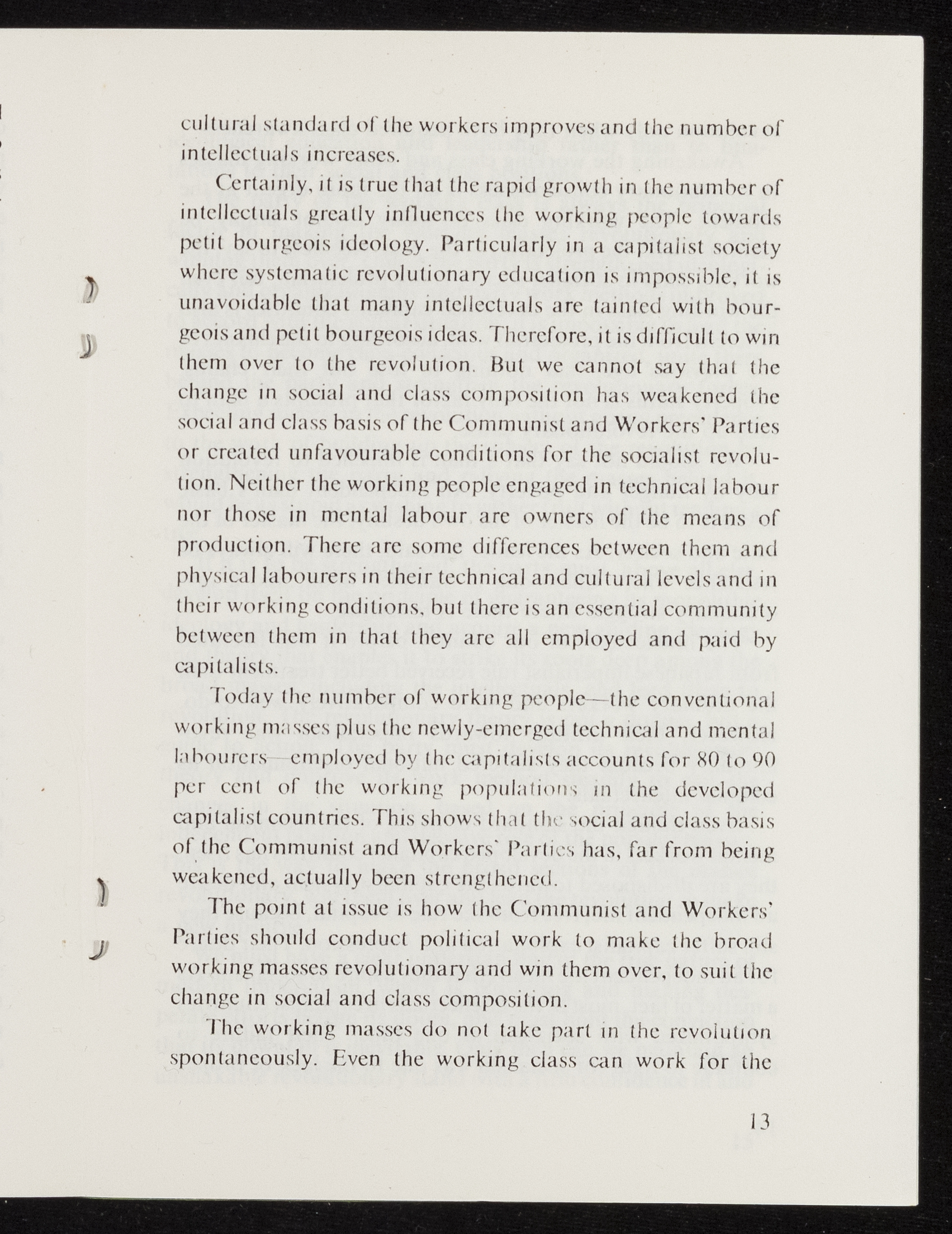
cultural standard of the workers improves and the number of intellectuals increases. Certainly, it is true that the rapid growth in the number of intellectuals greatly influences the working people towards petit bourgeois ideology. Particularly in a capitalist society where systematic revolutionary education is impossible, it is unavoidable that many intellectuals are tainted with bour- geois and petit bourgeois ideas. Therefore, it is difficult to win them over to the revolution. But we cannot say that the change in social and class composition has weakened the social and class basis of the Communist and Workers' Parties or created unfavourable conditions for the socialist revolu- tion. Neither the working people engaged in technical labour nor those in mental labour are owners of the means of production. There are some differences between them and physical labourers in their technical and cultural levels and in their working conditions, but there is an essential community between them in that they are all employed and paid by capitalists. Today the number of working people—the conventional working masses plus the newly-emerged technical and mental labourers—employed by the capitalists accounts for 80 to 90 per cent of the working populations in the developed capitalist countries. This shows that the social and class basis of the Communist and Workers' Parties has, far from being weakened, actually been strengthened. The point at issue is how the Communist and Workers' Parties should conduct political work to make the broad working masses revolutionary and win them over, to suit the change in social and class composition. The working masses do not take part in the revolution spontaneously. Even the working class can work for the 13