
Zone d'identification
Cote
Titre
Date(s)
Niveau de description
Étendue matérielle et support
1 digital image
Zone du contexte
Nom du producteur
Nom du producteur
Histoire archivistique
Source immédiate d'acquisition ou de transfert
Zone du contenu et de la structure
Portée et contenu
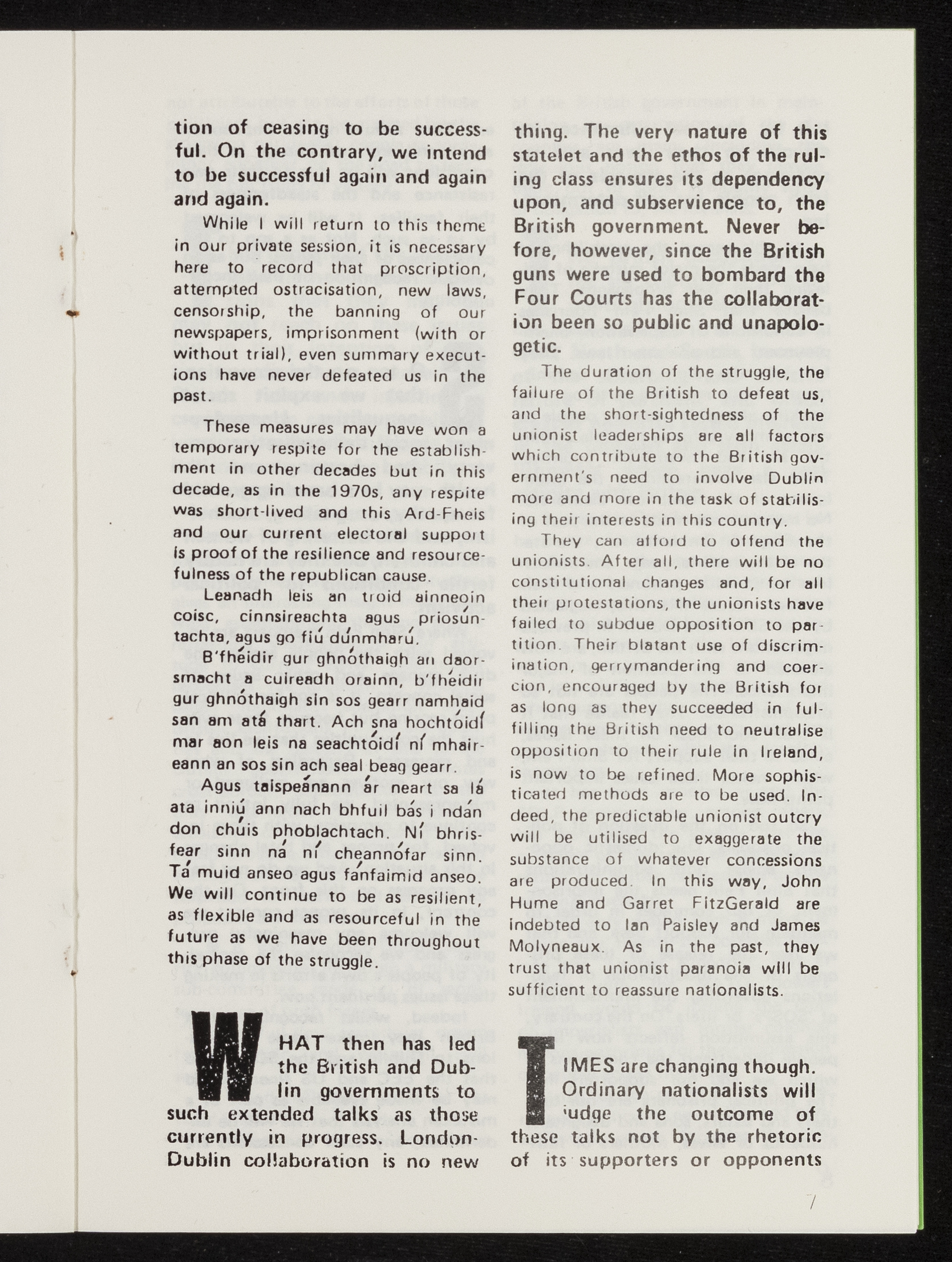
tion of ceasing to be success- ful. On the contrary, we intend to be successful again and again arıd again. While I will return to this theme in our private session, it is necessary here to record that proscription, atternpted ostracisation, new laws, censorship, the banning of our newspapers, imprisonment (with or without trial), even summary execut- ions have never defeated us in the past. These measures may have won a temporary respite for the establish- ment in other decades but in this decade, as in the 1970s, any respite was short-lived and this Ard-Fheis and our current electoral support is proof of the resilience and resource- fulness of the republican cause. Leanadh leis an troid ainneoin coisc, cinnsireachta agus priosun- tachta, agus go fiú dúnmharú. B'fhéidir gur ghnóthaigh an daor- smacht a cuireadh orainn, b'fhéidir gur ghnóthaigh sin sos gearr namhaid san am atá thart. Ach sna hochtoidĺ mar aon leis na seachtóidí ní mhair- eann an sos sin ach seal beag gearr. Agus taispeánann ár neart sa lá ata inniú ann nach bhfuil bás i ndan don chuis phoblachtach. Ní bhris- fear sinn ná ní cheannófar sinn. Tá muid anseo agus fanfaimid anseo. We will continue to be as resilient, as flexible and as resourceful in the future as we have been throughout this phase of the struggle. W HAT then has led the British and Dub- lin governments to such extended talks as those currently in progress. London- Dublin collaboration is no new thing. The very nature of this statelet and the ethos of the rul- ing class ensures its dependency upon, and subservience to, the British government. Never be- fore, however, since the British guns were used to bombard the Four Courts has the collaborat- ion been so public and unapolo- getic. The duration of the struggle, the failure of the British to defeat us, and the short-sightedness of the unionist leaderships are all factors which contribute to the British gov- ernment's need to involve Dublin more and more in the task of stabilis- ing their interests in this country. They can afford to offend the unionists. After all, there will be no constitutional changes and, for all their protestations, the unionists have failed to subdue opposition to par- tition. Their blatant use of discrim- ination, gerrymandering and coer- cion, encouraged by the British for as long as they succeeded in ful- filling the British need to neutralise opposition to their rule in Ireland, is now to be refined. More sophis- ticated methods are to be used. In- deed, the predictable unionist outcry will be utilised to exaggerate the substance of whatever concessions are produced. In this way, John Hume and Garret FitzGerald are indebted to Ian Paisley and James Molyneaux. As in the past, they trust that unionist paranoia will be sufficient to reassure nationalists. IMES are changing though. Ordinary nationalists will judge the outcome of these talks not by the rhetoric of its supporters or opponents 7
Évaluation, élimination et calendrier de conservation
Accroissements
Mode de classement
Zone des conditions d'accès et d'utilisation
Conditions d'accès
Conditions de reproduction
Langue des documents
Écriture des documents
Notes de langue et graphie
Caractéristiques matérielle et contraintes techniques
Instruments de recherche
Instrument de recherche téléversé
Zone des sources complémentaires
Existence et lieu de conservation des originaux
full_reference_code