
Identity area
Reference code
Title
Date(s)
Level of description
Extent and medium
1 digital image
Context area
Name of creator
Name of creator
Archival history
Immediate source of acquisition or transfer
Content and structure area
Scope and content
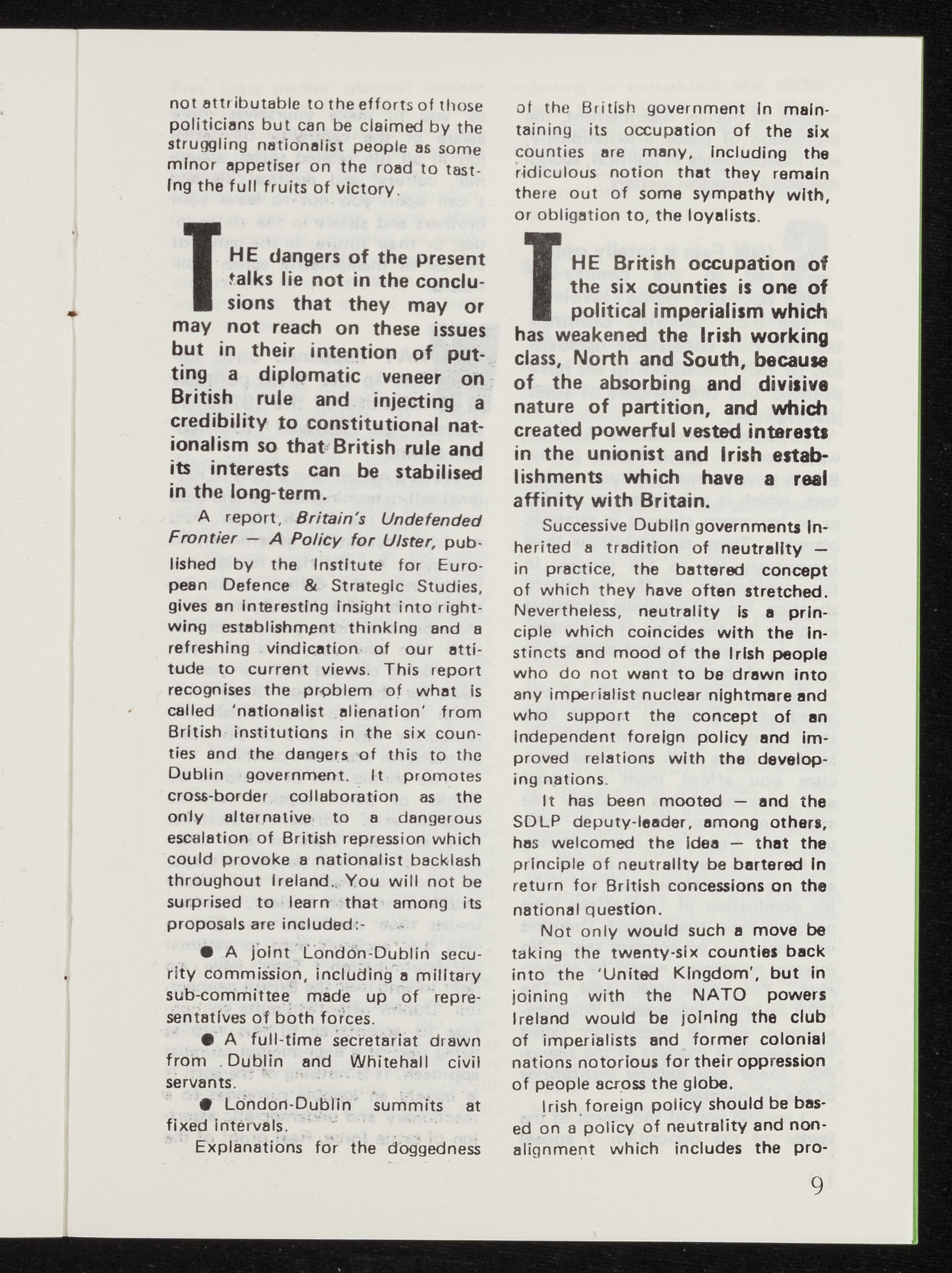
not attributable to the efforts of those politicians but can be claimed by the struggling nationalist people as some minor appetiser on the road to tast- ing the full fruits of victory. HE dangers of the present talks lie not in the conclu- sions that they may or may not reach on these issues but in their intention of put- ting a diplomatic veneer on British rule and injecting a credibility to constitutional nat- ionalism so that British rule and its interests can be stabilised in the long-term. A report, Britain's Undefended Frontier — A Policy for Ulster, pub- lished by the Institute for Euro- pean Defence & Strategic Studies, gives an interesting insight into right- wing establishment thinking and a refreshing vindication of our atti- tude to current views. This report recognises the problem of what is called 'nationalist alienation' from British institutions in the six coun- ties and the dangers of this to the Dublin government. It promotes cross-border collaboration as the only alternative to a dangerous escalation of British repression which could provoke a nationalist backlash throughout Ireland. You will not be surprised to learn that among its proposals are included:- A joint London-Dublin secu- rity commission, including a military sub-committee made up of repre- sentatives of both forces. A full-time secretariat drawn from Dublin and Whitehall civil servants. London-Dublin summits at fixed intervals. Explanations for the doggedness of the British government in main- taining its occupation of the six counties are many, including the ridiculous notion that they remain there out of some sympathy with, or obligation to, the loyalists. T HE British occupation of the six counties is one of political imperialism which has weakened the Irish working class, North and South, because of the absorbing and divisive nature of partition, and which created powerful vested interests in the unionist and Irish estab- lishments which have a real affinity with Britain. Successive Dublin governments in- herited a tradition of neutrality – in practice, the battered concept of which they have often stretched. Nevertheless, neutrality is a prin- ciple which coincides with the in- stincts and mood of the Irish people who do not want to be drawn into any imperialist nuclear nightmare and who support the concept of an independent foreign policy and im- proved relations with the develop- ing nations. It has been mooted – and the SDLP deputy-leader, among others, has welcomed the idea – that the principle of neutrality be bartered in return for British concessions on the national question. Not only would such a move be taking the twenty-six counties back into the 'United Kingdom', but in joining with the NATO powers Ireland would be joining the club of imperialists and former colonial nations notorious for their oppression of people across the globe. Irish foreign policy should be bas- ed on a policy of neutrality and non- alignment which includes the pro- 9