
Identity area
Reference code
Title
Date(s)
Level of description
Extent and medium
1 digital image
Context area
Name of creator
Name of creator
Name of creator
Archival history
Immediate source of acquisition or transfer
Content and structure area
Scope and content
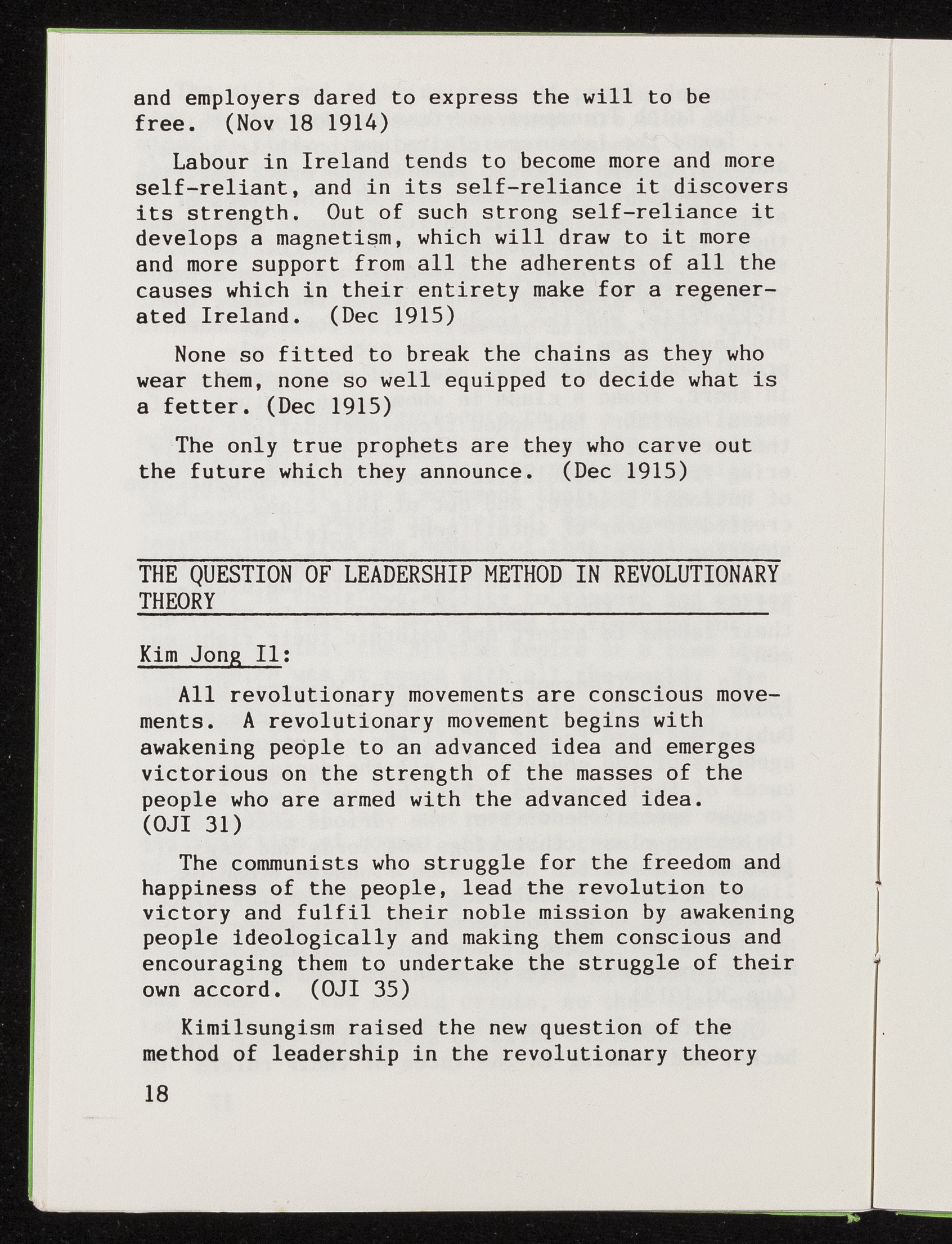
and employers dared to express the will to be free. (Nov 18 1914) Labour in Ireland tends to become more and more self-reliant, and in its self-reliance it discovers its strength. Out of such strong self-reliance it develops a magnetism, which will draw to it more and more support from all the adherents of all the causes which in their entirety make for a regener- ated Ireland. (Dec 1915) None so fitted to break the chains as they who wear them, none so well equipped to decide what is a fetter. (Dec 1915) The only true prophets are they who carve out the future which they announce. (Dec 1915) THE QUESTION OF LEADERSHIP METHOD IN REVOLUTIONARY THEORY Kim Jong Il: All revolutionary movements are conscious move- ments. A revolutionary movement begins with awakening people to an advanced idea and emerges victorious on the strength of the masses of the people who are armed with the advanced idea. (OJI 31) The communists who struggle for the freedom and happiness of the people, lead the revolution to victory and fulfil their noble mission by awakening people ideologically and making them conscious and encouraging them to undertake the struggle of their own accord. (OJI 35) Kimilsungism raised the new question of the method of leadership in the revolutionary theory 18
Appraisal, destruction and scheduling
Accruals
System of arrangement
Conditions of access and use area
Conditions governing access
Conditions governing reproduction
Language of material
Script of material
Language and script notes
Physical characteristics and technical requirements
Finding aids
Uploaded finding aid
Allied materials area
Existence and location of originals
full_reference_code