
Identity area
Reference code
Title
Date(s)
Level of description
Extent and medium
1 digital image
Context area
Name of creator
Name of creator
Name of creator
Archival history
Immediate source of acquisition or transfer
Content and structure area
Scope and content
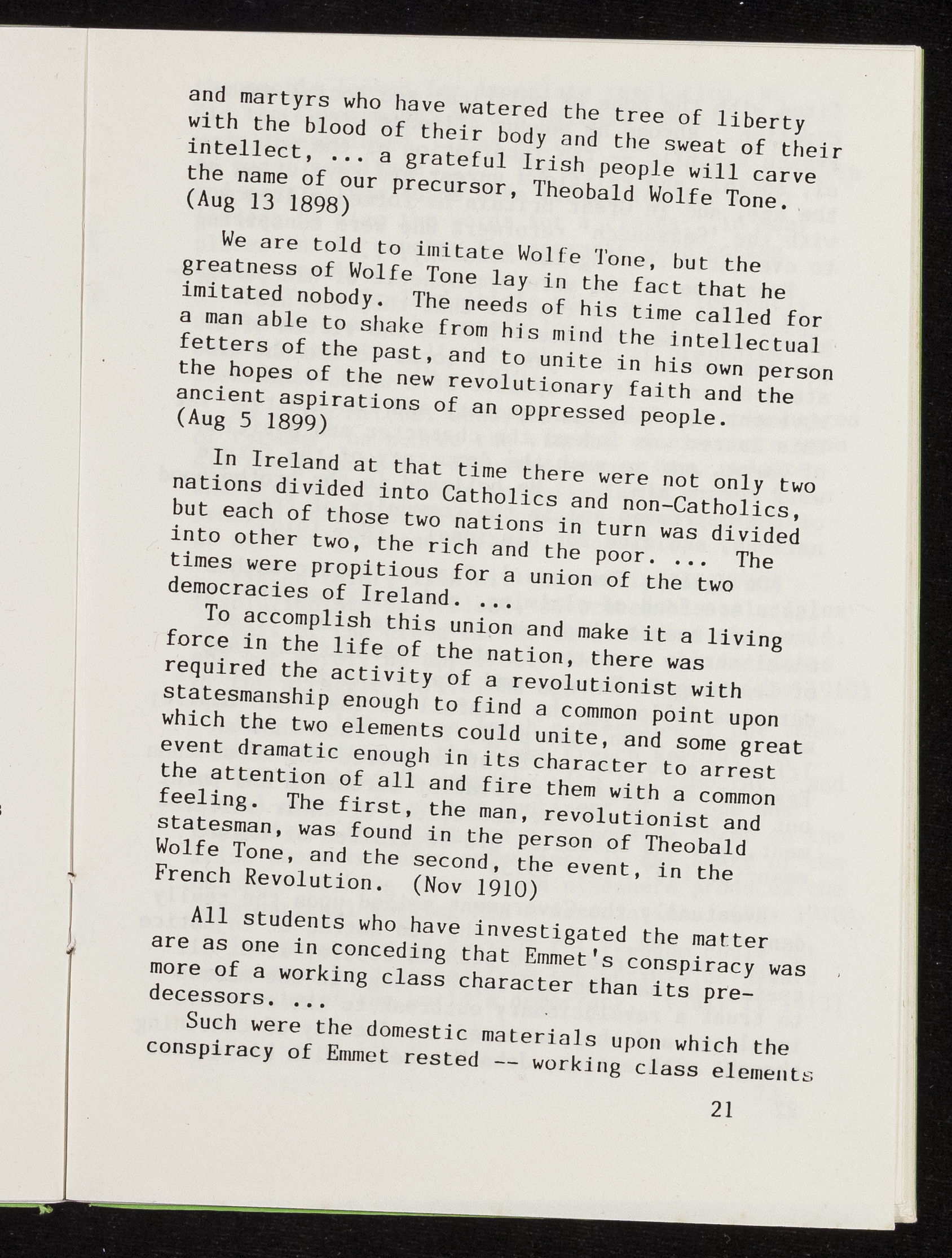
and martyrs who have watered the tree of liberty with the blood of their body and the sweat of their intellect, ... a grateful Irish people will carve the name of our precursor, Theobald Wolfe Tone. (Aug 13 1898) We are told to imitate Wolfe Tone, but the greatness of Wolfe Tone lay in the fact that he imitated nobody. The needs of his time called for a man able to shake from his mind the intellectual fetters of the past, and to unite in his own person the hopes of the new revolutionary faith and the ancient aspirations of an oppressed people. (Aug 5 1899) In Ireland at that time there were not only two nations divided into Catholics and non-Catholics, but each of those two nations in turn was divided into other two, the rich and the poor. ... The times were propitious for a union of the two democracies of Ireland. ... To accomplish this union and make it a living force in the life of the nation, there was required the activity of a revolutionist with statesmanship enough to find a common point upon which the two elements could unite, and some great event dramatic enough in its character to arrest the attention of all and fire them with a common feeling. The first, the man, revolutionist and statesman, was found in the person of Theobald Wolfe Tone, and the second, the event, in the French Revolution. (Nov 1910) All students who have investigated the matter are as one in conceding that Emmet's conspiracy was more of a working class character than its pre- decessors. ... Such were the domestic materials upon which the conspiracy of Emmet rested -- working class elements 21
Appraisal, destruction and scheduling
Accruals
System of arrangement
Conditions of access and use area
Conditions governing access
Conditions governing reproduction
Language of material
Script of material
Language and script notes
Physical characteristics and technical requirements
Finding aids
Uploaded finding aid
Allied materials area
Existence and location of originals
full_reference_code