
Identity area
Reference code
Title
Date(s)
Level of description
Extent and medium
1 digital image
Context area
Name of creator
Name of creator
Name of creator
Archival history
Immediate source of acquisition or transfer
Content and structure area
Scope and content
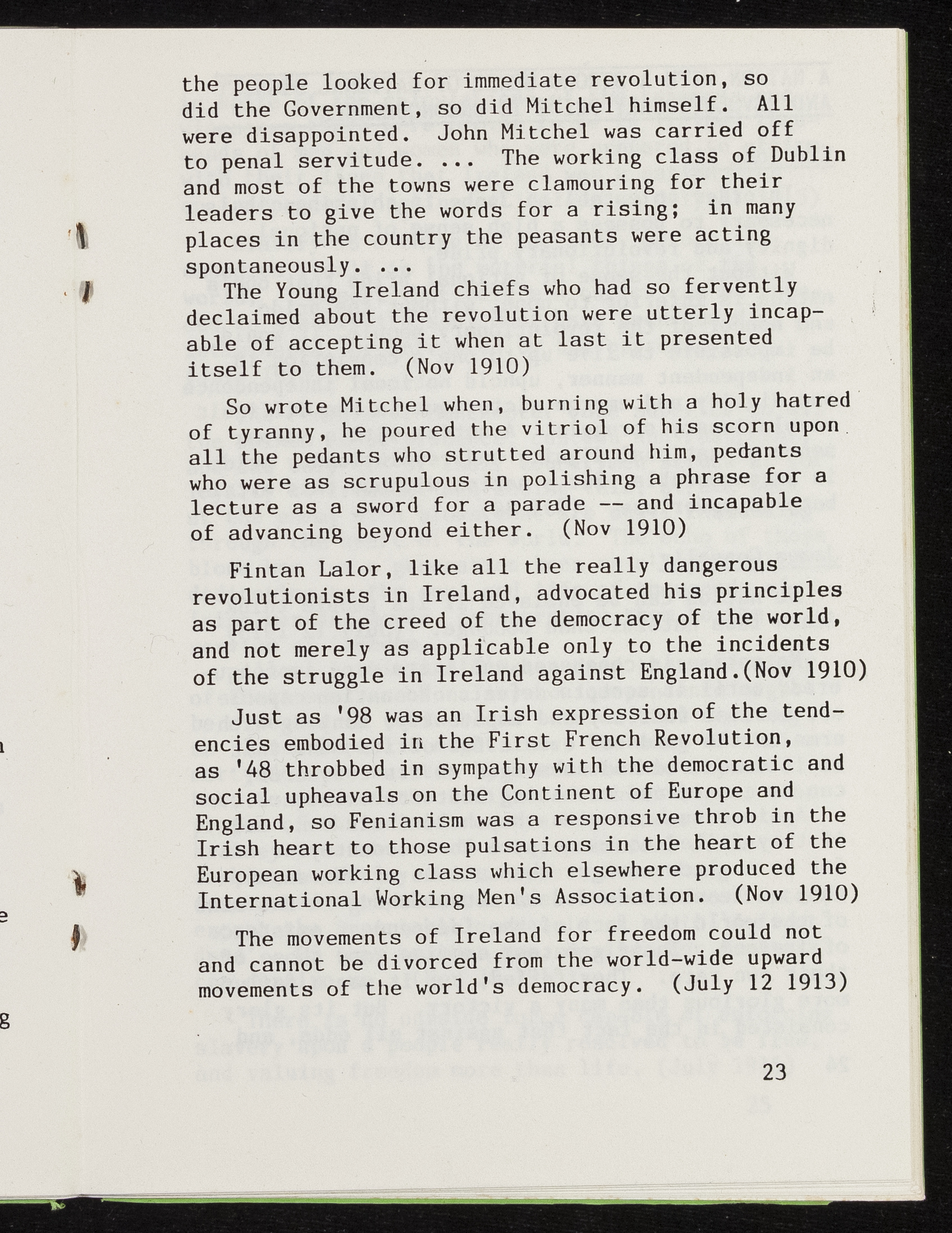
the people looked for immediate revolution, so did the Government, so did Mitchel himself. All were disappointed. John Mitchel was carried off to penal servitude. ... The working class of Dublin and most of the towns were clamouring for their leaders to give the words for a rising; in many places in the country the peasants were acting spontaneously. ... The Young Ireland chiefs who had so fervently declaimed about the revolution were utterly incap- able of accepting it when at last it presented itself to them. (Nov 1910) So wrote Mitchel when, burning with a holy hatred of tyranny, he poured the vitriol of his scorn upon all the pedants who strutted around him, pedants who were as scrupulous in polishing a phrase for a lecture as a sword for a parade -- and incapable of advancing beyond either. (Nov 1910) Fintan Lalor, like all the really dangerous revolutionists in Ireland, advocated his principles as part of the creed of the democracy of the world, and not merely as applicable only to the incidents of the struggle in Ireland against England. (Nov 1910) Just as '98 was an Irish expression of the tend- encies embodied in the First French Revolution, as '48 throbbed in sympathy with the democratic and social upheavals on the Continent of Europe and England, so Fenianism was a responsive throb in the Irish heart to those pulsations in the heart of the European working class which elsewhere produced the International Working Men's Association. (Nov 1910) The movements of Ireland for freedom could not and cannot be divorced from the world-wide upward movements of the world's democracy. (July 12 1913) 23