
Identity area
Reference code
Title
Date(s)
Level of description
Extent and medium
1 digital image
Context area
Name of creator
Name of creator
Name of creator
Archival history
Immediate source of acquisition or transfer
Content and structure area
Scope and content
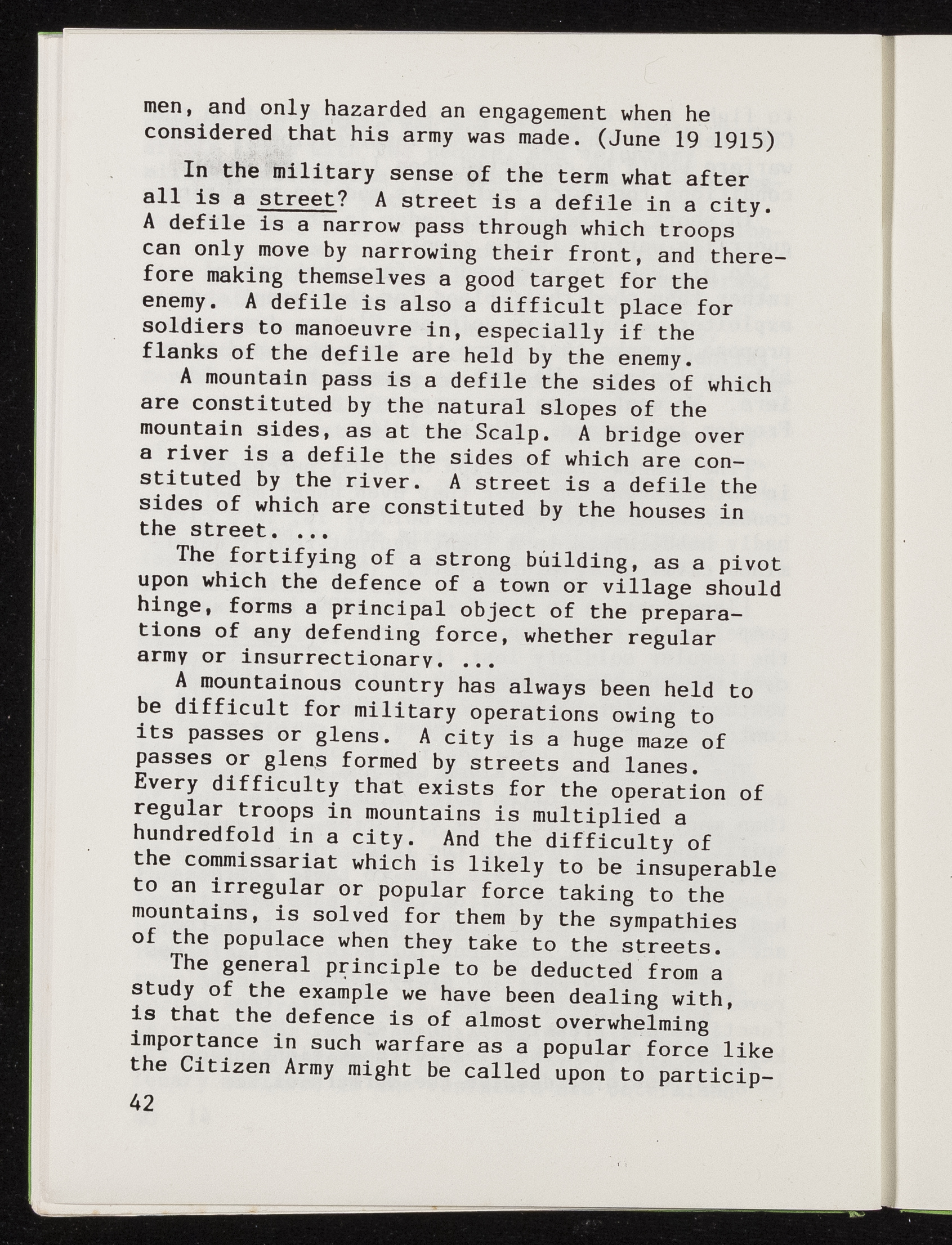
men, and only hazarded an engagement when he considered that his army was made. (June 19 1915) In the military sense of the term what after all is a street? A street is a defile in a city. A defile is a narrow pass through which troops can only move by narrowing their front, and there- fore making themselves a good target for the enemy. A defile is also a difficult place for soldiers to manoeuvre in, especially if the flanks of the defile are held by the enemy. A mountain pass is a defile the sides of which are constituted by the natural slopes of the mountain sides, as at the Scalp. A bridge over a river is a defile the sides of which are con- stituted by the river. A street is a defile the sides of which are constituted by the houses in the street. ... The fortifying of a strong building, as a pivot upon which the defence of a town or village should hinge, forms a principal object of the prepara- tions of any defending force, whether regular army or insurrectionary. ... A mountainous country has always been held to be difficult for military operations owing to its passes or glens. A city is a huge maze of passes or glens formed by streets and lanes. Every difficulty that exists for the operation of regular troops in mountains is multiplied a hundredfold in a city. And the difficulty of the commissariat which is likely to be insuperable to an irregular or popular force taking to the mountains, is solved for them by the sympathies of the populace when they take to the streets. The general principle to be deducted from a study of the example we have been dealing with, is that the defence is of almost overwhelming importance in such warfare as a popular force like the Citizen Army might be called upon to particip- 42